

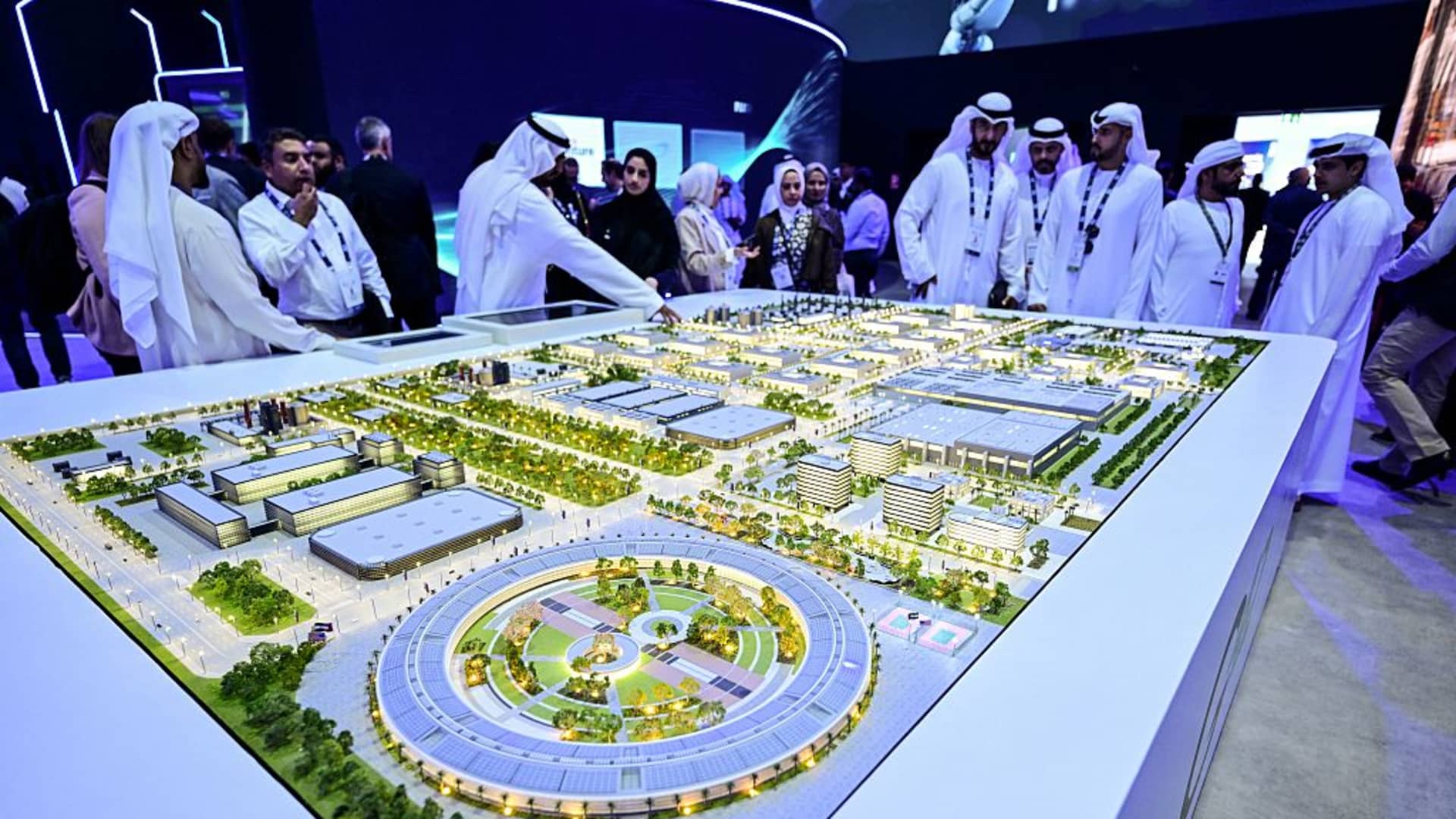
Guests look at a model of the UAE’s largest data center being built in Abu Dhabi as part of the Stargate Initiative, a joint venture between G42, Microsoft and OpenAI, during the Abu Dhabi International Petroleum Exhibition and Conference (ADIPEC) in Abu Dhabi on November 3, 2025 (Photo: Giuseppe CACACE/AFP) (Photo: GIUSEPPE CACACE/AFP via Getty Images)
Giuseppe Cacasse | AFP | Getty Images
Fossil fuel leaders welcome a paradigm shift in the energy transition narrative.
Speaking to CNBC on the sidelines of the Abu Dhabi International Petroleum Exhibition and Conference (ADIPEC), OPEC Secretary-General Haitham Al Ghaith said there was a “major shift” in the way industry leaders and policymakers talked about meeting the world’s growing energy needs.
“Three years ago, it was all about the energy transition: energy transition, climate change[and]getting rid of fossil fuels. Today, it’s about do we have to have a balanced approach,” Al Ghais said in an exclusive interview with CNBC’s Dan Murphy.
“So this is a very different tone. … I have to say it’s like music to my ears, because this is what OPEC has actually been saying for the last two, three, four years,” Al Ghaith said on Tuesday.
His comments were echoed by several industry players at the UAE’s annual oil summit, many of whom supported the concept of “energy addition” to secure supply and meet new demand from areas such as artificial intelligence.

This energy addition refers to promoting the development of new technologies, such as renewable energy such as solar and wind, alongside existing fossil fuels. In contrast, energy transition typically refers to movement from one energy source to another.
Climate scientists have repeatedly warned that fossil fuel use must be drastically reduced to curb global warming, with the burning of coal, oil and gas identified as the main cause of the climate crisis.
Sultan Al Jaber, UAE Minister of Industry and Advanced Technology, said at the opening of ADIPEC on Monday that global electricity demand will continue to soar until 2040, with power for data centers expected to quadruple and 1.5 billion people move from rural to urban areas.
Sultan Ahmed Al Jaber, CEO of Abu Dhabi National Oil Company (ADNOC), speaks at the opening ceremony of the ADIPEC conference on Monday, November 3, 2025 in Abu Dhabi, United Arab Emirates.
Bloomberg | Bloomberg | Getty Images
The minister, who is also CEO of UAE oil giant ADNOC and led talks at COP28, said renewable energy technologies were on track to more than double globally by 2040, with demand for liquefied natural gas (LNG) expected to increase by 50% and oil production expected to remain above 100 million barrels per day.
“All of this adds up to something much more complex than a single-path energy transition,” Al-Jabbar said. “What we’re talking about here is reinforcement, not replenishment. In fact, what we’re really talking about here is energy addition.”
“A major overhaul is underway.”
Mike Somers, president and CEO of the American Petroleum Institute (API), an industry lobby group, welcomed what he described as a “realistic conversation” about what will be needed to power AI in the future.
“I think we’re moving away from the energy transition, and I think everyone recognizes that we’re going to need more energy,” Somers told CNBC on Monday.
“Our institute, the American Petroleum Institute, and just about every other independent analyst suggest that we’re going to need more things going forward. Yes, it’s AI. Yes, it’s data centers. But it’s also going to increase air conditioning and connect more people to the power grid,” Somers said.
“We’ve known this for a long time. I think AI has put some punctuation on it,” he added.

Dan Yergin, an energy industry veteran and vice chairman of S&P Global, echoed this sentiment, saying a big demand surge is on the horizon as US tech giants ramp up their AI plans.
Asked if he agreed with Somers’ view that the narrative is moving away from the energy transition, Yergin said: “That’s right. That’s what’s happening. There’s a massive rethink happening.”
“You can see the perspective of tech companies who weren’t worried about energy. It wasn’t about cost for them. Now it’s a very big issue,” he added.
“Roughly half of U.S. GDP growth is now thought to be due to investments made by high-tech companies, known as hyperscalers, in building data centers.”
What’s next for the energy transition?
Ed Crooks, vice chairman for the Americas at Wood Mackenzie, agreed that the energy transition was a key focus of the ADIPEC conversation.
“When you talk about transition, it seemed to mean a lot of different things to a lot of different people. Does the energy transition mean we can get to net zero and limit global warming to 1.5 degrees by 2050? I think it’s fair to say it’s dead, but I don’t know if it was really alive in the sense that it was always very, very ambitious,” Crooks told CNBC on Tuesday.
“If by energy transition you mean that renewable energy is growing rapidly, there is a transition to electric vehicles, and generally moving towards a lower carbon energy system, then I think in that sense the energy transition is still alive.”
— CNBC’s Emilia Hardy contributed to this report.
