

moscow
—
The Kremlin’s constant nuclear boasts may finally resonate with the White House, with President Donald Trump ordering a resumption of U.S. nuclear weapons testing.
“As other countries have testing programs, I have directed the Department of the Army to begin testing nuclear weapons on an equal basis,” Trump said in a social media post Thursday.
It was not immediately clear whether President Trump was referring to nuclear weapons tests or tests of nuclear-capable weapons systems. His announcement came just before a meeting with Chinese President Xi Jinping in South Korea, but he told reporters late Thursday that “it had to do with other countries” and did not believe China had prompted his decision.
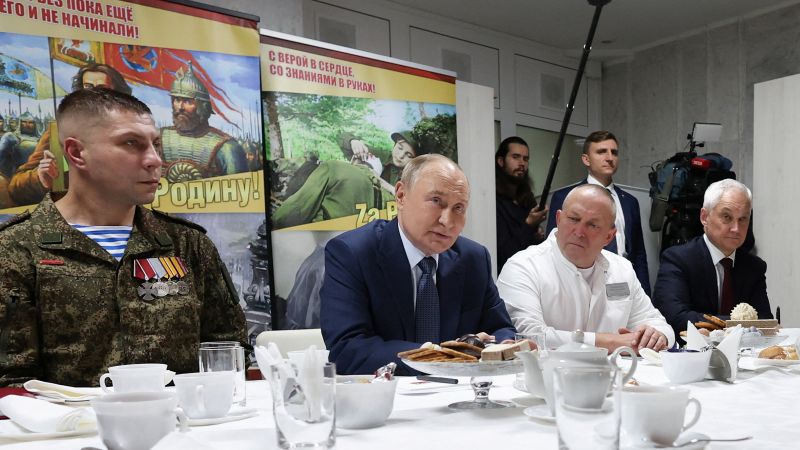
President Trump’s order came just hours after Russian leader Vladimir Putin, who was visiting a military hospital in Moscow, dropped the latest nuclear bomb. President Vladimir Putin, sitting alongside top doctors and hand-picked Russian military personnel wounded on the front lines of the brutal war in Ukraine, claimed to have successfully tested another “invincible” Russian weapon.
This time it was Poseidon. Putin said it was the first test launch of an experimental nuclear-powered underwater torpedo that military analysts have suggested could have a range of more than 6,000 miles (9,650 kilometers).
“The power of Poseidon significantly exceeds the power of our most advanced intercontinental ballistic missiles,” the Russian president told an audience already traumatized by war. “This is unique in the world,” he said, but added that it would be “impossible” to intercept the weapon.
Putin also mentioned, almost as an aside, that the long-anticipated giant Sarmat intercontinental ballistic missile, commonly referred to as “Satan 2,” would also soon be deployed. This is a modest announcement regarding the arrival of what is widely referred to as the world’s most lethal nuclear weapons delivery system.
It is the second time in a week that President Putin has boasted of new weapons of mass destruction ready to join Russia’s already powerful nuclear arsenal. The United States and Russia agreed to limit their possession of nuclear weapons under the New START Treaty, which took effect in 2011. Under the agreement, both countries had seven years to meet a set limit on the number of intercontinental-range nuclear weapons deployed. However, this treaty is scheduled to expire in February 2026.
A few days before the Poseidon announcement, Kremlin figures announced that Russia had successfully tested a nuclear-powered cruise missile, Burevestnik (also known as Stormpetrel). The military claims the missile uses nuclear fuel and can fly at subsonic speeds for virtually unlimited time and distance.
Of course, there are serious technical questions about the practicality of weapons that rely on nuclear power, which is notoriously unreliable, not to mention toxic. Even if deployment does occur, it is likely to be a long way off.
For its part, the Kremlin sees the rattle of nuclear sabers not as a direct military threat, but rather as a diplomatic tool. In other words, it is a cost-effective and immediate means of attracting the attention of the United States and the Western world as a whole. It’s about giving Russia what it wants in Ukraine and focusing on the potential existential threat that Russian provocations and denials could pose.
The Kremlin already feels both ways about Ukraine. More recently, a debate over whether to provide Ukraine with long-range Tomahawk missiles has threatened targets inside and outside Russia’s largest cities, Moscow and St. Petersburg. And it was denied by Washington’s failure to force Ukraine and its European backers to accept Moscow’s extremist conditions for ending the fighting in Ukraine.
To be sure, the timing of the latest threat was not subtle as diplomatic progress with the United States stalled.
But the reaction from the White House was unexpected for the Kremlin.
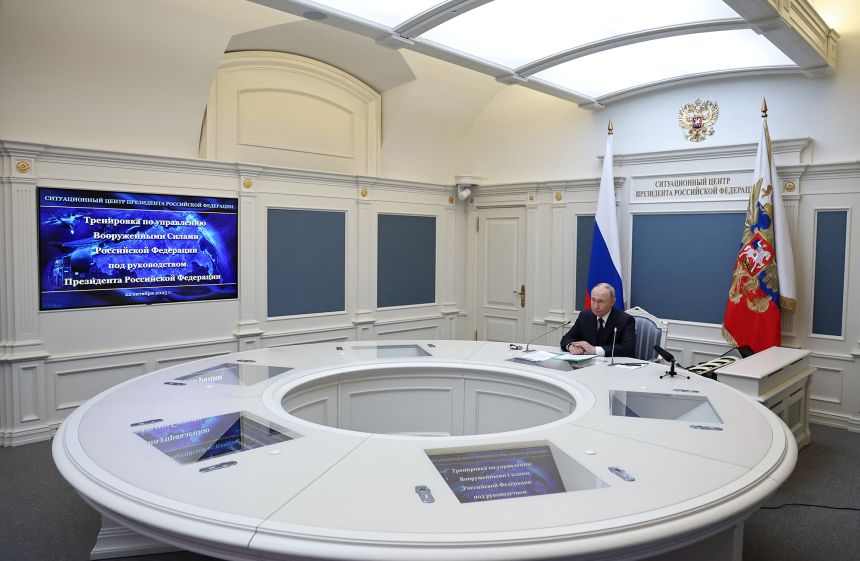
As President Trump, irritated with the Kremlin’s continued refusal to immediately halt the war in Ukraine, threatened to cancel his scheduled Budapest summit with President Vladimir Putin before imposing sanctions on Russia’s two biggest oil companies, the Russian president confirmed that he was seen overseeing a “planned” nuclear triad exercise that test-fired long-range missiles from land, sea and air.
It was typical theater, with the Kremlin’s nuclear saber rattling, but there seemed to be little American response.
A few days later, President Putin, somewhat unusually in military uniform, announced the Burevestnik cruise missile test. But even that was dismissed by a dismissive White House.
“By the way, I also don’t think what President Putin said was appropriate,” Trump told reporters on Air Force One on Monday, en route to Asia for a three-stop tour that included a landmark meeting with Chinese leader Xi.
President Trump added: “He should end the war. A war that was supposed to last a week is now in its fourth year. Instead of a missile test, that’s what he should do.”
But by ignoring that recommendation and immediately announcing a test of a nuclear-powered Poseidon torpedo that could cause radioactive devastation throughout the U.S. coastline, the Kremlin may have inadvertently pushed the White House into deciding to resume its own nuclear weapons testing.
This could be a lesson in the dangers of mixing loose conversation with nuclear weapons in an increasingly volatile world. And while it may have been intended by the Kremlin as a way to intensify the debate over Ukraine, it may have plunged us all into a new dangerous and unpredictable era.
