

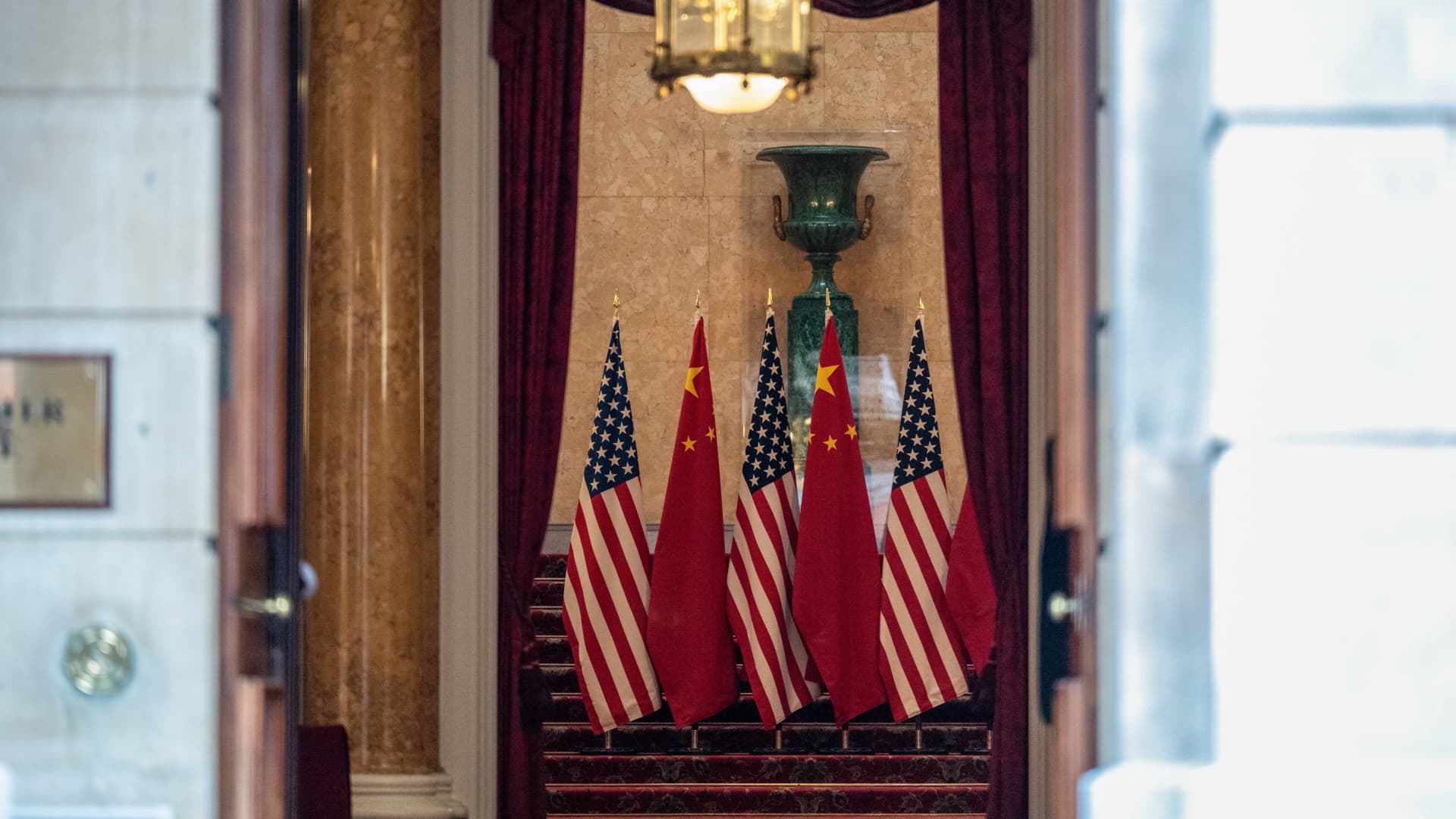
The United States and China held their fourth trade talks of the year in Malaysia over the weekend, as expectations mount for Thursday’s meeting between the leaders of the world’s two largest economies.
Bloomberg | Bloomberg | Getty Images
This report is from CNBC’s The China Connection newsletter this week, delivering insights and analysis on the powerhouse of the world’s second-largest economy. You can subscribe here.
big story
Ahead of Thursday’s meeting between U.S. President Donald Trump and Chinese President Xi Jinping in South Korea, tensions are rising between the two countries as they look to resolve escalating bilateral tensions.
“I look forward to a great meeting with President Xi of China, and I think many issues will be resolved,” President Trump said on his way to South Korea for the final leg of a three-nation Asian tour.
“Our relationship with China is very good,” Trump said from Air Force One on Wednesday, hours before China’s Foreign Ministry confirmed that Xi would meet with Trump in Busan.
The U.S. government has previewed potential victories, from a delay in China’s rare earth regulations to an agreement to sell TikTok’s U.S. operations from its Beijing-based parent company ByteDance. However, the Chinese government has not spoken out much.
President Trump’s optimism reflects a familiar pattern of American misunderstanding of China’s capabilities and interests.
Analysts told me that the Chinese government is most concerned about:
1. Stability
The Trump administration’s ad hoc approach stands in contrast to Beijing’s emphasis on stability.
“The Chinese basically want more stable and more favorable economic and trade relations,” said Zhicheng Wang, a researcher and international communications director at the China Globalization Center, a Beijing-based think tank.
He predicted that it could include “some kind of ceasefire so that there is no escalation of retaliation from the United States or countermeasures from China.”
2. Tariff reduction
The most realistic demand from the Chinese government is for the United States to lift tariffs on Chinese products. Tariffs more than doubled in just two weeks back in April, after which the two countries agreed to a 90-day suspension of tariffs, with the latest deadline set to expire in mid-November.
But overhangs remain, especially as President Trump has threatened new tariffs of up to 100% could go into effect next month.
But just minutes before arriving in South Korea on Wednesday, President Trump said he expected to lower fentanyl tariffs on China ahead of his meeting with President Xi.
“Companies need certainty. Right now there is no certainty,” said Cameron Johnson, a Shanghai-based senior partner at consulting firm Tidal Wave Solutions. They “need to stabilize the fee structure.”
Meanwhile, China is hedging. As U.S. exports plummet, shipments of goods to other parts of the world are increasing. Since the early stages of US-China tensions in 2018, Southeast Asia has overtaken the European Union (EU) as China’s largest trading partner on a regional basis.
3. Technology mitigation
U.S. restrictions on China’s access to Nvidia chips and other advanced U.S. technologies have accelerated over the past three years. It is currently unclear whether Nvidia will be able to regain its Chinese market share, which it says has fallen to zero.
“What the Chinese themselves want is to not be so tied down to technology,” Johnson said. “Is America finished? Or will it continue like this forever?”
President Trump hinted Wednesday that he may discuss export controls for Nvidia’s fastest AI chip, the Blackwell Graphics Processing Unit, during his meeting with Xi.
Although Beijing still needs cutting-edge American technology in the short term, the country’s top leaders last week emphasized plans to build domestic technology over the next five years.
4. Trade with other countries
China is also becoming more cautious as U.S. trade and technology moves begin to spill over into its relationships with other countries.
The Chinese government is using its advantage in rare earth materials as leverage to counter the U.S. government’s semiconductor regulations. On October 9, China expanded its rare earth licensing system to cover products containing even 0.1% of Chinese rare earths, including advanced chips.
What caused the reaction? Analysts point to new U.S. rules on Sept. 29 that expand restrictions to majority-owned subsidiaries of blacklisted Chinese companies, potentially affecting about 20,000 Chinese companies.
Wang of the China Globalization Center pointed out that the Dutch government’s order to acquire Nexperia, a semiconductor subsidiary of a Chinese company on the US Entity List, was issued on September 30th.
And on Monday, he added a clause to the U.S.-Malaysia trade agreement that would prohibit Kuala Lumpur from collaborating with “third countries” to the detriment of U.S. products, and urged Malaysia not to “undermine” U.S. technology regulations.
“Companies are concerned about that too, because it could spill over into all sorts of situations,” Johnson said, adding that the Chinese government wants to ensure that legitimate Chinese companies overseas are not cut off from global technology supply chains.
5. Mutual respect
Beijing has long demanded that trade negotiations with the United States be held on the basis of “win-win cooperation” and “mutual respect.”
That mutual respect includes the United States adhering to Beijing’s positions on Taiwan and territorial claims in the South China Sea, Dong Xiaopeng, a senior fellow at Renmin University of China, told me. He also believes that the United States needs to judge China’s development as “reasonable.”
Still, few expect breakthroughs.
“I don’t think there will be a result from this week’s meeting,” Dong said in Mandarin, according to a translation by CNBC.
Both sides could leave with something on Thursday, from photo ops to a framework agreement. Whether it lasts is another matter.
Popular TV Shows on CNBC

Swissport CEO Warwick Brady spoke about China’s export potential and trade trends as trade tensions continue after the aviation service provider opened a new smart cargo terminal in Shanghai.

Jeff Moon, president and founder of China Moon Strategies and former aide to the U.S. Trade Representative for China, said at the APEC meeting in South Korea that no “grand deal” could be struck between President Trump and President Xi, and that a decoupling of the U.S. and Chinese economies is impossible.

Yanliang Miao, chief strategist at CICC, talked about three factors behind the strong performance of China’s stock market in 2025.
need to know
China is touting its quantum computing ambitions. Last week, the leaders concluded their high-profile “4th general meeting” and set goals for the next five years, including advances in technology and expansion of domestic demand.
Industrial profits soar. China’s industrial profits rose more than 20% in September, the strongest growth in nearly two years, on the back of the Chinese government’s efforts to reduce unproductive and “innovative” competition.
Airbnb relies on Alibaba AI. According to a Bloomberg report, CEO Brian Chesky said that while Airbnb relies heavily on Alibaba’s Qwen AI model, which is fast and cheap, OpenAI’s ChatGPT is not yet ready to integrate with the travel booking platform.
Quote of the week
What we are looking for is some sort of agreement, and it would be quite substantive, but it would not really hit on those key issues and it would probably just return us to where we were on March 31st, before Liberation Day in April.
— Angela Mancini, Control Risks Partner
at the market
Chinese markets rose on Wednesday ahead of the meeting between President Trump and President Xi Jinping. The CSI 300 rose by about 1% after recording a rise of about 20% since the beginning of the year. The offshore yuan was flat at 7.099 yuan to the dollar.
Hong Kong markets are closed for public holidays.
—Li Yingshan

Shanghai Composite performance over the past year.
very soon
October 30th to November 1st: Chinese President Xi Jinping attends the APEC Economic Summit in Gyeongju, South Korea
November 2: 2025 Hong Kong Digital Asset Forum
November 3-7: Hong Kong Fintech Week
November 5th-10th: China International Import Expo
