

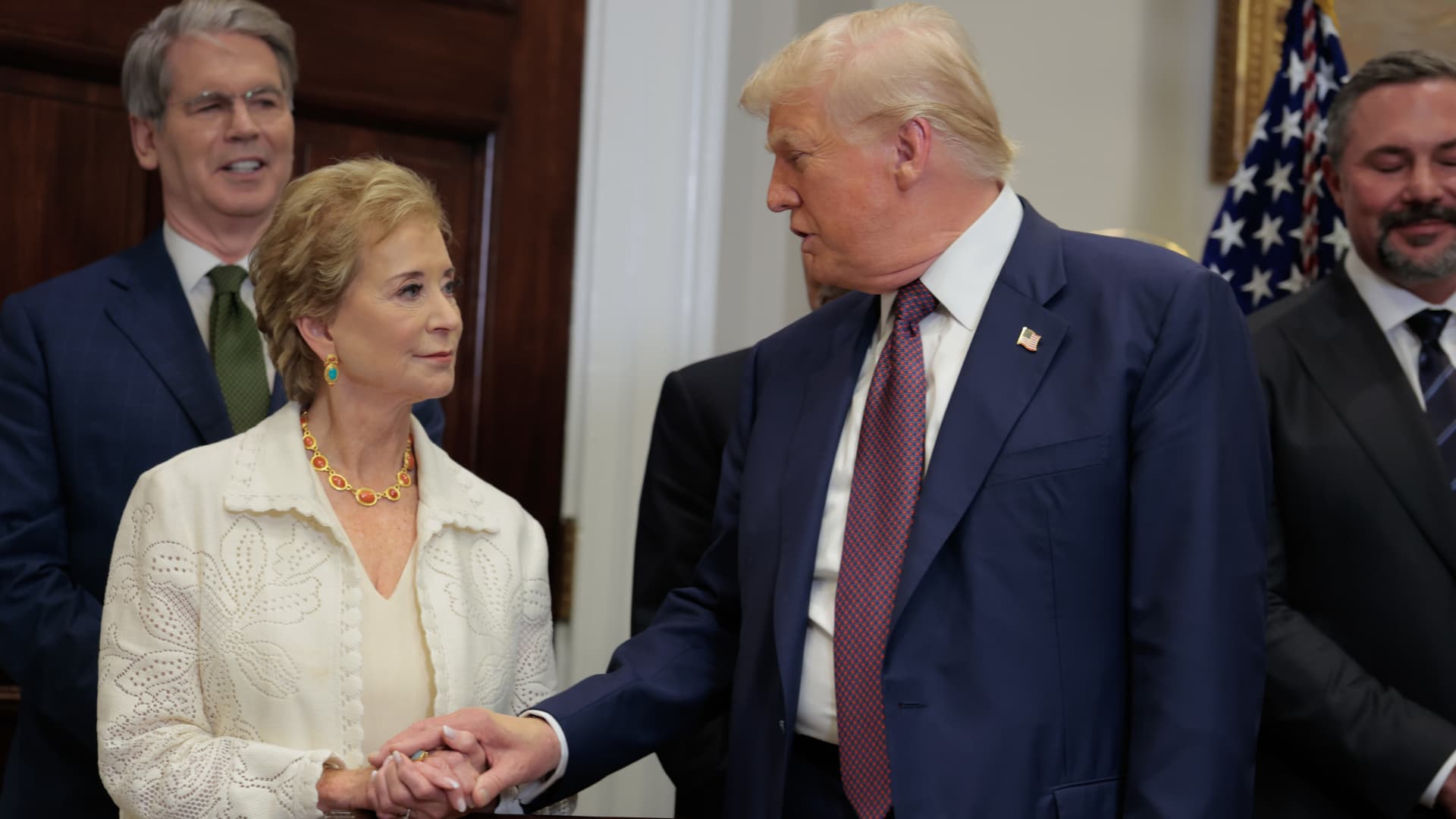
U.S. President Donald Trump speaks with Secretary of Education Linda McMahon during an executive order signing ceremony in the Roosevelt Room of the White House on July 31, 2025 in Washington, DC.
Anna Moneymaker | Getty Images
The Trump administration has agreed to cancel student loans under the program it had partially blocked, reopening the path to student loan forgiveness for millions of borrowers.
The results are the result of an agreement reached Friday between the U.S. Department of Education and the union, American Federation of Teachers.
In the agreement, the Trump administration said it would reinstate student loan forgiveness for eligible borrowers in two income-contingent repayment plans (the original income-contingent repayment plan and the Pay as You Earn plan) for as long as those programs remain in effect.
President Donald Trump’s “Big and Beautiful Bill” will phase out ICR and PAYE starting July 1, 2028.
“This is a huge win for borrowers,” said Winston Berkman-Breen, legal director at Protect Borrowers, which advised AFT. “The U.S. Department of Education has agreed to comply with the law and provide Congress-mandated affordable payments and debt relief to hardworking public servants across the country.”
The Department of Education did not respond to requests for comment.
Higher education expert Mark Kantrowitz estimates that more than 2.5 million borrowers are enrolled in either ICR or PAYE.
Why student loan forgiveness was blocked
AFT, which represents about 1.8 million members, sued Trump officials in March for blocking a program that was required for federal student loan holders under the terms of their original loans.
The Trump administration earlier this year suspended student loan forgiveness under some income-based repayment plans, saying it was in response to a court order. IDR plans set monthly charges as a percentage of the borrower’s discretionary income and write off the remaining debt after a set period of time (usually 20 or 25 years).
The Trump administration’s Department of Education said the court order ending the Savings for Valuable Education (SAVE) plan, a Biden administration-era program, also affects other IDR plans.
Consumer advocates had argued that this was too broad an interpretation of the court order. And that left only one repayment plan available to the borrower, which led to student loan cancellation. That’s an income-based repayment plan (IBR). The Trump administration also suspended IBR loan cancellations for a period of time, but has since resumed processing aid.
In its agreement with AFT, the Trump administration also made clear that borrowers eligible for student loan forgiveness in 2025 will not have to pay federal taxes on the relief. A law that makes canceled education debt tax-free at the federal level expires at the end of this year.
