

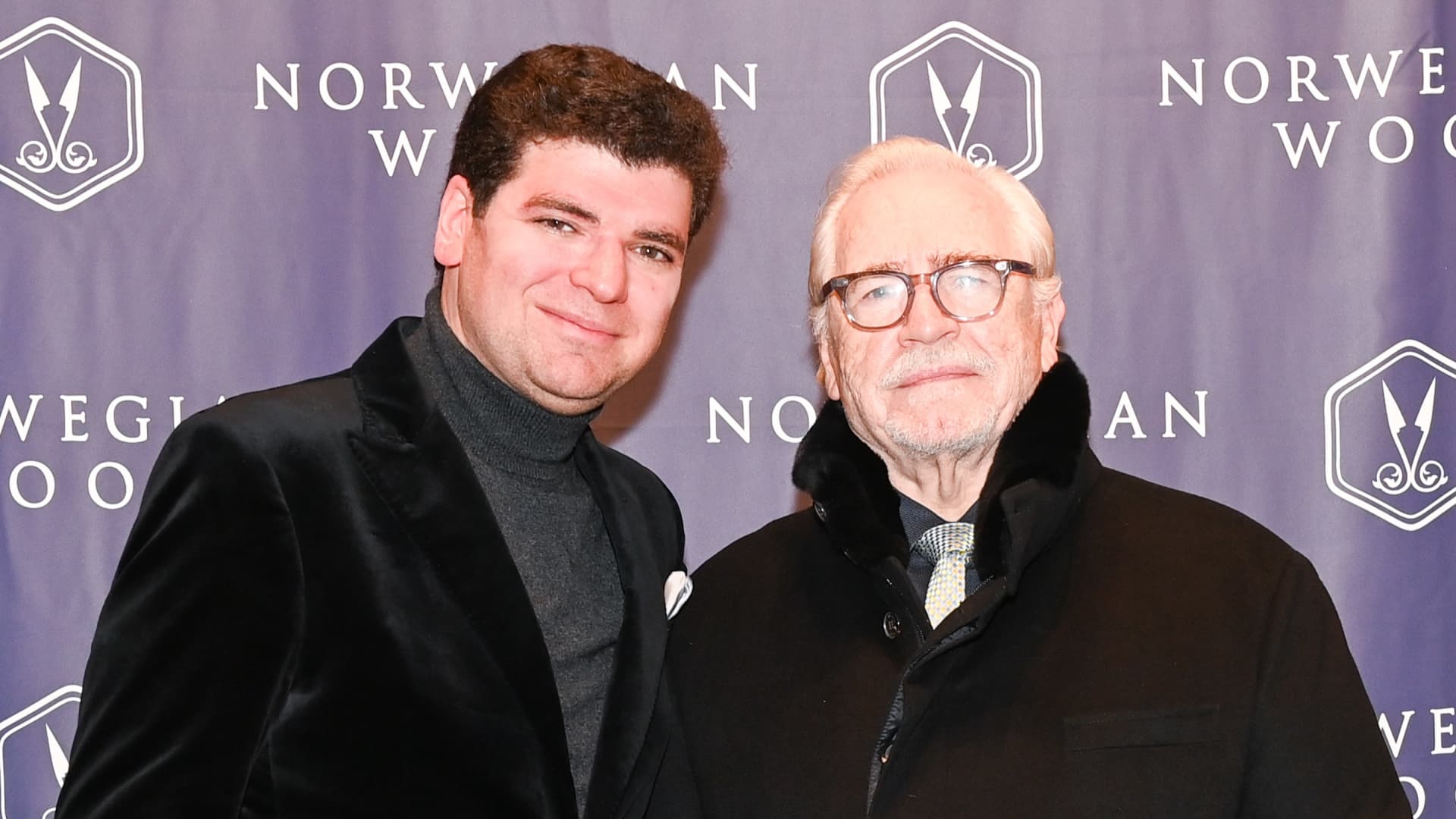
When the first prototype of the Norwegian Wool Jacket arrived at Michael Berkowitz’s apartment in the Bronx, New York, in August 2014, it was 95 degrees.
Needing to test a knee-length, waterproof wool coat to avoid heatstroke, the founder and CEO of the then-fledgling apparel brand took it to a West Harlem supermarket. “I spent 30 minutes going back and forth in the walk-in freezer,” Berkowitz, 38, recalls, to assess the warmth of the lining. “This is New York, so no one stops you, no one asks you questions. By the end, my face was cold, but my body was completely warm. I remember thinking, ‘Okay, I can handle this.'”
At the time, Berkowitz was a commodity trader who wanted to start his own business. Today, Norwegian wool coats adorn the shoulders of billionaires, actors, politicians, and financiers at campaign events, the annual World Economic Forum in Davos, Switzerland, and episodes of HBO’s Season 3 of Succession. Berkowitz said the clothing brand is on track to be profitable in 2024 and has been profitable for seven of the past eight years.
Don’t Miss: The Ultimate Guide to Starting a Business – Everything You Need to Know to Be Your Own Boss
Berkowitz declined to disclose other financial information, citing competitive pressures, but said the company’s products are now sold in more than 100 stores around the world, including Saks Fifth Avenue, Bloomingdale’s, Nordstrom and an appointment-only New York showroom.
Norwegian wool coats are both form and function. Although financiers are expected to dress a certain way, the classic wool Italian coats most of them wear aren’t designed to withstand weather below 40 degrees, Berkowitz said.
“If it’s only 40 degrees and you show up wearing[a down coat]that looks like you’re going to the North Pole, you don’t look like someone who can break through a wall and close a deal,” he says.
Norwegian Wool’s best-selling mid-length Euro coats currently range from $1,545 to $2,945 each, depending on the type of wool used. The brand also sells other lengths and styles, including blazers, sport coats, rain jackets, ski jackets, and a variety of winter coat options and accessories for men and women. Berkowitz estimates that about 40 billionaires buy coats made from Norwegian wool.
A luxury startup with modest roots
Berkowitz came up with the idea for Norwegian Wool in 2013 while shivering on a subway platform with a friend, he says. “I said to him, ‘I need a coat that looks good, that I can wear to work, and that actually keeps me warm,'” Berkowitz recalls. “He put his arm on my shoulder and was like, ‘Hey, if you find it, buy it for me too.’
After doing some research, Berkowitz identified a simple cause, he says. Many fashionable coats are designed in regions of Italy where the air rarely freezes. For example, the average January temperature in Florence is about 40 degrees Fahrenheit, compared to 30 degrees Fahrenheit in New York and 25 degrees Fahrenheit in Chicago.
Companies based in Canada and Scandinavia are making warm coats for harsh winters, but one designer told him the two industries are “not talking to each other.”
Norwegian Wool showroom in Midtown, New York
norwegian wool
Berkowitz spent months flying back to Italy to meet with the factory owner and convince him to send a prototype to his apartment. In the end, he says, he spent $250,000 — $50,000 of his own money and a $200,000 investment from the company’s former CFO, who had heard about Berkowitz’s efforts from a colleague — to sample the prototype and order an initial production run of 200 coats.
On nights, weekends and vacations, Berkowitz carried these coats, one on his body and two in small suitcases, to upscale family-run stores across the country. He often pitched directly to salespeople, he says, who knew the common dilemma of customers: wanting to look good but still feel warm in a fancy coat.
He sold all 200 coats in three months and quit his day job in early 2015, he says.
“I didn’t get much sleep that year,” Berkowitz said, adding that during the day she tried to hide her efforts so as not to jeopardize her job. Alan Kestenbaum, his former boss and now CEO of the New York-based holding company Bedrock Industries, said he had always had the impression that he was a “street-smart” and dedicated employee who was “the first to come to work and the last to leave.”
Like “dipping your hands in warm butter”
In 2017, Berkowitz formed its first partnership to sell coats in major department stores. The following year, Norwegian Wool participated in two funding rounds, both of which were seven-figure deals with private investors, Berkowitz said. He remains the majority owner of the company, he notes.
A coat made from Norwegian wool is typically more expensive than a Canada Goose parka, but less expensive than a cashmere coat from a long-established Italian luxury brand such as Loro Piana. But the quality of the materials is high, says John Schwartz, costume director for “Succession.” Norwegian Wool’s cashmere feels “like dipping your hands in warm butter.”
Berkowitz’s dream for Norwegian wool, he says, is a reputation similar to that of Range Rover cars, which are known worldwide for their blend of style and functionality. It added that it plans to add product lines, invest in marketing and hold pop-up retail events to increase brand awareness. He says he can already hear Norwegian wool brought up in natural conversations, even though no one realizes the brand’s founder is speaking up.
Even if you show up wearing something that looks like you’re going to the North Pole (down coat) and it’s only 40 degrees, you don’t look like someone who can break down walls and close deals.
michael berkowitz
Founder and CEO of Norwegian Wool
And as someone who falls squarely in Norwegian Wool’s target audience: businessmen who want to impress with their looks in the cold winter months, he says he still tests many of the company’s prototypes himself.
Berkowitz dressed himself and his friends in unreleased parkas for a ski trip to the Alps in February. He took samples of the bamboo blazer, which had just been released in September, to Paris and threw them on top of rolling suitcases and into the overhead bins of planes, testing them for wrinkles and pilling.
“I try things out by going to my midtown office or going to the Alps on vacation,” Berkowitz says. “It doesn’t matter where it is. It’s just as important as how I wear it. It has to be representative of how the customer will wear it.”
Want to stand out, expand your network, and land more job opportunities? Sign up for CNBC Make It’s new online course, “How to Build a Standout Personal Brand: Online, In-Person, and at Work.” Learn how to showcase your skills, build a great reputation, and create a digital presence that no AI can match.
Plus, sign up for the CNBC Make It newsletter for tips and tricks to succeed at work, money, and life, and request to join our exclusive community on LinkedIn to connect with experts and colleagues.

