

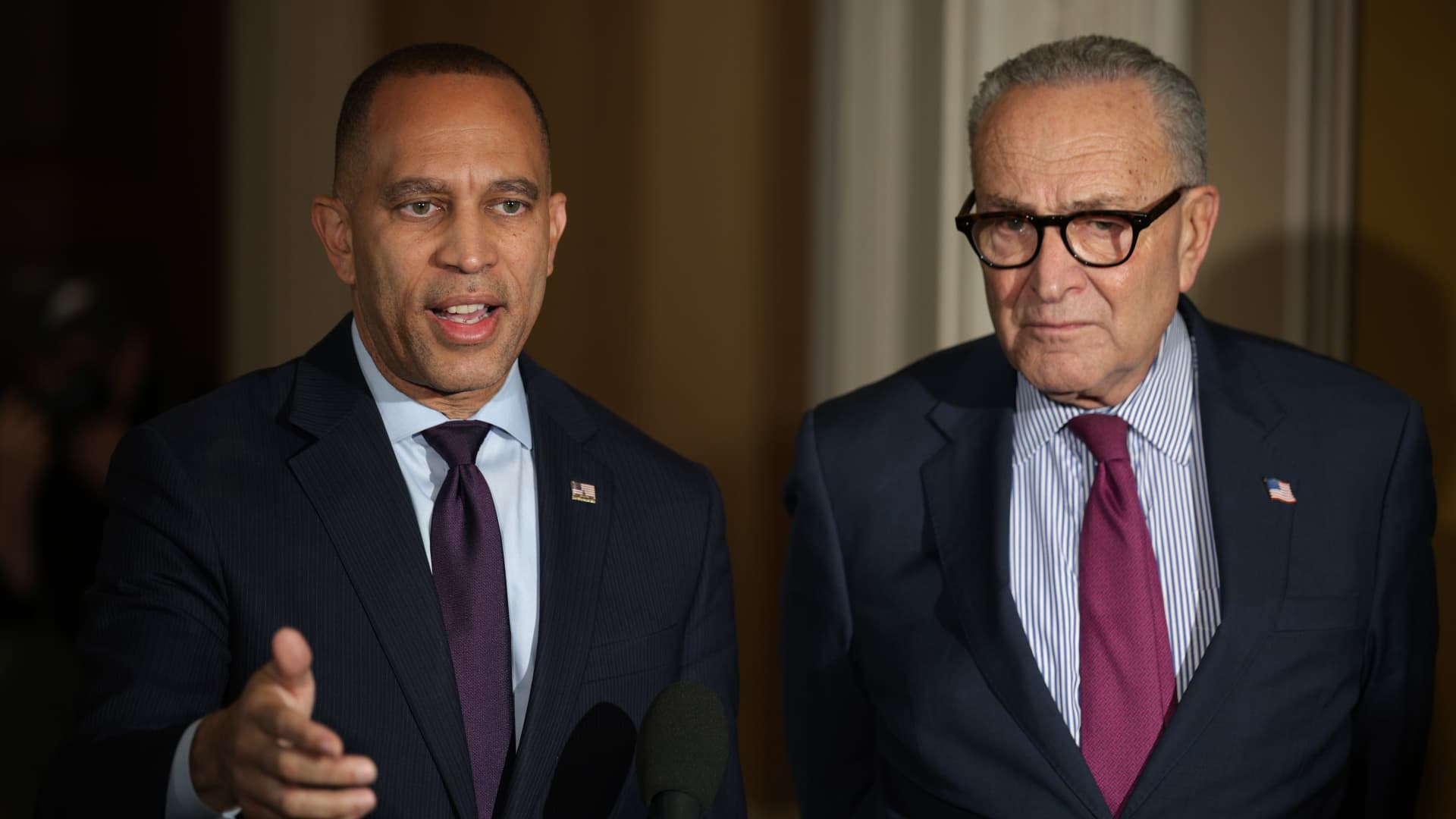
WASHINGTON, DC – OCTOBER 16: U.S. Senate Minority Leader Chuck Schumer (D-NY) (R) and House Minority Leader Hakeem Jeffries (D-NY) (L) brief reporters during a government shutdown press conference on October 16, 2025 at the U.S. Capitol in Washington, DC.
Alex Wong | Getty Images
A stalemate remains on Capitol Hill as the government shutdown enters its third week, with Democrats arguing that distrust of President Donald Trump is a major obstacle to negotiations.
In past legislative debates, bipartisan coalitions known as “gangs” have been formed to break deadlocks. These groups have helped build the initial framework for major deals before gaining buy-in from leadership and other lawmakers.
In the current cash-strapped climate, already lasting longer than most previous government shutdowns, these gangs are nowhere to be found.
“If the president of the United States considers himself a law unto himself and ignores norms and rules, what’s the point of an agreement by a gang of four, eight, or 12 people?” Sen. Richard Blumenthal (D-Conn.) told CNBC.
Bipartisan talks have been held to extend the Affordable Care Act’s health insurance premium tax credit, which is set to expire at the end of the year, and is a key demand from Democrats.
However, no specific group has been convened to clarify these details or negotiate an end to the closure more broadly.
Sen. Josh Hawley (R-Missouri), who supports extending the tax credit, said he has been talking with several Democratic senators, but no set group has formed.
Senate Majority Leader John Thune (R.S.D.) held up a continuing resolution to fund the government during a press conference with House Speaker Mike Johnson (R-Louisiana) regarding the Capitol closure on Friday, October 10, 2025.
Tom Williams | CQ-Roll Call Inc. | Getty Images
“What’s different about this is that it doesn’t feel coalesced,” Hawley said. “There doesn’t seem to be any momentum around people saying, ‘Okay, we really need a deal.'”
Mr. Trump, Senate Majority Leader John Thune (R-La.), and House Speaker Mike Johnson (R-La.) have insisted that negotiations are impossible until the government reopens. Passing a temporary bill to temporarily restore federal funding at current levels would require support from about eight Senate Democrats.
Thune told MSNBC on Wednesday that he offered Democratic leaders a vote on extending Obamacare subsidies in exchange for opening up the government.
However, Democrats have expressed strong doubts about the handshake agreement with Republicans.
“We need an ironclad path forward that decisively addresses the Republican health care crisis,” Democratic House Minority Leader Hakeem Jeffries of New York said Thursday on MSNBC’s “Morning Joe.”
“You can’t trust on a wing or a prayer,” Jeffries said.
Asked to comment on Democrats’ skepticism, White House press secretary Abigail Jackson told CNBC: “The entire administration has been clear: The president is happy to discuss health care policy, but he won’t do it while Democrats are holding the American people hostage.”
Democrats are wary that President Trump could undermine agreements with Republicans, as he has done in the past. For example, a bipartisan immigration reform proposal introduced last year stalled after President Trump publicly opposed it.
Some Democrats are now calling for Trump himself to participate in negotiations.
“They seem to be following his lead in everything,” Sen. Mark Kelly, D-Ariz., said Thursday of his Republican colleagues on CNBC’s “Squawk Box.”
“This is it,” Kelly said.
Sen. Chris Coons, D-Delaware, told reporters that the Trump administration’s intention to rescind billions of dollars in funding approved by a bipartisan group of lawmakers further eroded trust.
“What has happened over the last six to nine months has eroded trust between Senate Democrats and the administration and the House of Representatives when it comes to respecting the bipartisan spending bill that was signed last year,” Coons said.
Sen. John Cornyn (R-Texas) accused Senate Minority Leader Chuck Schumer (R-N.Y.) of sidestepping negotiations to appease his party’s progressive wing after he voted to fund the government in March, and Schumer infuriated him.
“I think he’s afraid to come to any kind of agreement, which we normally do in these situations, because he’ll be attacked by his progressive, radical base,” Cornyn said of Schumer.
Schumer was part of the “Gang of Eight” that helped pass the bipartisan immigration reform bill through the Senate in 2013.
Hawley said Democrats are comfortable continuing the confrontation.
“The public, especially Democrats, seem pretty content to leave the government shut down,” he said.
For now, at least, Democrats have reason to feel safe. Polls show a growing number of Americans hold Republicans responsible for the government shutdown.
According to the latest CNBC National Economic Survey, if the government shutdown caused significant economic damage, 53% of respondents would blame President Trump, Congressional Republicans, or both, compared with 37% who would blame Democrats.
The survey was conducted among 1,000 adults nationwide from October 8th to 12th, and has a margin of error of plus or minus 3.1%.
