

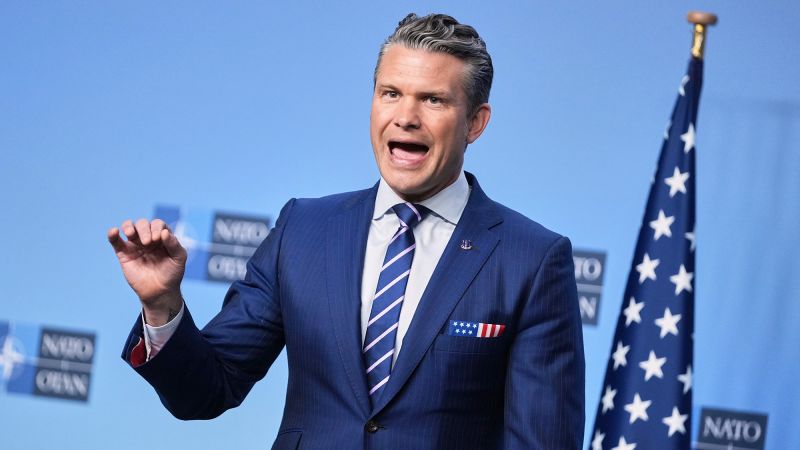
U.S. Secretary of Defense Pete Hegseth warned Russia on Wednesday that if the war against Ukraine does not end, the U.S. and its NATO allies will “impose a price on Russia for continued aggression.”
Hegseth said “firepower, it’s coming” to Ukraine through European countries’ purchases of U.S.-made weapons, but it’s not yet clear whether that will include U.S.-made Tomahawk missiles.
At a meeting of the Ukraine Defense Liaison Group of Kiev allies held at NATO headquarters, Hegseth appealed to countries to increase investments in weapons purchases under the new Ukraine Priority Requirements List (PURL) initiative.
Ukraine remains heavily dependent on U.S. weapons, more than three and a half years after Russia launched a full-scale ground invasion of the country.
The plan promises $2 billion in military equipment to Ukraine, but this is less than the $3.5 billion that Ukrainian President Volodymyr Zelenskiy had hoped to receive by October.
Hegseth called on NATO countries to “translate words into action by investing in PURL. There are no free riders among all the countries around this table.” Hegseth said.
NATO Secretary-General Mark Rutte said more than half of NATO member states are currently participating in the PURL program, adding that “commitments” by European countries would soon translate into “capabilities” for Ukraine.
“After today’s meeting, we have more than half of all allies, and now more than 16 or 17 allies are participating in PURL,” Prime Minister Rutte told NATO defense ministers gathered in Brussels.
After pledging funding at Wednesday’s meeting, Swedish Defense Minister Pal Jonsson told CNN’s Aisa Soares that the U.S. and European positions on Ukraine are “more and more aligned.”
“Putin doesn’t really seem interested in negotiating, and I think he would give a similar interpretation that he won’t negotiate unless he’s put under more pressure,” Johnson said.
“The path to peace in Ukraine is through tightening sanctions on the Russian economy and also by providing more arms to the Ukrainians,” he added.
Ukraine’s Defense Minister Denis Shmyhal expressed his gratitude to the countries that announced new contributions to the PURL program and to those that joined the initiative on Wednesday.
“Decisive action is needed to increase pressure on Russia and force an end to the war,” Shmyhal said.
Ukraine hopes European countries can buy advanced long-range Tomahawk missiles under that mechanism, but that decision rests with U.S. President Donald Trump.
President Trump said Wednesday that he will advocate launching an offensive in the war against Russia when Ukrainian President Volodymyr Zelenskiy visits the White House later this week.
President Zelenskiy is expected to push for access to the American Tomahawk, which could allow strikes deep into Russia and put Moscow within range.
“They want an attack,” Trump said from the Oval Office. “I’ll be the judge of that, but they want to be aggressive.”
President Trump has previously suggested he may be willing to give Ukraine the tomahawk as his patience with Russian President Vladimir Putin over the war grows and wanes.
Russian Foreign Minister Sergei Lavrov warned on Wednesday that supplying Tomahawks to Ukraine would cause severe damage to relations between the United States and Russia.
In an interview with Kommersant, Foreign Minister Lavrov said the move was seen as a serious escalation and would undermine the chances of normalizing U.S.-Russian relations, which he said were at an “stalemate.”
Missiles are one of the key points in Ukraine’s efforts to strengthen its defense, but the issue was not on the agenda in Brussels on Wednesday.
“It’s a bilateral issue,” NATO Secretary General Rutte said, referring to direct talks between Ukraine and the United States.
NATO defense ministers have already committed to adding more drones to Ukraine, with Britain pledging to deliver 100,000 drones and the Netherlands pledging to provide 90 million euros ($104 million) to build the drones at home.
Russia’s recent incursions into the airspace of various NATO countries (the most serious of which was last month when a NATO aircraft fired the first shots of the war and shot down a suspected Russian drone over Poland) have focused European attention on how the continent will respond.
Russia insists it did not intentionally fly drones into Poland and that its warplanes do not violate NATO airspace.
British Defense Secretary John Healy said on Wednesday: “When NATO is threatened, we act. And we must use our powers to counter his (Putin’s) escalation.”
Healey said the Russian invasion was “reckless, dangerous and completely unacceptable” and announced that British aircraft would continue to fly in Polish airspace until the end of the year.
But Dutch Defense Minister Ruben Brekelmans said Europe needed a better solution than fighter jets to deter Russia.
“We are very proud that Dutch F-35s were able to destroy several Shahed drones in Poland,” Brekelmans said, referring to the American aircraft, which is one of the most capable fighter jets in NATO’s arsenal.
“But, of course, we also need to learn from this. The F-35 is not the most efficient way to defeat drones. We need to find more effective ways to do that,” he added.
“Russia’s threat looms ever closer to NATO territory.”
In response to the threat, Latvian Defense Minister Andris Spruz said weapons capable of hitting Russian targets were “very important” for Ukraine.
“While Russia is bombing all kinds of civilian infrastructure and killing civilians, it is Ukraine’s legitimate right to attack (Russian) military targets, because this is also self-defense,” he said.
“So that’s absolutely what NATO plans to do, and we would be happy to do a deep strike in any situation, in any scenario,” Spruce continued.
“And I think this will also be an important part of Ukraine’s defense and deterrence. Don’t attack our targets because we can counterattack.”
Finland’s Defense Minister Antti Hakkanen has warned that even after the Ukraine war ends, Russia will still pose a risk to Europe.
“Russia is actually building up its military for a potential second stage of invasion… After the Ukraine war, there is a real threat to NATO,” he said.
Hakanen pointed to Russia’s military modernization and military buildup “close to its borders” as signs.
