

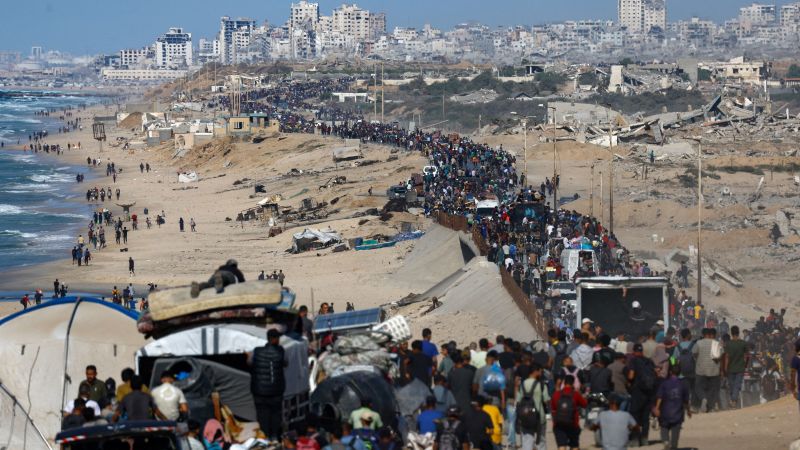
Thousands of Palestinians began the long, dusty walk from southern Gaza towards Gaza City after a ceasefire took effect in the enclave on Friday. Although they found their city in ruins, they were still relieved to be able to return home.
Virtually the entire population of northern Gaza has been displaced since the October 7, 2023 Hamas attack that led to Israel’s war in the enclave, and the area has been reduced to rubble over the past two years.
Aerial footage shows vast tracts of land with nothing but ruins. There is no infrastructure, no electricity, no running water.
But for many of those making the trek on Friday, there’s no question of returning.
“We pray that God will ease our sorrow and pain and that people will return to their homes. Even if our homes are destroyed, God willing, we will return,” said Ahmad Abu Watfa.
Abu Watfa told CNN on his way back to Sheikh Radwan’s home in Gaza City. He said he feels an overwhelming sense of joy, even though he knows there’s likely nothing waiting for him to call home.
“There is no more beautiful feeling than this, the feeling of people coming back from the South to the North,” he said.
An Israeli Defense Forces (IDF) spokesperson said people were allowed to travel from the south to the north via al-Rashid Street along the coast and Salah al-Din Street in the center of the Gaza Strip.
For many residents of northern Gaza, Friday was a second chance to try to return home.
Israel forced most residents of northern Gaza to leave the area early in the war, but temporarily allowed them to return to some areas during the final ceasefire in January.
But their return was short-lived for most, as Israel once again ordered a complete evacuation of Gaza City in early September, ahead of a ground invasion of the city.
The Israel Defense Forces told CNN at the time that 640,000 people left the city after the evacuation order. This figure represents about 90% of Gaza City’s pre-war population, but it has not been possible to verify this estimate.
The situation in Gaza City was critical even before the ground attack, with no fully functioning hospital and few evacuation centers.
On Friday, a medical team from Al-Rantisi Hospital in Gaza City visited the facility and found it completely destroyed. Dr. Youssef Abu al-Rish, Gaza’s deputy health minister, shared video from the scene with CNN showing ruins and medical equipment burnt and destroyed.
The Integrated Food Security Classification (IPC), a UN-backed initiative, said famine hit Gaza City in August and then spread to the rest of the Gaza Strip.
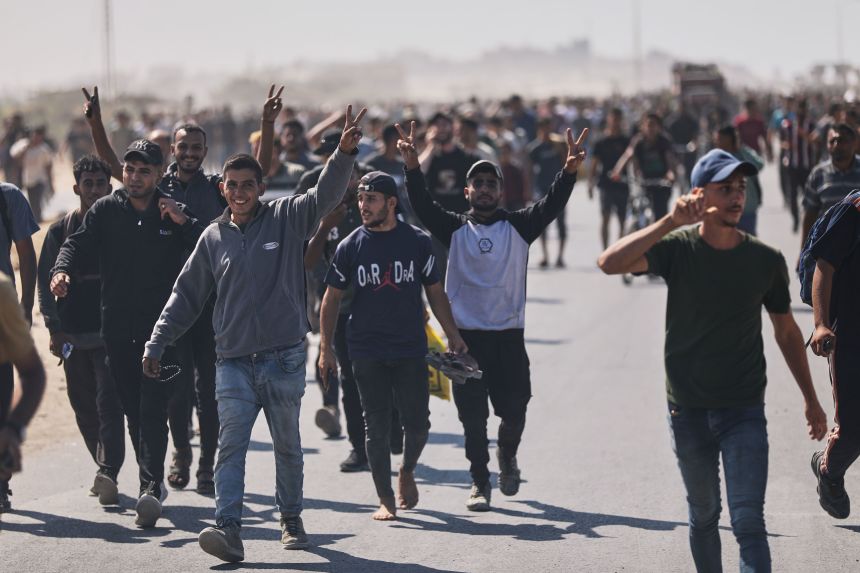
As the people began to return north, a horrifying discovery awaited them there. Footage from the city showed many skyscrapers completely flattened and others torn apart by the blast. The entire area appears to be covered in gray dust, with almost no other colors visible.
At least 33 Palestinian bodies were recovered from Gaza City on Friday after Israeli forces withdrew from some areas of the city, Mohammed Abu Salmiya, head of Al Shifa Hospital in the north, told CNN.
He said some of the bodies were impossible to identify, so they were sent to a hospital where a forensic team could examine them.
Majidi Fuad Mohammad al-Khor stood in the rubble of the building that was once his home in Tal el-Hawa in an interview with CNN.
He said that two of his children, a son and a daughter, died in the war. His home was destroyed and almost everything he owned was lost.
“It took 40 years to build this house,” he said. “I am 70 years old now. I worked from the age of 10 until I got married, built a house, and had children. I can’t work now, and I can’t work even if I’m healthy. Where should I go? My health is no longer what it was when I was younger. I can’t work because I’m old and sick. My wife is also sick and can’t see.”
The Israeli military announced on Friday that a ceasefire is now in effect in the Gaza Strip and troops are withdrawing according to a plan approved by the Israeli government.
A 72-hour period for the release of hostages held by Hamas under a cease-fire agreement began on Friday. As part of the agreement, approximately 2,000 Palestinian prisoners and detainees in Israel will also be released.
Sir Hikmat Subh, from Beit Rahiya, a town just north of Gaza City, said he was “tired and fed up” but wanted to go home soon.
Subu told CNN as he was dismantling and packing his tent near Al Rashid Street ahead of his trip north.
“I’m glad that the obstacles have been removed. Praise God for everyone’s safety. Of course I’m happy!” he told CNN.
But he said the experience has made him more cautious.
“I dismantled many tents and left many things behind. I evacuated nearly 20 times,” he said.
Mr. Sabu was probably right to be cautious. An Israeli Defense Forces spokesman said on Friday that Israeli forces remain stationed in various areas of Gaza, including Beit Hanoun, Beit Lahia and Shujaiyah, and warned people to avoid them.
“It is extremely dangerous to approach areas where troops are stationed,” the spokesperson said.
CNN’s Abeer Salman and Eyad Kurdi contributed reporting.
