

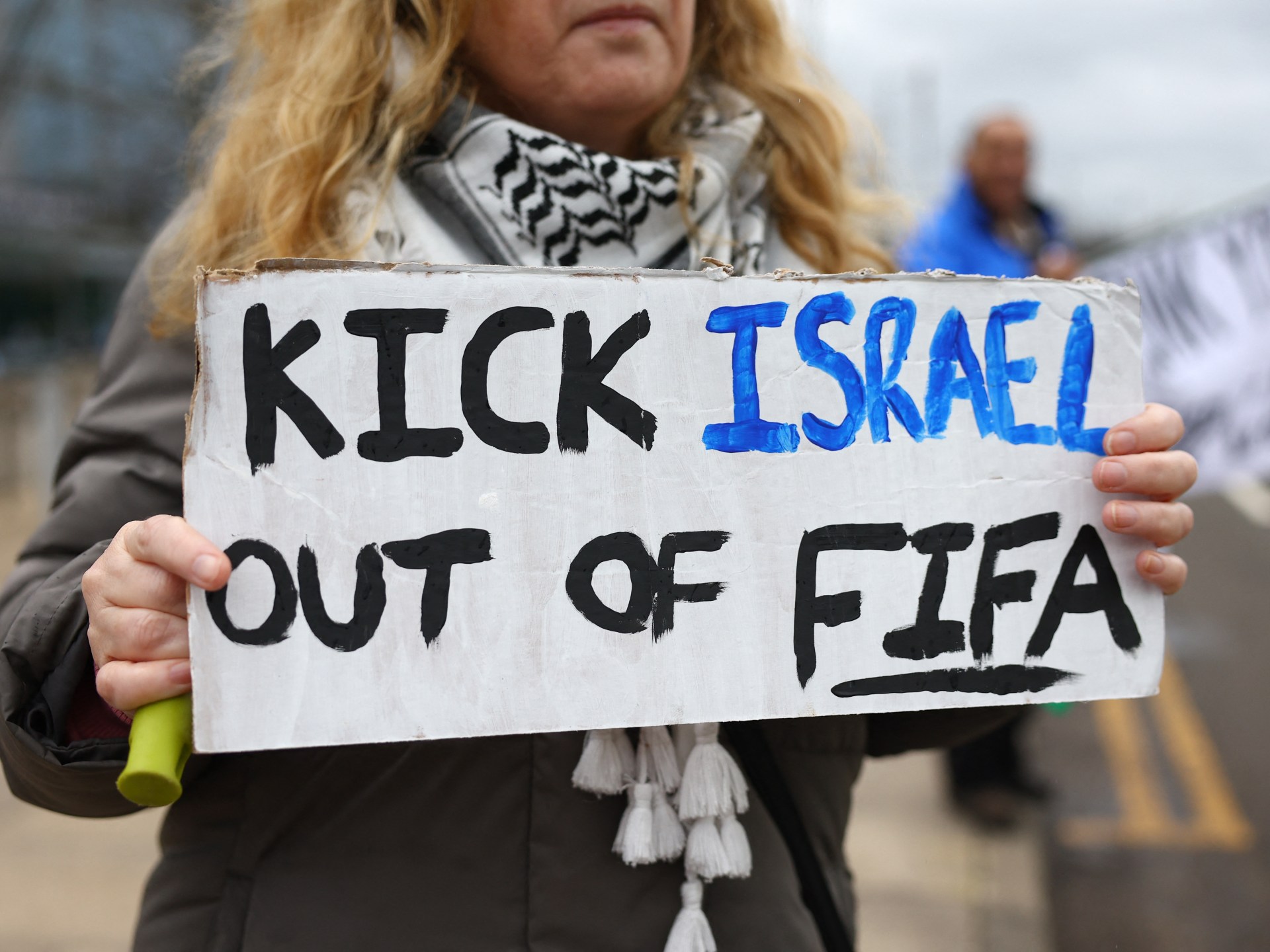
Israel will resume its campaign to qualify for the 2026 FIFA World Cup this weekend amid widespread public protests and growing calls for soccer’s governing body to impose sanctions on Israel over the massacre in Gaza.
Despite widespread opposition, Israel’s upcoming World Cup qualifiers – against Norway on Saturday and Italy on Tuesday – will go ahead as scheduled after FIFA sidestepped the issue, saying “geopolitical issues cannot be resolved”.
Recommended stories
list of 3 itemsend of list
Soccer fans and several experts have accused FIFA and UEFA of double standards for swiftly sanctioning Russia following Moscow’s 2022 invasion of Ukraine, but failing to take action against Israel during the two-year war in Gaza.
Who called for a ban on Israel and why?
More than 30 legal experts have called on UEFA to ban Israel and its clubs from the competition over atrocities in Gaza.
The letter cited a United Nations commission of inquiry report that concluded that Israel was committing genocide against Palestinians, and said an Israeli entry ban was “essential.” The letter highlighted the damage Israel has inflicted on sports in Gaza (at least 421 Palestinian soccer players have been killed since Israel launched its military offensive in October 2023) and said that Israel’s bombing campaign is “systematically destroying Gaza’s soccer infrastructure.”
A ceasefire was agreed between Israel and Hamas in the early hours of Thursday, but the war in Gaza has left at least 67,183 people dead and 169,841 injured over two years. Almost a third of those killed were children. Thousands more are believed to be buried under the rubble of destroyed buildings.
Last month, Spain’s Sports Minister Pilar Alegría said the Israeli team should be banned from the sport in 2022, along with the Russian team.
“They (Israeli forces) killed more than 60,000 people. Children and babies starved to death, hospitals were destroyed,” Alegría told Spanish radio station Cadena SER.
“It is difficult to explain and understand that there is a double standard. Given this situation, it is important that the sport takes at least the same position as it did against Russia.”
Former France international and Manchester United captain Eric Cantona spoke at a fundraising event for Palestine in London on September 17th, questioning the inaction of football officials.
“FIFA and UEFA must suspend Israel,” he said. “Every club must refuse to play against Israeli teams.”
Additionally, hundreds of thousands of soccer fans and pro-Palestinian protesters have called for similar action against Israel over the past two years.
Fans have registered protests inside and outside sports venues, using banners, tifos, pitch invasions and stadium strikes.
French footballer Eric Cantona criticized FIFA and UEFA’s double standards towards Israel. pic.twitter.com/eJ9m2k32NN
— AJ+ (@ajplus) September 23, 2025
Why didn’t FIFA ban Israel?
FIFA President Gianni Infantino ignored the call, indirectly addressing the issue as a “geopolitical issue” at the FIFA Executive Board meeting on October 2.
“We are committed to harnessing the power of soccer to bring together the divided peoples of our world,” Infantino said.
Abdullah Al Arian, associate professor of history at Georgetown University in Qatar, said the apparent preferential treatment given to the Israeli soccer team is an extension of the “total impunity” the country has enjoyed during the two years of war.
“Sporting organizations are often a reflection of the broader power politics that are happening[in the world]and they are just doing what we have seen happening in all areas of politics, and Israel is not held accountable,” Al-Arian told Al-Jazeera.
“Israel (Israel) has been allowed to operate with complete impunity throughout this genocide and has enjoyed this punishment for decades.”
Al-Arian, author of the book Football in the Middle East: Nation, Society and the Beautiful Game, said the double standards and “complicity” of the governing body was clear.
“FIFA has been under pressure for two years, but following the latest UN findings (on Israeli atrocities in Gaza), the pressure (calls for Israel’s suspension) escalated and led to actual mobilization.
“But the United States intervened on Israel’s behalf and basically reacted quickly by issuing all sorts of threats against these institutions if they proceeded with (sanctions against Israel).”
Al-Arian highlighted the role of the United States as co-hosts of the next World Cup, along with Mexico and Canada, and the “very close relationship” between U.S. President Donald Trump and FIFA President Gianni Infantino as another factor.
In 2024, the Palestinian Football Association (PFA) submitted an argument accusing the Israeli Football Association (IFA) of violating FIFA regulations by including clubs based in the Gaza War and illegal settlements in the Palestinian territories in its national football league.
The PFA called on FIFA to impose “appropriate sanctions” against the Israeli national team and club teams, including international suspensions.
FIFA called for Israel to be banned, but the international federation deferred a decision by referring the matter to a disciplinary committee. Al-Arian called it “a move that keeps the bureaucracy running without making any real progress.”
“Ultimately, political decisions will be made at the highest levels of the organization,” he said.
Al-Arian believes the PFA is under “immense pressure” from Israel.
“Being under the control of an occupying force, the PFA is subject to significant internal constraints, and decisions to pursue this issue often have very harsh consequences,” he explained.
He suggested the implications include Israel preventing Palestinian athletes from traveling and “Palestinian teams congregating in one place for practice.”
“There have been no international matches held in Palestine for many years,” he pointed out. “And this was before we were exposed to the violence that Palestinian soccer players are subjected to. Several players have been shot, imprisoned, and held at checkpoints for years, and their entire careers have been ruined.”
Although the PFA falls under the auspices of the Palestinian Authority (PA), al-Arian argued that it is not always “in the interests of Palestine.”
“There is certainly a lot of criticism to be made regarding the PA’s own stance on Palestinian rights. Many refer to the PA as a kind of occupation subcontractor.”
Why was Israel expelled from the AFC and why did they join UEFA?
But this is not the first time Israel has faced calls for its expulsion from a soccer body.
Israel became a founding member of the Asian Football Confederation (AFC) in 1954 and played under its umbrella for 20 years.
In 1974, several Islamic and Arab countries, as well as North Korea, refused to play against Israel. This followed the 1973 Arab-Israeli War.
Kuwait led the campaign against Israel’s membership in the AFC, and by a vote of 17 to 13, Kuwait was expelled from the regional organization. During the 1980s, Israel played most of its international matches against European countries and even participated in the European qualifying rounds for the World Cup. In 1994, they were admitted as full members of UEFA.
Why will Norway and Italy play Israel in the 2026 World Cup qualifiers?
Israel are in Group I of the UEFA World Cup qualifiers alongside Italy and Norway.
Italy’s government, which has largely supported Israel during the war in Gaza, has seen increasingly large protests calling for a ceasefire and criticizing Prime Minister Giorgia Meloni’s government for refusing to condemn Israel.
Meanwhile, Norway’s government has asked its sovereign wealth fund, the world’s largest, to scrutinize all investments in Israel and divest from investments related to the war or the illegal occupation of the West Bank.
But for soccer teams from these countries, the stakes are different. If you withdraw from the match, you risk being eliminated from the qualification process.
Italy’s coach Gennaro Gattuso said of the forfeited game rule: “We have to play this game, because if we don’t we’ll lose 3-0.”
Norway has pledged to donate money raised from ticket sales for the match against Israel to the humanitarian work of Médecins Sans Frontières (known by its French initials MSF) in the Gaza Strip.
Will there be protests against Israel in Italy and Norway?
Protesters are expected to gather outside the stadium for both games, and pro-Palestinian messages are expected to be broadcast inside the stadium.
“It’s not going to be a calm environment,” Gattuso admitted on Tuesday, after Italy’s training sessions were also targeted by protesters.
“There will be 10,000 people outside the stadium and 5-6,000 inside the stadium,” he said.

Can sports protests lead to sanctions?
According to Al-Arian, sport has been a means of promoting popular causes and protest movements, but its “commodification” has placed significant constraints on the movement’s ability to achieve its goals.
“In the changes in world football relations over the past few decades, financial and political interests have often played an outsized role, imposing severe restrictions on football as a mobilizing arena,” he said.
“This is why the Football Association, which should be more sympathetic and united, has fallen far short of expectations.”
Israel’s expulsion from the AFC in 1974 is often cited as an example of Arab-Muslim solidarity against Israeli atrocities in Palestine. However, these countries have not been able to ask FIFA to impose sanctions on Israel, and Al-Arian believes that these countries are not pursuing such policies due to “deeper motives”.
“The established political, economic and trade relationships[over the past few decades]make it very difficult[for states to take action],” he said.
“This also comes after a series of normalization efforts by some Arab and Islamic countries to normalize relations with Israel and maintain diplomatic relations with Israel throughout the Gaza massacre.”
