

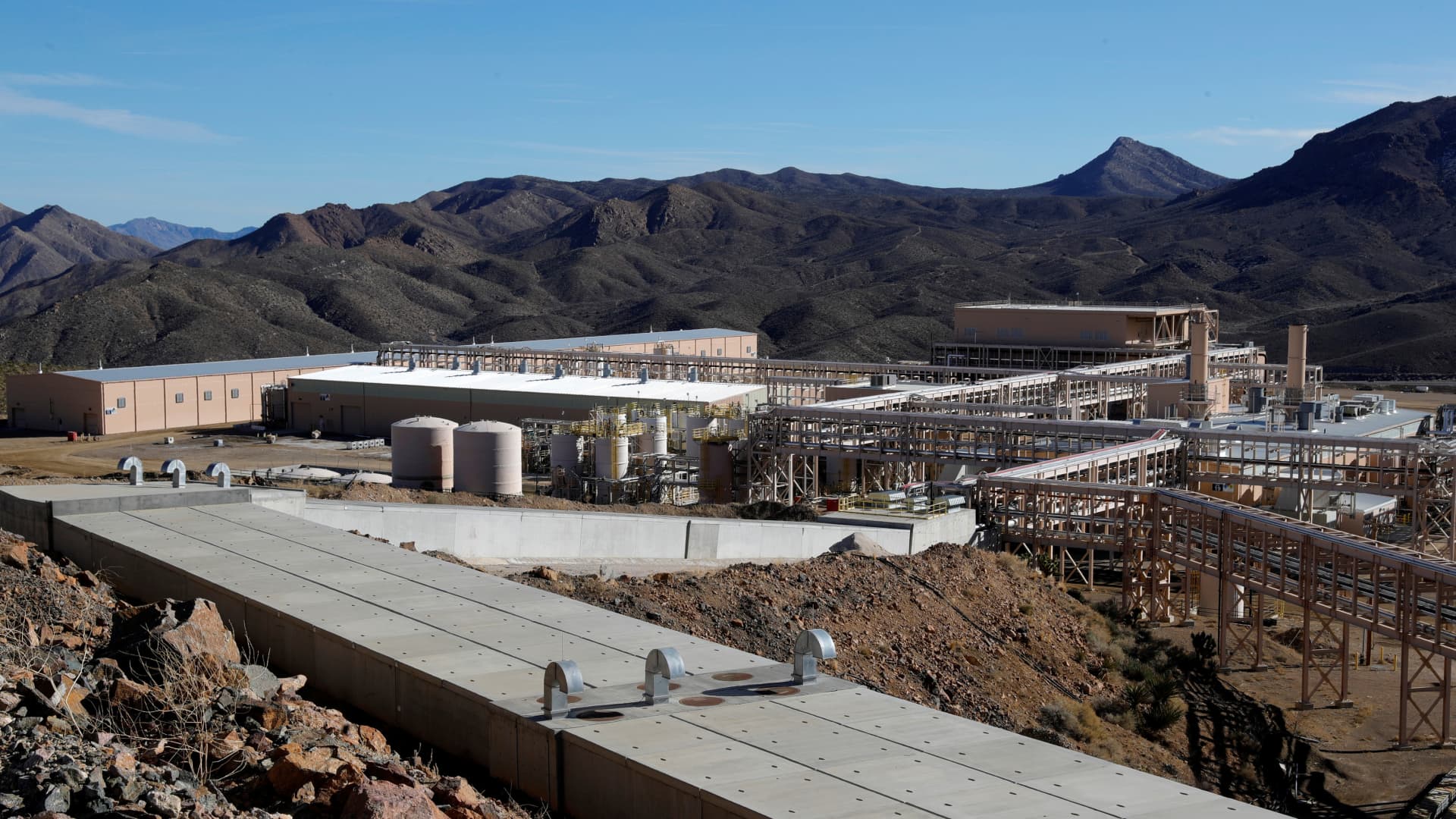
A view of the mining facility at MP Materials Rare Earth Mine in Mountain Pass, California, USA, January 30, 2020.
Steve Marcus | Reuters
China has tightened export controls on rare earths and related technology while banning its citizens from participating in unlicensed mining overseas, placing new burdens on a key area of geopolitical influence.
The Ministry of Commerce announced Thursday that foreign companies will need to obtain a permit from Beijing to export products containing more than 0.1% domestically produced rare earths, or products made using China’s extraction, refining, magnet manufacturing and recycling technologies.
The Commerce Department said companies with ties to foreign militaries or on export control or watch lists will be denied permits to prevent the “misuse” of rare earth minerals in military and other sensitive sectors. Applications for items that could be used for weapons, terrorism, or other military purposes will also be rejected.
Eurasia Group’s China director Dan Wang said the move is a “significant tightening of rare earth export controls” and expands restrictions from just raw materials to intellectual property and technology. In April, China added several rare earths and related substances to its export control list.
Such restrictions could aid Beijing’s efforts to move its own industries up the value chain, while making other countries even more dependent on Chinese know-how, Wang added.
Chinese citizens are also prohibited from supporting overseas activities related to rare earth extraction or magnet manufacturing without approval from the Chinese government.
According to official announcements, new rules on the export of rare earth materials will come into force on December 1, while new rules on technology and labor will take effect immediately.
The ministry said applications for exports of rare earths used in the production of semiconductors below 14 nanometers, advanced memory chips, semiconductor manufacturing and testing equipment, or artificial intelligence with potential military applications will be reviewed on a case-by-case basis.
George Chen, a partner at Asia Group, said the measures primarily target the defense sector and are part of Beijing’s efforts to dwarf U.S. defense capabilities.
Rare earths are essential to high-tech industries such as automotive, defense, and semiconductors. This year, access to rare earths became tighter, with international supply chains disrupted by the crossfire between the United States and China.
“The Chinese government recognizes that it has leverage in this area and is clearly not shy about leveraging it,” said Wendy Cutler, senior vice president at the Asian Social Policy Institute and a former U.S. trade negotiator. The move could put pressure on Washington to make further concessions in ongoing talks, including lowering tariffs and easing U.S. export restrictions.
negotiation leverage
China accounts for about 70% of the world’s supplies and has repeatedly used the critically needed mineral as a bargaining chip in trade negotiations.
The latest restrictions were imposed weeks before a potential meeting between US President Donald Trump and Chinese President Xi Jinping. The two leaders are scheduled to hold face-to-face talks on the sidelines of the Asia-Pacific Economic Cooperation Forum to be held in Gyeongju, South Korea, in the last week of October.
China has been silent about future talks, but Trump also said he planned to visit China early next year and that Xi would visit the United States at a later date.
Asia Group’s Chen said the new announcement could be seen as a “series of deals” that Beijing wants to strike even before the next major trade talks.
“The Chinese side is becoming more and more experienced in dealing with other countries and knows what its friends in the United States want,” Chen added.
Since the end of last year, China has been tightening export controls on rare earths, including requiring proof that rare earths will not be used for military purposes. The Chinese government began issuing single-use export licenses following a trade ceasefire with the U.S. government in May.
China’s official data shows that exports of rare earth magnets have recovered in recent months, but progress appeared uneven. In a study released last month, the European Chamber of Commerce said at least one member had suffered losses of “several million euros” due to the Chinese government’s strict control, while others cited inconsistent procedures for obtaining export approvals.
A Chinese ministry spokesperson said Thursday that there will be certain exceptions under the new rules, including exports for medical emergencies and disaster relief. A “transition period” will also allow companies to honor existing contracts and meet compliance requirements.
Eurasia’s Wang said the transition period is likely to ease some of the short-term impact on companies, noting that “just as the US ban on high-tech exports to China left more room for US high-tech companies to lobby and apply for approvals, most companies received approvals.”
“It gives China more power than just a blatant ban,” Wang said.
—CNBC’s Evelyn Cheng contributed to this article.
