

Phnom Penh, Cambodia
—
Jacqueline Kennedy visited Cambodia in 1967, four years after her husband, President John F. Kennedy, was assassinated and she became the world’s most famous widow.
When she arrived in the capital, Phnom Penh, in the midst of a generation-defining war, there was no question where she would stay. Hotel Le Royal was the most serene address in town. Opened in 1929 and inaugurated by then King Sisowat Monivong, the hotel takes its name from its roots.
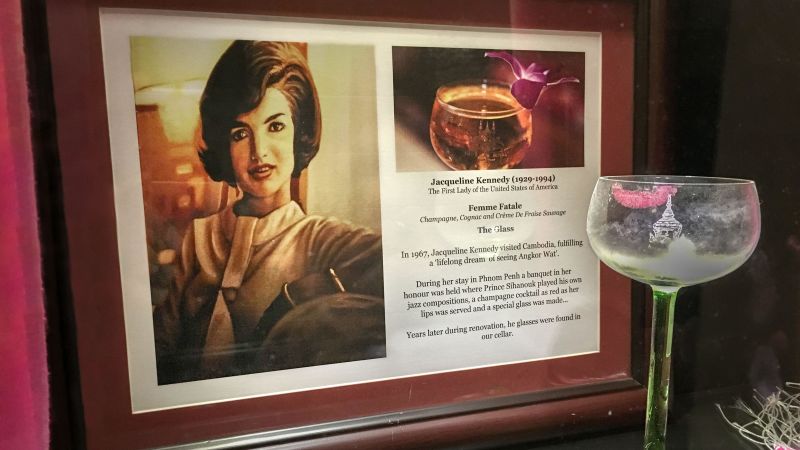
To commemorate the visit of the former first lady, the hotel’s bartenders created a special cocktail “Femme Fatale”. Made with cognac, champagne, and crème de frèse, it’s garnished with frangipani flowers and served in a long-stemmed coupe glass. Effervescent, elegant, and perfect for sipping while hiding from Phnom Penh’s humid climate.
Forty years later, much has changed at the hotel, but Femme Fatale remains on the bar menu.
The story doesn’t end there.
Many of the hotel’s decorations were abandoned in storage, untouched, after the country’s brutal civil war. After the property was purchased by Raffles Group in 1996, an employee allegedly discovered the exact glass from which Kennedy drank Femme Fatale, with lipstick marks on the rim, and rescued it during renovations to the hotel.
The glass is now on display in an exhibit outside the hotel’s Elephant Bar, along with several photos from President Kennedy’s trip to Phnom Penh.
The hotel also features the Kennedy Suite, with a portrait of the former first lady looking admiring on the pristine white linens and cool tile floors. A vintage copy of a Life magazine issue about Kennedy’s trip to Cambodia, acquired by Raffles on eBay, sits on a table in the hallway, already open to the relevant page.
“I call it her transition period,” Elizabeth J. Nuttall, author of “Jacqueline Kennedy and the Structure of First Lady Diplomacy,” says of Kennedy’s post-White House years and before her remarriage.
At that point, Kennedy was probably the most famous and talked about woman on the planet. Her love life was under as much scrutiny as her clothes.
Accompanying Kennedy on his trip was David Ormsby Gore, a British aristocrat and former ambassador to the United States. The two visited Angkor Wat, a huge complex in northern Cambodia that is a UNESCO World Heritage Site, together.
Although their relationship was kept under the radar at the time, letters auctioned after their deaths revealed the depth of their love, including Kennedy’s rejection of Ormsby-Gore’s marriage proposal.
Nuttall believes Kennedy suffered from undiagnosed PTSD after witnessing her husband’s assassination. However, Kennedy was horrified by the idea of riding in an open-top motorcade, similar to the one she was traveling in on November 22, 1963, but agreed to do so as a gesture of goodwill towards her host in the Southeast Asian country, Prince Sihanouk.
Yes, she was a celebrity, but she was not a politician. Therefore, Natal points out, she had a unique soft power. As a widow she had the dignity to be respected, and since she was no longer the incumbent First Lady, her position was neutral.
“Soft power is the antidote to military policy and official government diplomacy,” Nuttall said. “First ladies have a certain credibility just by being first ladies. They’re not formal members of the government, they don’t have a job description, they don’t have a constitution.”

Although visiting Cambodia while a U.S.-backed war was raging across the border may have seemed like a political gesture, Kennedy insisted he was only there to visit Angkor Wat and other historic sites.
Her vacation was a carefully planned performance. Public opposition to the Vietnam War reached a fever pitch in the United States, and official relations between the United States and Cambodia were severed in 1965. As a result, Kennedy needed a formal invitation from the King to enter Vietnam.
Then there was the issue of logistics. There were no direct flights between the US and Cambodia. This is still true today. Finally, the solution was that she was flown to Bangkok on a commercial flight and then taken to Phnom Penh on a US Air Force flight C54, which was given special landing clearance.
Kennedy, a French speaker, supported her husband’s political career by translating French books and political speeches, including material about Cambodia, which was part of French Indochina. According to Natale, she was known for granting access and interviews to French-speaking journalists, even if she ignored English-speaking journalists during her travels.
And she has long been known as a lover of history, art and architecture, after visiting countries such as Greece and Spain during similar “transitional” periods.
“She was interested in ancient civilizations,” Natal says. “Angkor Wat is probably part of that too. It was her way of glorifying the host and the ruins themselves as important.”
Located near the banks of the Ton Le Sap River and two miles from the Royal Palace, Hotel Le Royal has supported the lives of many people.
It survived the darkest period in modern Cambodian history, when the ultra-Maoist Khmer Rouge ruled the country. At least 1.7 million Cambodians were murdered by the regime between 1975 and 1979. Many Cambodians were forced out of Phnom Penh or fled to the countryside.
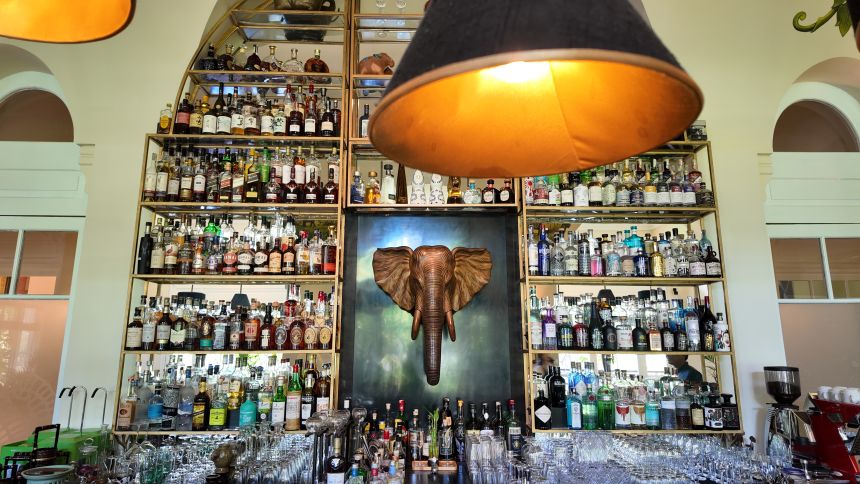
After the Khmer Rouge era, Hotel Le Royal was renamed the Solidarity Hotel and hosted an influx of international journalists and aid workers into the country. When Raffles Group purchased the hotel in the 1990s, they settled on the name Raffles Hotel Le Royal.
Even after all these years, Raffles Le Royal remains an important part of Phnom Penh. Angelina Jolie, Charlie Chaplin and Charles de Gaulle also stayed here.
In 2012, President Barack Obama visited Cambodia as the final stop on his diplomatic tour of Southeast Asia and was photographed sitting on a sofa at Raffles talking on a mobile phone.
But he wasn’t in the Kennedy Suite.
