

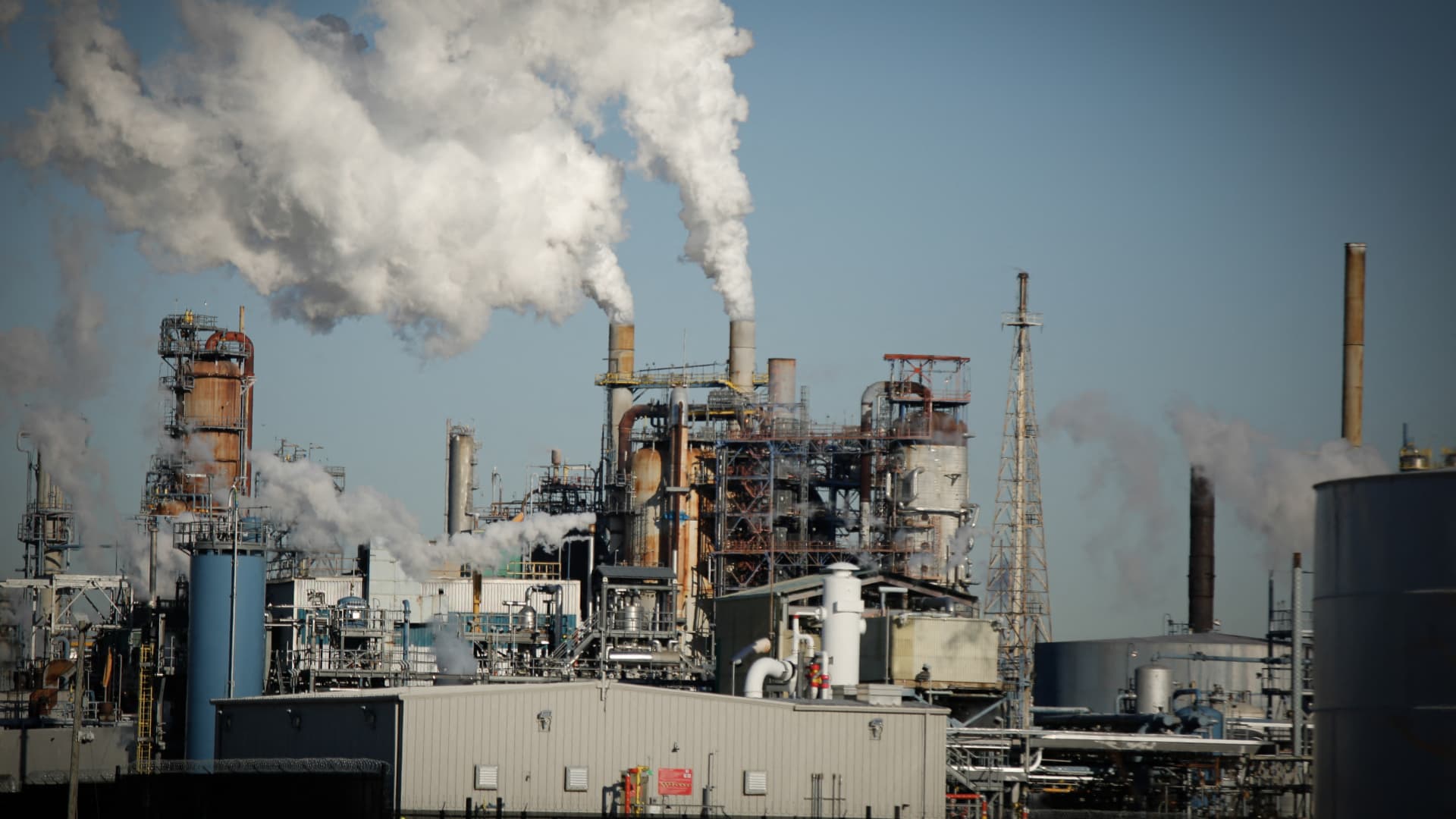
Smoke rises from a refinery chimney on March 18, 2026 in Linden, New Jersey.
Kenna Betancourt | AFP | Getty Images
Oil prices rose on Monday after Yemen’s Iran-backed Houthis fired a missile at Israel and US President Donald Trump reportedly wanted to acquire Iranian oil, deepening concerns about growing risks to Middle East energy flows.
International benchmark Brent crude oil futures (for May delivery) rose 2.5% to $115.45 per barrel, while US West Texas Intermediate futures (for May delivery) rose 1.5% to $101.17 per barrel.
Brent crude soared more than 55% in March, marking the benchmark’s biggest monthly rise on record.
In an interview with the Financial Times on Sunday, President Trump said his preferred option in Iran was to “take the oil,” likening it to U.S. actions in Venezuela, where the U.S. effectively took control of the country’s oil sector after the arrest of leader Nicolas Maduro.
His comments came as the conflict between the United States, Israel and Iran enters its fifth week, with attacks spreading across the region, increasing risks to energy infrastructure and causing oil prices to soar.

Crude oil prices since the beginning of the year
Yemen’s Houthis announced Saturday that they had fired a missile at Israel, marking their first direct involvement in the U.S.-Israel war against Iran.
Spokesman Yahya Salih said in a post on X that the group fired a barrage of ballistic missiles at what it called important Israeli military targets in support of Iran and Hezbollah forces in Lebanon.
The attack marks a further escalation in the conflict that began with the US and Israeli attack on Iran on February 28th.
Michael Hague, global head of fixed income and commodities research at Société Générale, said further disruptions in the Bab el-Mandeb strait, a key sea route between the Gulf of Aden and the Red Sea, could cause prices to rise further.
“We’re talking about between 4 million and 5 million barrels a day going through there,” Haig said Monday on CNBC’s “Squawk Box Europe,” referring to the Bab el-Mandeb Strait.
“There will be a lot of correction going into April, but if an additional 4 million barrels are extracted from the Red Sea on top of the existing oil, oil prices in this sector will be much higher,” he added.
Analysts at Société Générale said in a note earlier this month that prolonged supply disruptions in the Middle East could push prices up to $150 a barrel in April.
Analysts told CNBC that the Houthis could cut off maritime traffic through the Bab el-Mandeb strait, which separates the Arabian Peninsula from the Horn of Africa, through which ships must pass to reach the Red Sea and the Suez Canal, increasing pressure on global trade.
Will crude oil prices rise over time?
Ed Yardeni, president of Yardeni Research, said global stock markets were beginning to reflect a scenario in which oil prices and interest rates would “rise for an extended period of time” as the risk of protracted conflict increases.
He warned that continued blockade of the Strait of Hormuz could deepen the market backlash and increase recession risks, and that uncertainty surrounding the conflict, including the possibility of increased U.S. involvement, would likely keep volatility high until oil flows normalize.
“The speed and scale of this move highlights how quickly energy markets are reassessing geopolitical risks, challenging previous efforts to anchor both oil and bond markets and reinforcing the risk of sustained disruption in the Strait,” Yardeni said in a note released Monday.
David Roche, a strategist at Quantum Strategies, said markets are increasingly pricing in a more aggressive U.S. response, including the possibility of a “ground war” and a move to seize Iran’s key export hub, Kharg Island, through which about 90% of the country’s oil flows.
He warned that such measures would effectively cut off Iran’s dollar income but risked a full-scale escalation, with Iran likely to retaliate by targeting critical infrastructure across the Gulf.
This expansion could rapidly spill over into global supply routes. Roche pointed to the vulnerability of Saudi Arabia’s east-west pipeline, which carries about 5 million barrels a day to the Red Sea, and warned that any disruption at Yemen’s Houthi-held Bab al-Mandeb chokepoint could severely limit exports.
He added that even under the alternative route through the Suez Canal, production capacity would be significantly reduced, with 4 million to 5 million barrels per day potentially leaving the market.
—CNBC’s Azhar Sukri and Anniek Bao contributed to this report.
