

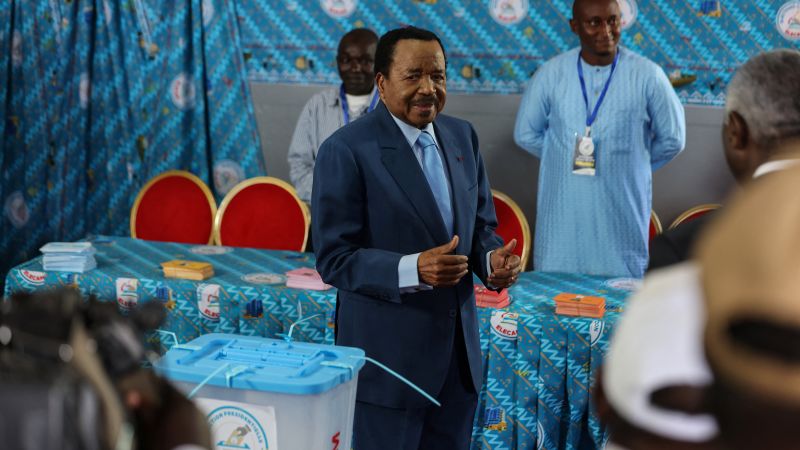
Cameroon voted Sunday in an election that could see Africa’s oldest leader – and the world’s oldest president – extend his rule for another seven years.
Analysts predict a victory for President Paul Biya. He is currently 92 years old, but will be 99 by the end of his term. He first came to power in 1982 following the resignation of Cameroon’s first president, Ahmadou Ahidjo, and has ruled the country ever since. Mr. Biya was declared the winner of seven subsequent elections. Cameroon has had only two leaders since independence in 1960.
However, there may be cracks in Biya’s image.
His health has been a constant topic of speculation as he leaves day-to-day governance to senior party officials and his family and spends most of his time in Europe.
Activist and Syracuse University professor Dr. Benjamin Aki believes opposition candidate Issa Chiloma Bakary has a chance of winning because of Biya’s age and long track record representing Cameroon.
“I think this election is different. Mr. Biya was the weakest candidate that the CPDM could put forward, considering his age and the poor situation of the country after 43 years in power,” he said.

In announcing his candidacy again, Mr. Biya said, “The challenges we face are becoming increasingly urgent in an increasingly difficult international environment.” “In these circumstances, I cannot avoid my mission.”
Mr Biya is facing nine opposition candidates, including former allies and appointees. These include Bello Buba Maigari, who served as Minister of Tourism, and Issa Ciroma Bakari, who most recently served as Minister of Employment.
Mr. Biya voted at an elementary school in the capital, Yaounde, and told reporters he would not comment on his plans until the results were in.
The results are expected to be known by October 26th at the latest.
Joshua Osi, the opposition presidential candidate for the Social Democratic Front and a member of parliament who came fourth in the 2018 election, told The Associated Press that his party is concerned about voter fraud, but stressed that the process of counting votes will take time.
“There is still a lot of room for progress to make things smoother. Unfortunately, as we always say, the bottleneck is not a single vote, but multiple votes, and the fact that the process is very cumbersome,” Osi said. “As we know, this system allows elections to be anything but free and fair.”
In Cameroon, there is only one vote and the person with the most votes is the winner.
Chukam Ginet, a 34-year-old environmental activist and first-time voter, said he would not choose Mr Biya.

“Things have to change. First of all, life costs money. Healthcare is not easy to access,” she said outside a polling station in Yaoundé. “There are no roads, there are potholes everywhere. Everything is ruined. That’s why I voted for the opposition. We know our country, so we have no confidence in the electoral process, but we have hope.”
At a campaign rally in the northern city of Maroua last week, Mr. Biya promised to bring about change in one of Cameroon’s poorest regions. Maigari and Bakari have strong supporters in the Muslim-majority north, where they make up nearly 20% of voters.
Cameroon is facing an escalating security crisis. In the western region, a secession war is being waged between government forces and mainly English-speaking separatists who say they are alienated from the French-speaking majority. In the north, the Boko Haram insurgency has spilled over from neighboring Nigeria, with militants routinely attacking border towns.
The United Nations estimates that at least 43% of the population lives in poverty, as measured by core living standards such as income, education and health.
Some 8 million voters, including more than 34,000 overseas voters, are eligible to vote at more than 31,000 polling stations in the central African country. Cameroon has a population of over 29 million people, the majority of whom are young people.
