

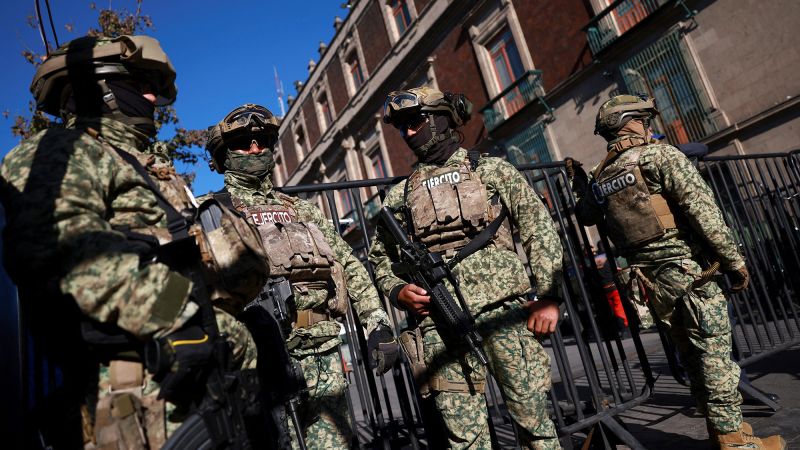
Analysts say the killing of Jalisco cartel boss Nemesio Oseguera, also known as “El Mencho,” could fuel a turf war between drug lords in Mexico and abroad, with the rival Sinaloa cartel already torn apart by infighting.
Cartels in Jalisco and Sinaloa have long fought for control of the lucrative U.S. illegal drug market, including cocaine, heroin and fentanyl trafficking, but competition has intensified in cracking down on illegal immigration into the United States.
The U.S. government describes the Jalisco New Generation Cartel (known by its Spanish abbreviation CJNG) as “one of the five most dangerous criminal organizations in the world,” generating billions of dollars in revenue from its operations.
The U.S. Department of State designated CJNG as a foreign terrorist organization in February 2025.
Who takes control of the group after Oseguera’s death, or whether it splits into sectarian bloodletting, will have major implications for drug trafficking in the Americas.
CJNG founder Oseguera took advantage of the chaos in Sinaloa to rapidly expand the group’s scope and activities, including fuel theft, human trafficking, and financial fraud. Jalisco groups have even allied with parts of Sinaloa to deepen divisions.
Former Sinaloa national team leaders Joaquín “El Chapo” Guzmán and Ismael “El Mayo” Zambada are currently detained in the United States. Mr. Guzman was extradited in 2017 and Mr. Zambada last year, intensifying the fight for control of the group between Mr. Guzman’s sons and a faction loyal to Zambada.

The history of human trafficking groups in both Colombia and Mexico is one of constant turbulence, driven by territorial disputes and greed. Rivals attack at any sign of weakness or division.
The Sinaloa conflict was caused by the lack of a clear family heir, and the same may now apply to the CJNG. El Mencho’s son Ruben Oseguera was extradited in 2020 and is currently serving a sentence in the United States. His wife was arrested in Mexico on money laundering charges in November 2021. Two of his brothers are also in prison in Mexico.
“The line of succession for the Jalisco cartel has collapsed,” said David Saucedo, a security expert based in Mexico City. Only one brother and son-in-law remain, Saucedo said, and he “still lacks influence among other cartel commanders.”
Saucedo said four CJNG commanders may be vying for supremacy and “could enter into a succession war to determine control of the cartel, but a negotiated takeover is also possible.”
Mr. Oseguera’s status as the CJNG’s leader was never in doubt, but rumors that he was ill had already caused defections. Four years ago, the Mescales faction, a CJNG splinter faction in Colima state, declared an end to its alliance with the CJNG, believing him to be dead. The defection sparked weeks of gang-related violence.

The conflict between CJNG and Sinaloa spans multiple Mexican states, with the two groups “disputing territorial control of various drug trafficking routes in central and northern Mexico,” according to Insight Crime, which tracks cartels. One area where competition is fierce is Mexicali, the capital of Mexico’s Baja California state, which borders the United States. After El Mencho’s death, a barricade was set up there by a faction of the cartel.
According to Insight Crime, the two groups are also embroiled in a battle over the crackdown on migrant smuggling in the state of Chiapas, which borders Guatemala.
For the Mexican government, fighting cartels risks sparking violence across the country as gang members retaliate against security forces and fight each other. CJNG has a presence in more than 20 states in Mexico, analysts said.
There is also a risk that the CJNG or its factions would resort to narco-terrorism similar to that endured by Colombia in the 1980s, when Pablo Escobar effectively declared war on the country and was marked by bombings, assassinations, and kidnappings.

Saucedo sees signs of this in the violent response of CJNG members to date. “Drug terrorism, blockades and arson of grocery stores across Mexico.”
Saucedo added that “all-out war against the Mexican state” remains a possible scenario. CJNG has shown a preference for such attacks in the past. Six years ago, he attempted to assassinate Public Security Secretary Omar García Harfucci, wounding him and killing two of his bodyguards and a bystander.
“For now, it appears that all the major commanders of the CJNG have united in launching an attack against the Mexican state,” Saucedo said, with the aim of “paralyzing economic activity and imposing domestic and international image costs on the government.”
But El Mencho’s death could also present an opportunity for the Mexican government to tip the balance of the cartel with further precision operations against its leaders.
For now, security forces are doing their best to restore order after CJNG members set up hundreds of barricades and attacked commercial establishments in several provinces.
“It’s no surprise that the bad guys react with fear, but we must never let up,” Deputy Secretary of State Christopher Landau wrote on X.
Disruptions within the CJNG could also cause a domino effect in Latin American countries that are part of the cartel’s cocaine production, transportation and export network, particularly Ecuador and Colombia.
Analysts say regional competition for control of routes and territory can lead to tensions and renegotiations that directly impact the activities of gang partners.
Former Ecuadorian military intelligence chief Mario Pazminho told CNN Spanish that competition for control of drug trafficking routes and ports from Ecuador could intensify as the rival Sinaloa Cartel and its Ecuadorian operational arm, the Choneros Gang, seek to reorganize territory and local leadership.
“If these organizations work for CJNG and receive support from Mexico, Sinaloa will automatically try to take over those spaces,” Pazminho said.
“The situation is critical and serious,” he said, adding that “a new internal conflict could erupt between Los Lobos, Tiguerones and Chounekillers.”
In Colombia, Mr. Oseguera’s death will directly impact the financial institutions that support the country’s most dangerous armed groups, where armed groups, including FARC dissidents, have long supplied drugs to Mexican cartels.
“If domestic violence erupts over the leadership of the CJNG, it could also change the dynamics along Colombia’s borders with drug-trafficking countries Venezuela and Ecuador,” said Nestor Rosania, a lawyer and defense management expert.
