

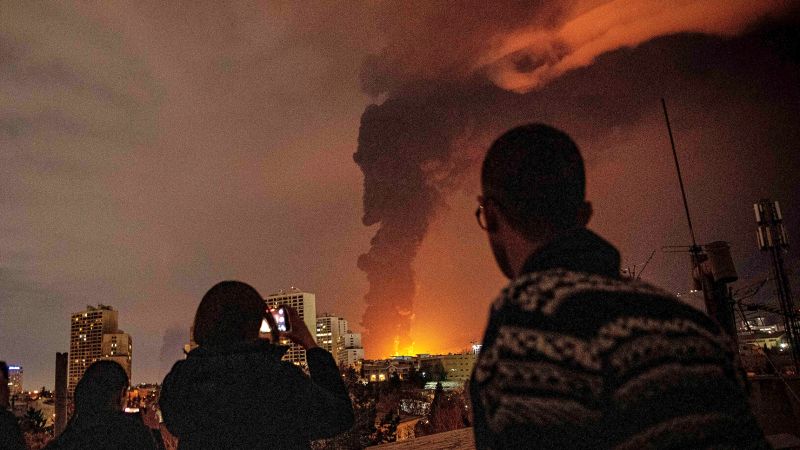
Since the Iran war began, Gulf states have faced a barrage of Iranian missiles and drones, forcing their leaders to make an unenviable choice. You can either anger your closest allies and guarantors of security, or you can anger your powerful neighbors with whom you will have to live next door long after the war is over.
Iran’s Revolutionary Guards acknowledged over the weekend that about 40% of its firepower is directed toward Israel, with much of it targeting its Arab neighbors instead. More than 2,000 projectiles were launched into Gulf countries.
Both sides in the conflict appear to be using Gulf attacks to their advantage. Iran hopes to draw Gulf states away from Washington by attacking them, but the United States and Israel appear to be using Iranian attacks to pressure Arab governments into joining the war.
Kamal Khalazi, Iran’s supreme leader’s main foreign policy adviser, told CNN that airstrikes would continue in a bid to urge Gulf states to persuade US President Donald Trump to withdraw from the conflict.
President Trump told CNN last week that America’s Arab allies being hit by Iran was the “biggest surprise” of the war, adding that the attack prompted Gulf states to “claim their involvement.”
However, Gulf Arab states have repeatedly stated that they have no intention of joining the war.
Republican Sen. Lindsey Graham, a Trump ally, has been the most vocal in urging Arab allies in Washington to join. After his visit to Israel, he questioned why the United States should defend a partner like Saudi Arabia, which refuses to participate in what he calls joint efforts with Iran. If they don’t, he warned, “the consequences will follow.”

Regional leaders have largely avoided publicly responding to these pressures. But Dubai billionaire and businessman Khalaf Al Habtoor offered a glimpse of the Gulf state’s sentiments in response to Graham’s comments.
“I know full well why we are under attack, and I also know who dragged the entire region into this dangerous escalation without consulting those we call our ‘allies’ in the region,” he wrote to X before deleting the post.
Gulf states are highly wary of becoming drawn into a wider war, the long-term effects of which they may ultimately have to deal with alone.
Hasan al-Hasan, a senior fellow on Middle East policy at the International Institute for Strategic Studies, said there is a sense in the Gulf states that by going to war with Iran, the Trump administration prioritized Israel’s security over that of Arab countries.
“That distrust is likely to be an obstacle for Gulf states to engage in offensive action,” he said.
Gulf countries are keenly aware of the difficult position they find themselves in.
“At the end of the day, you are our neighbors,” a UAE official told CNN about Iran. Relations with Iran must eventually normalize, even if it takes decades to rebuild the “huge trust gap,” the official said.
Bader al-Saif, a professor of history at Kuwait University, said American troops would eventually “withdraw en masse” from the Middle East, but Iran would remain a permanent neighbor.
“They left Afghanistan. They left Iraq, and they are leaving our region as well. So we need to take matters into our own hands,” he said.

Small and medium-sized Gulf states may also be waiting to see how Saudi Arabia reacts. Saudi Arabia is a powerful player in the region, and its decisions could determine whether other countries follow suit.
But a conflict could force Riyadh to fight on multiple fronts, including along its southern border with Yemen, where Iranian-backed Houthi rebels have only recently scaled back a years-long offensive on Saudi territory.
Among the Gulf Arab states targeted by Iran, Saudi Arabia is the only one on the Red Sea, providing an export route that bypasses the Strait of Hormuz. But that route is also vulnerable to Iranian proxies. Yemen’s Houthis have previously blocked shipping through the Bab al-Mandab Strait, a choke point linking the Red Sea to global shipping lanes, and could threaten the strait again if the conflict escalates.
Al-Hassan said Gulf states should weigh the risks of joining the war against the costs of withdrawing, warning that failure to act could weaken deterrence and increase the likelihood of future attacks on Iran.
He said opening up airspace and bases could support U.S. operations, but said this was the “least escalatory option.” It could also escalate further by targeting Iran’s missile and drone launch sites, or by directly attacking infrastructure called “refineries for refineries.”
But while the United States and Israel appear focused on destroying Iran’s military capabilities, Gulf governments are likely to intervene with the goal of restoring deterrence and ending the conflict quickly, he said.
Another concern for Gulf states is retaliatory attacks that target critical civilian infrastructure.
Last weekend, Iran’s desalination plant on Qeshm Island was attacked, and Iran retaliated by destroying a desalination plant in Bahrain with a drone.
The incident raised concerns across the Gulf that the war could spread to include the region’s water infrastructure, which relies heavily on desalination.
The desert Gulf state has less than 1% of the world’s population but accounts for about half of its desalination capacity. An Iranian counterattack against water infrastructure could cause significant disruption to supplies in a region that relies almost entirely on desalinated water.
The Jerusalem Post reported on Sunday, citing Israeli officials, that the UAE was responsible for the attack on an Iranian factory, which could be the first attack on Iran during the war.
The UAE’s refusal was swift. Officials said Abu Dhabi’s posture in the war was and would remain purely defensive, while reiterating the country’s right to protect its sovereignty.
Anwar Gargash, an adviser to the UAE president, said Abu Dhabi “will not be drawn into any escalation.”
The Jerusalem Post later reported, citing sources close to the United Arab Emirates, that Israeli officials had accused them of spreading “rumours.”
There are signs that Iranian strategy may be having an impact.
Energy transport through the Strait of Hormuz, the narrow waterway linking the Persian Gulf to global markets, has all but stopped, effectively threatening about a fifth of the world’s oil supply.
The disruption triggered what analysts called the biggest oil shock in history, sending fuel prices soaring in the United States.
Iran’s foreign minister sought to increase pressure on Monday with a direct appeal to American voters.
“Condemn high gas prices, high mortgages, and 401(k) lies to Israel and its suckers in Washington,” Abbas Araghchi wrote for X.

Just days after Iran launched attacks on the Gulf state, Qatar Energy, which accounts for about 20% of the world’s LNG supplies, halted production after attacks on its facilities, and gas prices in Europe soared by nearly 50%.
Qatar’s energy minister has warned that oil prices could rise to around $150 a barrel if the conflict continues to disrupt the Gulf state’s exports.
Meanwhile, just months after President Trump touted trillions of dollars in investment promises from the region as a major economic victory, Gulf Arab officials told CNN that some of Trump’s Gulf Arab states are reconsidering their overseas investments as wars strain their economies.
But even as the conflict shakes up global markets and the Gulf’s economy, local governments remain reluctant to engage in a war they cannot control, wary of becoming embroiled in a conflict where they may have to manage the outcome long after outside forces move in.
“Still, there is a risk of inaction,” Alhassan warned. “How long can the Gulf states sit back and absorb an attack? Doing nothing is not without risks.”
CNN’s Becky Anderson and John Lui contributed reporting.
