

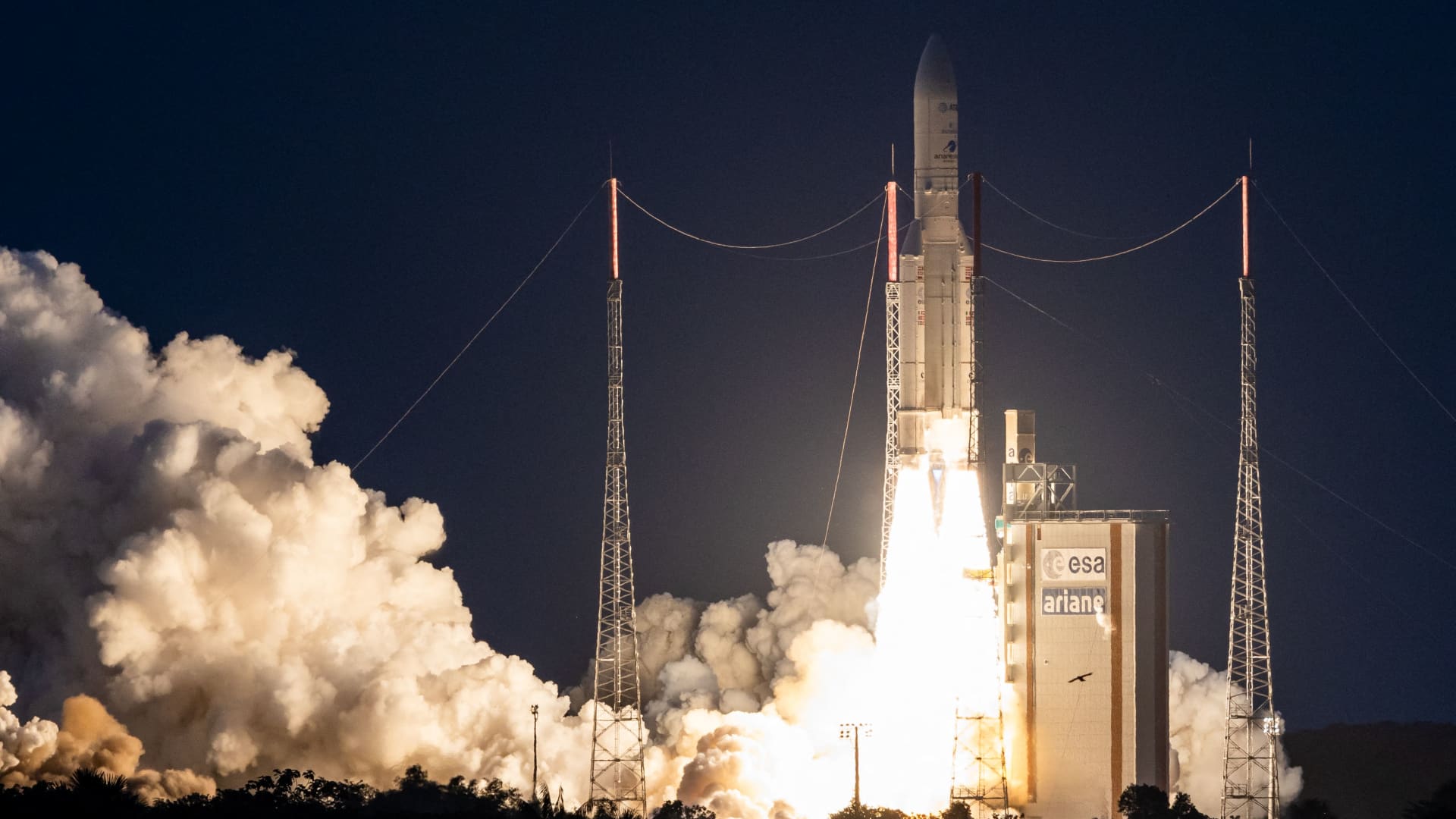
On July 9, 2024, a European Ariane 6 rocket takes off from Kourou, French Guiana. european space agency
ESA | via Reuters
A new layer of critical infrastructure is emerging above our heads.
Low Earth orbit (LEO), defined by NASA as space below 2,000 km altitude, is rapidly evolving from a niche technology area to one of the most strategically important environments of the 21st century.
It underpins global navigation, telecommunications, defense and global connectivity, and is expected to attract a flood of investment.
LEO satellites are relatively close to Earth, resulting in faster response times, lower launch costs, and faster communication speeds. Unlike satellites in higher orbits, satellites do not remain above a fixed point on Earth and often operate in multiple constellations to maximize global coverage.
Higher orbits, such as medium earth orbit (MEO) and geostationary orbit (GEO), have long-established satellite infrastructure but are subject to more stringent operational constraints.
According to Space IQ, a report that tracks startup activity and investment trends in the space economy, investment in the space will exceed $45 billion in 2025, up from just under $25 billion in 2024.
“Access to orbit is becoming a strategic asset, just like ports, cables and energy grids on Earth,” Carlos Moreira, CEO of Swiss cybersecurity and semiconductor company WISeKey, told CNBC.

The most visible example of this change is Elon Musk’s rapidly expanding satellite network. His rocket company SpaceX already operates the Starlink constellation, which currently has more than 9,500 satellites in flight.
The company plans to expand this network by adding thousands more satellites. SpaceX is also proposing an even larger project, a solar-powered orbital data center system that could eventually involve up to a million satellites.
But SpaceX isn’t alone. Technology darling this week only Nvidia announced a new platform aimed at getting AI computing off the ground. The system is designed to support orbital data centers, geospatial intelligence, and autonomous space operations.
“The final frontier, space computing, has arrived,” Nvidia CEO Jensen Huang said at the company’s GTC 2026 conference in San Jose. This approach could turn orbiting data centers into discovery instruments and spacecraft into self-navigation systems, he said.
Amazon LEO (formerly known as Project Kuiper) plans to deploy more than 3,000 satellites into low Earth orbit. Earlier this year, the Federal Communications Commission (FCC) approved an additional 4,500 satellites for future deployment. Meanwhile, Blue Origin, founded by Jeff Bezos, is expected to launch more than 5,000 satellites by the second half of 2027.
In Europe, eutelsatThe OneWeb LEO satellite network currently consists of more than 600 satellites. Although it currently operates on a much smaller scale, France hopes the company will eventually rival Musk’s Starlink and has pledged to invest 1.35 billion euros ($1.58 billion) in Eutelsat, making it the company’s largest shareholder with a roughly 30% stake.
China has also submitted plans for more than 200,000 satellites spread across 14 satellite constellations.
The scale of these planned deployments represents a fundamental change in the way space is used, managed, and commercialized.
A new investment moment
According to Space Capital, more than $400 billion has been invested in the space economy since 2009, with the United States contributing more than half of that, followed by China.
Space Capital CEO Chad Anderson said the industry remains “in the early stages of a multi-decade infrastructure cycle.” He noted that while the field is still in its early stages of evolution, it is mature enough to offer meaningful public market opportunities.
About a dozen space companies have already gone public, and more are expected to go public next year, including the long-awaited SpaceX IPO, which could mark a “Netscape moment” for the space sector, Anderson said. This is a pivotal event that will reshape investor expectations and attract broader capital into the market.
But as momentum builds and commercial activity accelerates, WISeKey’s Moreira warned that this expansion needs to be “managed with the same level of seriousness as digital sovereignty on Earth.”
He argued that space should remain an area that benefits humanity, including supporting connectivity, scientific discovery and economic growth, rather than becoming a place of uncontrolled competition and systemic risk.
regulatory risk
A key challenge for market growth is Leo’s fragmented governance and multi-tiered operating system.
At the international level, the Outer Space Treaty holds states responsible for all space activities conducted under their jurisdiction, while the United Nations Space Debris Reduction Guidelines set out non-binding sustainability principles.
The International Telecommunication Union (ITU) manages global spectrum allocation and helps prevent interference and maintain reliable operation across communications networks. Alongside these formal mechanisms, industry associations such as the Space Safety Coalition are promoting voluntary best practice standards.
State authorities then oversee operations. In the United States, for example, the FCC licenses satellite constellations and spectrum use, and the FAA oversees launch and reentry activities.
However, many experts argue that the existing framework is no longer fit for purpose.
Raza Rizvi, TMT attorney at Simmons & Simmons, says much of today’s legal structure is designed around the more predictable terms of GEO. “We are now entering a riskier and more complex environment for LEO, but there are still no concrete legal tools to manage this new technology.”
Shiamak Hesar, CEO of spaceflight intelligence firm Keihan Space, said current regulations were created for slow-moving, state-run space programs, and “we need to evolve them to match the scale of the industry.”
He said regulation requires a “new perspective” as commercial operators, rather than governments, become the primary users of space.
The shift from state-led to commercially-led activity is also reshaping how industry leaders view future opportunities. Martijn Rogier van Delden, head of European consumer at Amazon LEO, sees a “huge opportunity” for LEO satellites to connect billions of people, calling it a “game changer in bridging the digital divide.”
