

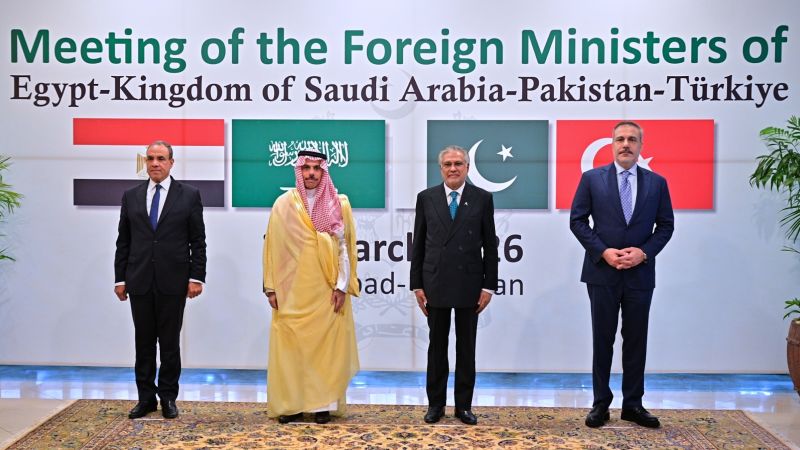
islamabad, pakistan —
In the month since the United States and Israel launched airstrikes against Iran, the rapidly escalating conflict has killed thousands of people and cost economies billions of dollars a day in at least nine countries. The world is facing a global energy crisis.
But the scale of this war could be even worse.
Iran fired a volley of drones and missiles at Saudi Arabia, as well as Gulf Cooperation Council members Kuwait, Bahrain, Qatar, the United Arab Emirates, and Oman.
However, so far none of these countries have retaliated against Tehran.
“Saudi Arabia has been very patient,” said retired Lt. Gen. Muhammad Saeed, former second-ranking officer in the Pakistan Army.
“If Saudi Arabia retaliates militarily, it will not be alone,” Saeed continued. “Then the whole area would be up in flames.”
Saudi Arabia’s direct involvement in the war would have repercussions far beyond the Arab states of the Gulf.

In 2025, Saudi Arabia signed a mutual defense agreement with Pakistan.
During a meeting with the Saudi foreign minister in Islamabad on Sunday, Pakistan’s prime minister thanked his ally for its “remarkable restraint”.
He also assured Saudi diplomats that “Pakistan will always stand shoulder to shoulder with Saudi Arabia.”
This means that if the Islamic Republic of Iran pushes Saudi Arabia too far, it could force its nuclear-armed neighbor Pakistan to come to Riyadh’s defense.
Pakistan’s leadership does not necessarily intend to spoil the fight.
It has been less than a year since arch-rivals India and Pakistan fought a four-day air and missile war. And Pakistan’s military has been engaged in cross-border skirmishes with the Taliban in neighboring Afghanistan for months.
Pakistan has significant incentives to help de-escalate the conflict. And after launching drones and missiles at so many of its neighbors, Iran has few friends left in the region.
“In the strategic environment,[Iran’s]least problematic relationship is with Pakistan,” said Kamran Bokhari, senior resident fellow at the Council on Middle East Policy in Washington.
“There are no other channels.”
It was the recognition that the current conflict would only bring more “death and destruction,” in the words of Pakistan’s Deputy Prime Minister and Foreign Minister Ishaq Dar, that prompted top diplomats from Turkey, Saudi Arabia and Egypt to meet for crisis talks in Pakistan’s capital on Sunday.
After these discussions, Dar claimed that some type of US-Iran peace talks, hosted by Pakistan, were on the table.
“Both Iran and the United States have expressed confidence that Pakistan will facilitate talks,” Dar said, adding that such talks could be possible “within days.”
In his statement Sunday, Dar also referred to his recent telephone conversation with Chinese Foreign Minister Wang Yi.
“China fully supports Pakistan’s efforts to host Iran-US talks,” Dar said.
A Pakistani diplomat is scheduled to fly to China for talks on Tuesday despite sustaining a hairline fracture in his shoulder after falling during talks with an Egyptian delegation.

However, Pakistan’s crisis diplomacy faces even more serious challenges.
Last weekend, Yemen’s Iranian-backed Houthis joined the fight, firing missiles for the first time in hostilities against Israel, further escalating the regional war.
Meanwhile, the United States has sent thousands of troops to the Middle East, raising fears of a possible ground operation against Iran.
There are also voices within Iran vowing to continue the fighting for a long time.
“This is our war, and we will not stop defending until we teach Mr. Trump and Mr. Netanyahu a historical lesson,” a senior Iranian security official told CNN’s Fred Preitgen.
Iranian Foreign Ministry Spokesman Esmail Baghai said on Monday that Iran had not taken part in recent meetings with regional countries hosted by Pakistan, saying the meetings were in the form of a framework to which Iran had not agreed.
“Meetings that Pakistan holds with neighboring countries are conducted within a framework of its own design and we are not a part of this framework,” he said.
The spokesperson said the United States has communicated requests for negotiations and proposals through intermediaries, including Pakistan, but that Iran’s current priority is to protect itself from ongoing attacks. “In the current climate of intense U.S. military aggression and aggression, it is true that all of our efforts and all of our capabilities are being focused on defending ourselves,” the spokesperson said.
The situation is incredibly fluid and dangerous. The Trump administration and the Islamic Republic of Iran are both declaring victory while simultaneously firing massive amounts of deadly weapons at each other.
But even the warring parties to this conflict have shown momentary restraint.
The risk of further escalation of this war is very real.
