

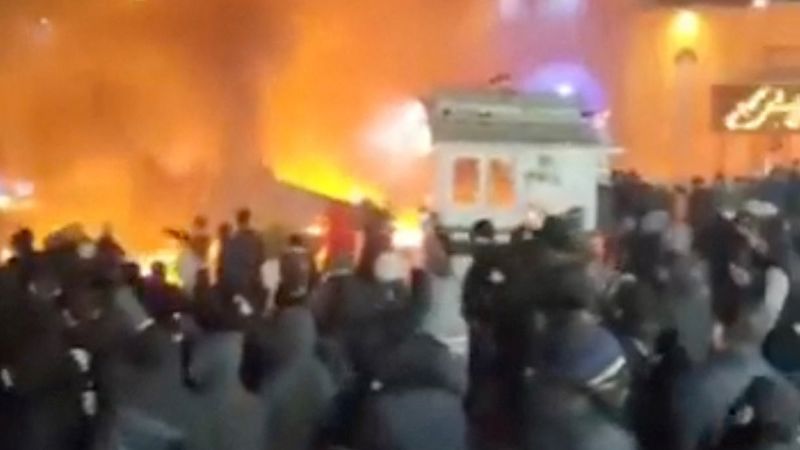
Anti-government protests in Iran erupted for the 13th straight day on Friday, in a nationwide wave of unrest that represents the biggest challenge to the regime in years.
Authorities cut internet access and phone lines on Thursday – the biggest night of nationwide demonstrations so far, leaving Iran largely cut off from the outside world. Human rights groups said dozens of people have been killed since the protests began.
US President Donald Trump has threatened to attack Iran if security forces respond with force. Supreme Leader Ali Khamenei urged President Trump to “focus on his country” and accused the United States of inciting the protests.
As public anger grows and demonstrations continue, here’s what you need to know.

The protests began as demonstrations in Tehran’s bazaars against rampant inflation, but have spread across the country and turned into more general protests against the regime.
Concerns about inflation surfaced last week as prices for essential goods such as cooking oil and chicken rose dramatically overnight, with some items disappearing from shelves en masse.
Further exacerbating the situation was the central bank’s decision to end a program that allowed some importers to take advantage of cheaper US dollars compared to other markets. This prompted shop owners to raise prices, some to close their doors, and to start demonstrations.
As it is known, this move by Bazaar is a drastic step for groups that have traditionally supported the Islamic Republic.
The reformist-run government tried to ease the pressure with direct cash transfers of nearly $7 a month, but the measures did not quell the unrest.
The protests are the largest since 2022, when the death of 22-year-old Martha Amini in religious police custody sparked widespread protests calling for “women, life and freedom.”
People in more than 100 cities have taken part in the demonstrations, which began nearly two weeks ago.
Protests have spread to western Iranian provinces, including the Kurdish-majority Iram and Lorestan provinces that border Iraq, both of which have emerged as battlegrounds for defiance. Stirring ethnic divisions and poverty, crowds set fires in the streets and chanted “death to Khamenei,” directly challenging Khamenei, who has ultimate authority over the country’s religion and state affairs.
Iran’s state-run Fars news agency said 950 police and 60 members of the Basij militia were injured in the protests, most of them in clashes with “insurgents” from the west “equipped with firearms, grenades and weapons.”
The Norway-based Iranian Human Rights NGO (IHRNGO) reported on Thursday that at least 45 protesters, including eight children, have been killed since the demonstrations began. Hundreds more were injured and more than 2,000 were arrested. CNN cannot independently confirm the number of people killed and arrested, and Iranian state news outlets sometimes report individual deaths without reporting a comprehensive tally.

It is noteworthy that the recent protests began in the bazaar, a powerful force for changing Iranian history and one that is seen as loyal to the regime.
The enduring alliance between the bazaar and the clergy in Iran meant that shopkeepers played an important role as kingmakers throughout Iranian history. It was precisely their support for the clergy that ultimately helped the Islamic revolution of 1979 succeed, giving the rebels an economic backbone that led to the overthrow of the shah, or monarch.
“For more than 100 years of Iranian history, the bazaar has been a key actor in every major political movement in Iran. … Many observers believe that the bazaar is some of the most loyal people to the Islamic Republic,” Alan Keshavarjian, associate professor of Middle Eastern and Islamic studies at New York University and author of “Iran’s Bazaar and the State,” told CNN.
Since then, their role as a major political force has become more symbolic, but the impact of exchange rate fluctuations on their business led them to stage what turned out to be deadly protests.

Authorities have also sought to distinguish between economic protesters and those seeking regime change, labeling the latter as “insurgents” or foreign-backed “mercenaries” and pledging to step up crackdowns on them.
Two experts who spoke to CNN said the protests could lead to big changes.
“Regardless of the outcome, these protests are sure to further undermine the legitimacy of an already fractured state, and I think we are nearing the end,” Sanam Vakir, head of the Middle East and North Africa program at Chatham House, told CNN’s Eleni Dziokos.
Dina Esfandiary, head of the Middle East at Bloomberg Economics, said the latest round of protests feels different from previous ones due to Iranians’ frustration and fatigue.
“We’ve reached a boiling point,” Esfandiari said. “I predict that the Islamic Republic that we are witnessing today will not be possible in 2027. I really think there will be some change.”
Who is running Iran? What does it mean for the Iranian regime?
Iran has been a theocracy since 1979, when clerics allied with Western powers overthrew a secular monarch, leading to the establishment of the Islamic Republic led by Ayatollah Khomeni.
Massoud Pezeshkian was elected president in 2024 and has pushed for a more pragmatic foreign policy, but his powers are limited and Khamenei remains in control of all major state affairs.
“The government should not expect to be able to deal with all of this on its own,” Pezeshkian said in a televised address on Monday.
Mr. Pezeshkian has previously cast himself as a champion of the working class, pledging economic relief through reduced government intervention in currency markets, while criticizing U.S. sanctions, corruption and excessive money printing.

But corruption across all branches of government, mismanagement of funds, converging environmental issues and stagnant leadership are pushing the government to the brink.
More than a year after his election, the very working class he swore to protect and the middle class, which forms the backbone of Iranian society, are struggling.
External factors, such as crippling sanctions and the possibility of new wars with the United States and Israel, have made the nation paranoid and its citizens anxious.
On Friday, state media Tasnim reported that the Islamic Revolutionary Guard Corps issued a statement warning that preserving the government was their “red line not to be crossed” and that they reserved the right to “retaliate.”
Reza Pahlavi, the late shah’s exiled son, has positioned himself as a viable alternative to the ruling regime, declaring support for the protests and directly calling for concerted action nationwide.
On Tuesday, President Pahlavi called on Iranians to chant in unison.
At least some demonstrators appeared to heed his call. One of the slogans shouted by demonstrators on Thursday was “This is the last fight, Pahlavi will return,” according to a video seen by CNN.
Although voices of support for the monarchy can be heard in videos of the demonstrations, it remains unclear how much support the monarchists have in the country as a whole.
“None of Iran’s political leaders has a blueprint for getting Iran out of this crisis,” Keshavarzian told CNN.
“The only real tools left for the Islamic Republic are coercion and force. People have tried different methods to get their point across,” he added. “But over the past 15 years, a large part of the population has lost trust in the government.”
What did President Trump and Ayatollah Khamenei say?
President Trump has repeatedly warned Tehran of serious consequences if protesters are killed.
“I told them that if they start killing people, which they tend to do in riots, we’re going to attack them very hard,” Trump told conservative radio host Hugh Hewitt on Thursday.
The next day, in a meeting with oil executives, President Trump reiterated that Iranian authorities “better not start shooting because we’re going to start shooting too,” but said the United States had no intention of “putting boots on the ground.”
Just six months ago, Israel and the United States launched their first attack on Iran, and President Trump raised the possibility of another attack last week, days after speaking with Israeli Prime Minister Benjamin Netanyahu.
In a televised address, Khamenei’s first public comments since the demonstrations began, he called on President Trump to “focus on his country’s problems.”
“There are some agitators who want to please the American president by destroying public property. A united Iranian people will defeat all enemies.”
Khamenei added: “The Islamic Republic will not back down in the face of those who seek to destroy us.”
