

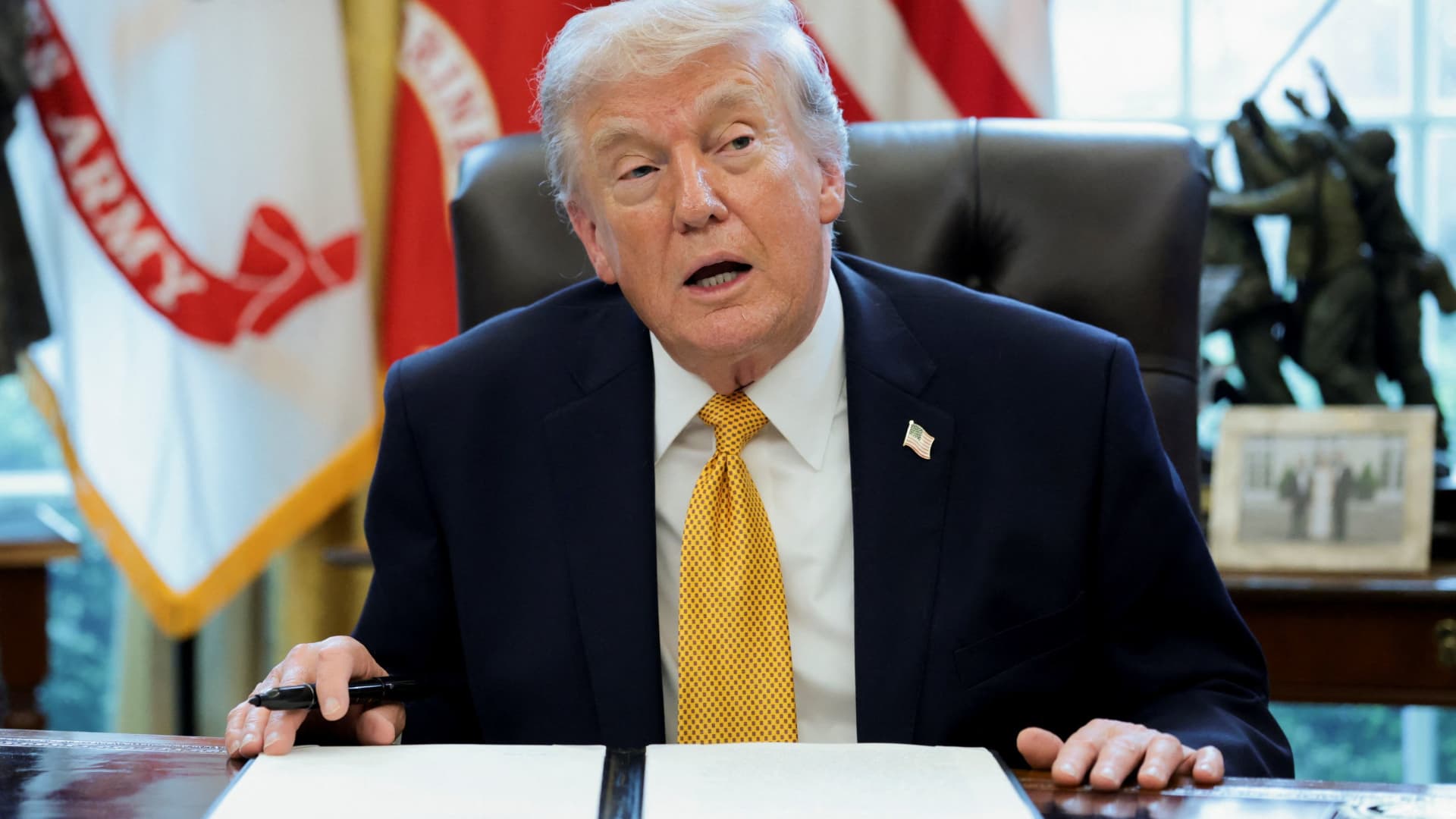
U.S. President Donald Trump speaks during an event to sign an executive order creating the Task Force on Fraud, headed by Vice President J.D. Vance, in the Oval Office of the White House on March 16, 2026, in Washington, DC.
Jonathan Ernst | Reuters
The SAVE America Act is a top priority for President Donald Trump, and he’s mentioned it at every opportunity, from appearances before reporters in the Oval Office, at campaign-style rallies in rooms full of supporters, to musings on his Truth Social platform.
The Senate is expected to begin a marathon debate this week on an election bill that would require proof of U.S. citizenship to register to vote and a photo ID to vote.
Trump, Republican hardliners and conservative influencers like Elon Musk have argued that the Senate must pass the bill that the House passed in February. Democrats strongly oppose the bill, and voting rights groups warn it could disenfranchise millions of people.
Below, we detail what the bill is about, who it could affect, and why it has been the subject of so much debate.
Who is opposed to the bill and why?
Most Democrats and voting rights groups have warned that the bill could disenfranchise millions of voters by imposing citizenship and photo ID requirements.
According to the Brennan Center for Justice and the Center for Democracy and Civic Engagement at the University of Maryland, approximately 21 million Americans do not have readily available documentation of citizenship, and 2.6 million Americans do not have any type of government-issued photo ID. Low-income and minority voters are more likely to lack the documentation required by the SAVE America Act, and people who change their last names (primarily married women) will also face additional barriers to registration.
Democrats also warned that the SAVE America Act is part of President Trump’s broader attempt to change the outcome of the 2026 midterm elections, which will determine control of the House and Senate and set the tone for Trump’s final two years in office.
Why is President Trump focused on the SAVE America Act?
Mr. Trump has for years warned of the threat of a non-referendum vote and claimed without evidence that U.S. elections are unsafe. He has doubled down on those claims in recent months in the run-up to the 2026 midterm elections, warning that he would be impeached a third time if Democrats retake the House and Senate. In recent months, President Trump has advocated nationalizing elections, enacted voter ID laws and threatened to ban mail-in voting by executive order.
“The Save America Act is one of the most important and consequential pieces of legislation in the history of Congress and America itself. No more election fraud! No voter ID, no citizenship, no fraudulent mail-in voting (we’re the only country in the world that allows this!),” the president said in a post on Truth Social on Tuesday.
Is our country the only country in the world that allows mail-in voting?
Do voters already have to show identification or register to vote?
Laws vary by state. According to the National Conference of State Legislatures, 36 states have laws requiring or requiring voters to show some form of identification to vote. Ten of these countries have strict photo ID laws.
Fourteen states and Washington, D.C., do not require ID to vote and instead verify a voter’s identity using other information, such as a signature that is checked against a database.
Registration rules also vary by state, but a 2002 federal law requires voters who are voting by mail for the first time and have not provided identification to register before voting. Valid documents include photo ID, bank statements, utility bills, and payroll checks. Most states require voters to prove they are U.S. citizens before they can register to vote.
It is already illegal for noncitizens to vote in federal elections.
Have there been any initiatives like this in the past?
There have been numerous attempts to enact federal voter ID laws, some of which gained traction in Congress.
One such proposal, led by Representative Henry Hyde, Republican of Illinois, passed the House in 2006. The bill would have established voter ID requirements for elections in 2008 and required photo ID to prove citizenship by 2010. It would also have required states to set up programs to distribute IDs to voters, sometimes free of charge. The bill was never voted on in the Senate.
Democratic opposition to these efforts also goes back decades. In 2005, then-Illinois Senator Barack Obama introduced a resolution expressing Congress’ sense that voter ID requirements should be rejected.
More recently, a slightly stripped-down version of the SAVE America Act (simply known as the SAVE Act) passed the House last year. The SAVE Act contained the same non-referendum provisions as the SAVE America Act, but did not include language mandating photo ID at polling places.
Are there many fraudulent votes?
Voting rights groups generally agree that voter fraud is extremely rare.
After losing the 2020 election in Georgia, President Trump claimed that thousands of dead people voted. A report commissioned by the president found the evidence weak. A voter fraud database compiled by the conservative Heritage Foundation lists 1,620 cases of documented fraud dating back to 1982, a fraction of the total number of votes cast over a period of more than 40 years.
A voter fills out a ballot at an El Dorado County polling place during the California special election under Proposition 50, a bill that temporarily redraws congressional districts, on November 4, 2025 in El Dorado Hills, California, United States.
Fred Greavesreuter
Will people who are registered to vote be removed from the voter list?
The bill would require states to verify citizenship status, in some cases by sharing voter rolls with the Department of Homeland Security, which would cross-reference the lists with its internal citizenship database. Registered voters who are flagged must prove their citizenship or face removal from the voter rolls.
What documents will prove citizenship?
Real ID showing proof of citizenship is accepted under the SAVE America Act. This includes a U.S. passport, birth certificate, military or tribal ID. A recent analysis by the Bipartisan Policy Center found that about 12% of registered voters do not have ready access to the necessary documents. BPC research shows that people with higher incomes and higher levels of education are more likely than other Americans to have access to such documents.
If passed, when will these changes become effective?
The provisions of this bill will become effective upon passage. Some state election officials have warned that if the bill is passed before the November midterm elections, it could be difficult to implement these changes during an election year.
The California Attorney General’s Office said in a February statement that the measure “requires states to fundamentally restructure their voter registration processes” by creating a new system for document verification and criminalizing errors by election officials with up to five years in prison.
