

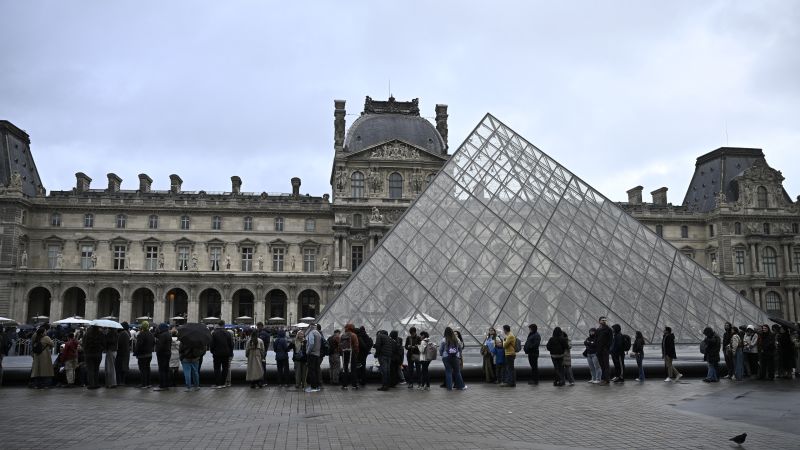
Paris’s Louvre museum said it would remain closed Monday as investigations into Sunday’s unusual theft of historic jewelry continued, but experts said the chances of recovering the treasure were slim.
In a post to
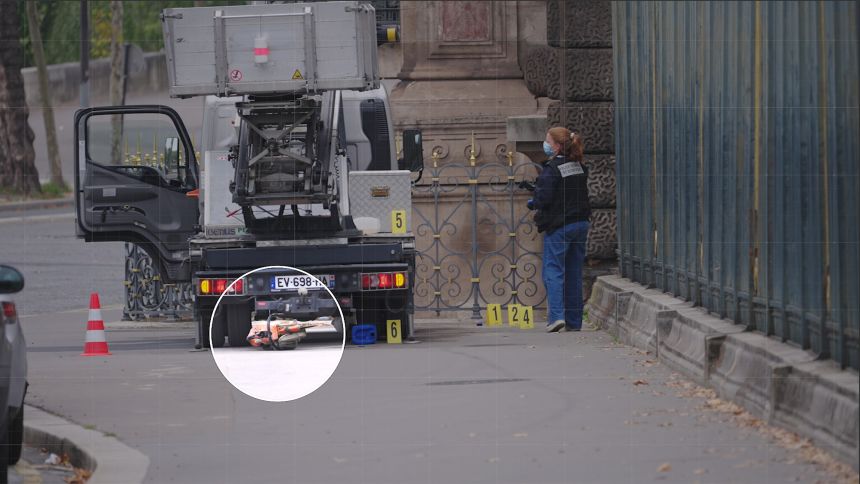
The thieves used a ladder attached to a truck to enter the Apollo Museum, one of the Louvre’s most ornate rooms, through a window.
Armed with tools including angle grinders and blowtorches, they targeted two high-security display cases.
Paris prosecutors said it took four minutes for the robbers to break into the gallery, take the jewelry and leave.
“At 9:34 a.m., 30 minutes after the doors opened, two men wearing yellow vests broke a window,” the prosecutor’s office said in a statement Monday. The robbers “left at 9:38 a.m.” and left “along the banks of the Seine” on two scooters.
Officials said the entire operation lasted just seven minutes.
Among the items taken from the Louvre were diamond and sapphire jewelry sets, including tiaras and necklaces worn by Queen Marie-Amélie and Queen Hortense.
The Diadem, a jeweled headdress worn by royalty, is set with 24 Ceylon sapphires and 1,083 diamonds and can be removed and worn as a brooch, according to the Louvre.
Also stolen was an emerald necklace and earring set given by Napoleon as a wedding gift to his second wife Marie Louise of Austria in March 1810, containing 32 intricately cut emeralds and 1,138 diamonds.
Eight of the nine items taken are still missing.
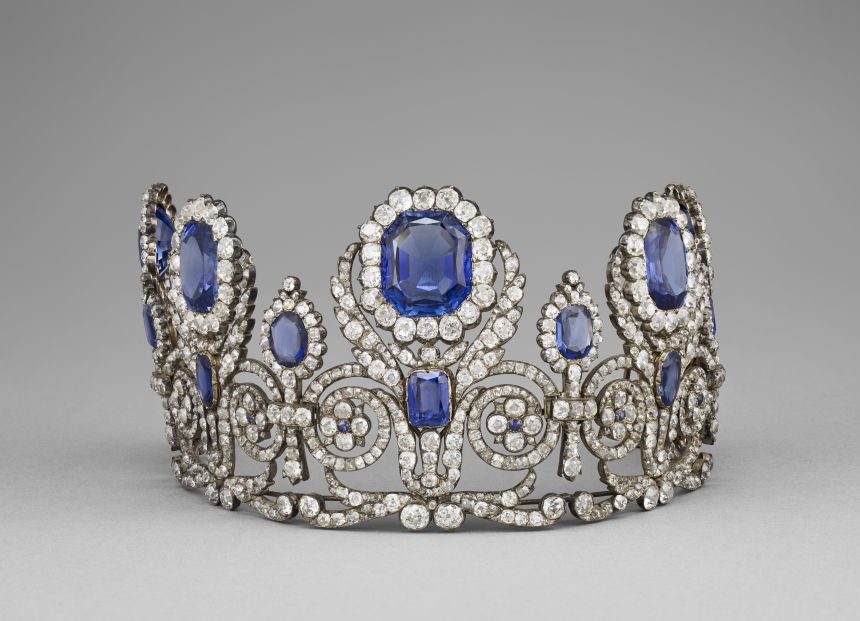
Jewels stolen from the Louvre
France’s Justice Minister Gerald Darmanin acknowledged that the Louvre robbery had exposed lapses in the museum’s security.
“There are questions, for example, about the fact that the windows were not closed and the fact that the basket lift was on a public road,” he told France Inter radio. “What is certain is that we failed.”
“All French people feel like they’ve been robbed,” he added.
Elaine Sciolino, author of “The Louvre Adventure: How to Fall in Love with the World’s Largest Museum,” highlighted the significance of the robbery at the Louvre, which was built as a fortress before becoming a palace for the French royal family.
“This attack is truly a dagger into the heart of France and French history,” she said.
Nathalie Goulet, a centrist member of France’s Senate, told CNN on Monday that she believed the jewelry had probably already been taken out of the country.
“I think the work is already overseas,” she said. “I think it’s lost forever.”
Mr Goulet also appeared on BBC Radio and said “no” when asked whether the jewelery would ever be recovered.
“The jewelry will be cut up and sold and used as a money laundering system,” she said. “That’s the easiest way to clean dirty money.”
Goulet said the robbery was likely connected to organized crime.
“They have no morals at all,” she said. “They value jewelry not as a piece of history, but as a way to clean dirty money.”
Goulet added that he was “very pessimistic” about the prospects for recovering the jewels.
The author, Sciolino, was similarly depressed.
“You can dismantle it, you can mutilate it, you can sell it on the black market,” she told BBC radio. “It is unlikely that everyone will recover to what they are now.”
Christopher Marinello, founder of Art Recovery International, said if thieves were simply trying to get cash as quickly as possible, they might melt down precious metals or recut stones without considering the integrity of the piece.
“We need to dismantle the gangs and find a different approach, or we will lose something we will never see again,” Marinello told CNN.
The most famous robbery at the Louvre took place in August 1911, when Leonardo da Vinci’s Mona Lisa was stolen from the museum wall by handyman Vincenzo Perugia.
It took 24 hours for anyone to notice that the Mona Lisa was missing, and the work was frequently removed for photos and cleaning.
After a failed police investigation, the painting lasted two years until its recovery in December 1913, making it the most famous work of art in the world.
More recently, a work by French painter Camille Corot was stolen from its frame in 1998 and has never been recovered.
Recent robberies at other European museums include the theft of four ancient gold artifacts from a Dutch museum in January.
The robbers used explosives to break into the Dolenz Museum in Assen and stole three gold bracelets dating from around 50 BC and a gold Helmet of Cotofenesti from the 5th century BC, a historically important artifact on loan from the Romanian National History Museum in Bucharest.
Correction: This article has been updated to reflect a theft at the Louvre in 1998.
