

Khirbet Humsa, West Bank
—
Last weekend, dozens of masked Israeli settlers broke into the small village of Qusay Abu al-Kebash in the middle of the night.
They grabbed Abu al-Kebash, bound his hands and feet, and stripped him naked. They then tied his genitals with zip ties and marched him through the area while beating him.
Israeli settlers have increased violence against Palestinians in the occupied West Bank in an effort to force them from their homes. However, sexual assault appears to be a new weapon in these settlers’ intimidation arsenals, representing an alarming new level of violence.
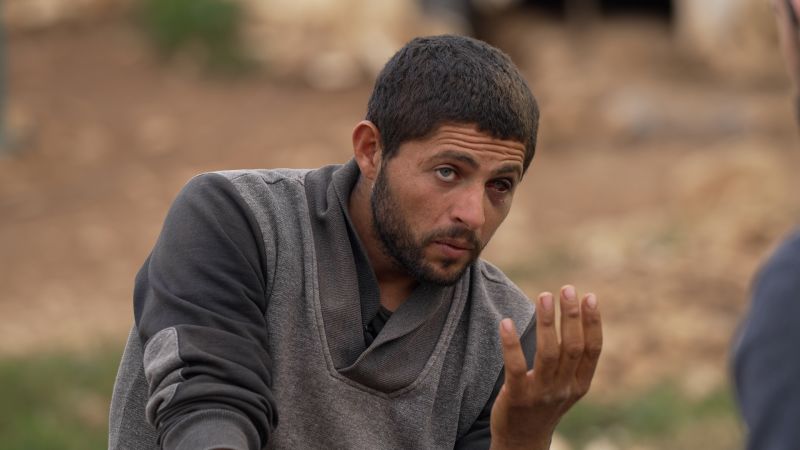
“They cut off my belt with a knife and cut off my boxer shorts. They tied my penis with a zip tie, tightened it, and then dragged me around the village,” Abu al-Kebash told CNN in front of the cameras for the first time.
“It was very, very painful. … I thought I was going to be killed.”

The 29-year-old continued: “I felt humiliated and insulted. Why would they do that to us? Why would they chain people like that?”
Several of Abu al-Kebash’s family members who were present corroborated his account. So did two foreign activists, volunteers with the International Solidarity Movement, who told CNN they witnessed Abu al-Kebash being sexually assaulted.
Israeli authorities said they were investigating the alleged assault on hundreds of Abu al-Kebash sheep and theft by settlers, and told CNN on Thursday that “seven suspects were arrested a few days ago for their alleged involvement in the incident.” Police also said they were under a “court-issued gag order” as part of the investigation.
“The investigation is ongoing, led by the Israeli Police and in cooperation with the security forces,” the Israeli police said in a statement. “The Israeli Police strongly condemn the violence and crime and will continue to work to ensure the safety of the population and maintain public order in the area.”
Israeli police are investigating suspicions of sexual assault, particularly aggravated indecent assault using force or threat, as well as assault on a helpless person and racially motivated crimes, according to a police report obtained by CNN.
Al-Kebash said police and investigators from the Shin Bet Internal Security Agency visited the village a few days after the incident and went to the police station to give statements.
Abu al-Kebash said he has not been able to sleep since then. There was a wound on his left eye, and it was bleeding.
“I’m worried they’ll come back. I’m worried they’ll kill us in the middle of the night or burn our village down like they said.” he said.
He told CNN that settlers had previously tried to intimidate Abu al-Kebash and his family, but nothing like this had happened.
He said his wife, cousin and father were also tied up with zip ties and beaten that same night. Abu al-Kebash and his relatives said the settlers poured water and dirt on the women and threatened to rape them. It is said that the settlers sometimes beat the children.
He and six of his relatives were hospitalized, they detailed to CNN, showing medical reports. Abu al-Kebash said the settlers stole everyone’s mobile phones, then destroyed the village’s surveillance cameras and cut off the power. He said he believed it was to prevent the assault from being recorded.
Two foreign anti-occupation activists who spoke to CNN on condition of anonymity for fear of retaliation said they too had been detained and threatened.
Both activists told CNN they were in Abu al-Kebash’s tent when he was beaten and sexually assaulted. Activists said the settlers first tied them up before turning their attention to Abu al-Kebash.
One activist, a 24-year-old American, said the settlers, who were “armed with clubs and knives on their belts,” tackled them to the ground, ransacked their bags and stole their cell phones, wallets, rings and passports.
Describing the assault on Abu al-Kebash, she said that after tying his genitals with zip ties, the settlers began “brutally beating him with sticks.”
“He was lying in a fetal position and all he could do was scream and flinch while they were beating him… it was really horrible,” she said.
The second activist, a 25-year-old Portuguese woman, said she was on the floor when the settlers pulled down Abu al-Kebash’s pants and forced her to watch the assault.
Before the start, the Portuguese activist said he asked the settlers what they wanted and one replied, “I want to kill you.”
“Honestly, I thought I was going to die,” she said.


The American activist told CNN that the settlers dragged her by her hair and tore out large chunks. When they poured water on him, the American said he feared it would burn them all to death because it was gasoline.
“One of them started messing with my belt and I started screaming. I thought they were going to rape us, especially after what I witnessed them doing to me,” she said.
The shepherd said he hopes police will bring the perpetrators to justice and give him back the sheep that are his livelihood.
However, Palestinians have largely lost confidence in Israeli investigations into settler violence, which rarely result in convictions or even arrests. Instead, Palestinians and anti-occupation activists describe a culture of impunity that pervades Israeli settler communities, with Israeli soldiers sometimes standing by as settlers threaten, harass, and even attack Palestinians.
Since 2023, Israel has significantly escalated its military activities in the occupied West Bank, as Prime Minister Benjamin Netanyahu’s right-wing government seeks to expand Jewish settlements and strengthen Israel’s control over the land in order to prevent the establishment of a Palestinian state.
Israeli settlements in the West Bank are considered illegal under international law.
Israeli settlers have also stepped up attacks on Palestinians and their property, which is an almost daily occurrence. Violence is on the rise again during the war with Iran. According to the Palestinian Ministry of Health, nine Palestinians have been killed by Israeli soldiers or settlers in the West Bank and East Jerusalem since the war began. Israeli human rights group B’Tselem accused Israel of using “a cover for war with Iran” to further accelerate what it called “ethnic cleansing” of the West Bank.
Abu al-Kebash said his family had been displaced by Israeli government sabotage in the past and was now under threat of displacement by settlers.
“We hope they don’t succeed. We remain resolute here. We have no other place. This is our home. We have lived here for a long time,” he said.

The American activist, who was on his first volunteer trip to the West Bank, said the experience showed him “the depth of the systematic violence of the Israeli occupation.”
“When it really started and it became clear that there was no one left to protect our family… all we could do was pray that the sun would rise and it would mean some kind of respite,” she said.
Despite the risks, Abu al-Kebash said he felt it was important to share his story.
“I’m sharing my whole story so that people can see it and the world can know what’s going on. We didn’t do anything to them and they came and beat us and did this to us,” Shepherd said. “That’s why I have the courage to speak out.”
This story has been updated with additional developments.
