

The Trump administration touted last year’s bombing of Iran’s nuclear facilities as a major military success.
U.S. Air Force B-2 bombers dropped 14 of the world’s largest bombs, striking two Iranian nuclear facilities without causing any American casualties or loss of aircraft, including dozens of fighters, tankers, and support planes that contributed to the mission.
Now, President Donald Trump is threatening to attack Iran again, this time in solidarity with the hundreds of thousands of ordinary Iranians who have taken to the streets to oppose the hardline regime in Tehran.
But analysts say a new U.S. attack on the Islamic Republic is unlikely to mirror the one-off strike that struck three nuclear targets last summer.
Attacks in support of protesters will need to focus on various command centers and other targets associated with Iran’s Islamic Revolutionary Guards Corps (IRGC), its Basij forces, and Iranian police, the main organizations carrying out the bloody crackdown on the opposition.
But these command centers are located in densely populated areas, analysts say, meaning there is a significant risk that the very civilians Trump is trying to help would be killed in a U.S. raid.
And the killing of civilians could backfire, nullifying what the US is trying to accomplish and giving the Iranian regime both a propaganda victory and a rallying cry, especially for a population that may want reform but also doesn’t want to be bombed by the US again.
“Whatever[the United States]does, it has to be very precise with no casualties other than the Revolutionary Guards,” said Carl Schuster, a former U.S. Navy captain and Hawaii-based analyst.
Schuster said attacks that harmed civilians, “even inadvertently,” risk “alienating the opposition, which is united only by hatred of the regime. With our losses, we become a foreign force seeking to suppress and control Iran, rather than a liberating influence.”
Peter Leighton, a visiting fellow at the Griffith Asia Institute in Australia, issued similar warnings about the potential for civilian casualties, but said the U.S. government had a variety of goals.
First, Iran’s top leadership may be vulnerable, most likely indirectly because Iran is learning from Israeli attacks that targeted and killed Iranian military officials and nuclear scientists last year, Layton said.

Schuster agreed.
Iranian leaders “have recognized the need to disperse and hide what is important to Iran. We have shown that we can attack what we can find,” Schuster said.
Still, Leighton said attacking the homes and offices of regime leaders would get the message across.
“The military value is small, but doing something for the protesters is just theater,” he said.
Analysts said the US government could also hit Iranian leaders’ wallets.
“The leadership and the Revolutionary Guards have various commercial and money-making enterprises across the country. They attack specific facilities that are economically important to individuals and their families,” Leighton said.

He cited Australian government estimates that between one-third and two-thirds of Iran’s gross domestic product is controlled by the Revolutionary Guards, and said there were a lot of them.
Layton added that “weak spots” could be found in the list of IRGC companies.
Schuster noted that there is some distance between the Revolutionary Guards and Iran’s supreme leadership.
“The aim is to make the Revolutionary Guards leadership and the general public worry more about their own survival than about the regime,” he said, adding: “The Revolutionary Guards themselves have never had suicidal thoughts.”
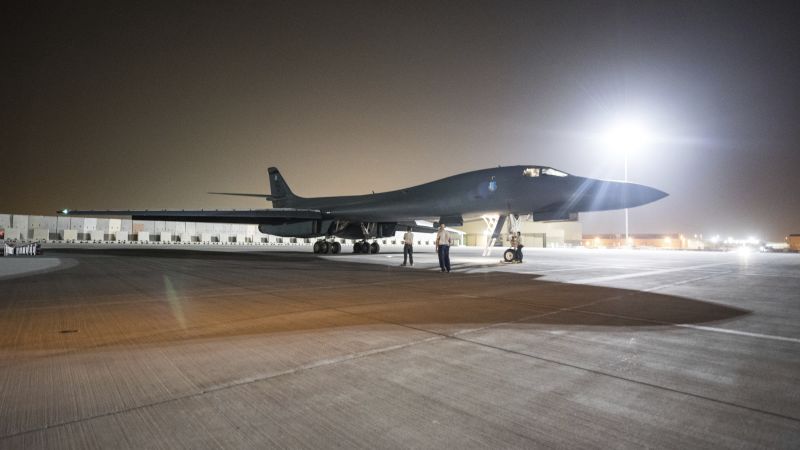
B-2 bombers were the last resort for U.S. attacks on nuclear facilities last summer, but analysts said the variety of targets now set could suit other U.S. assets.
“Interior Guard headquarters and bases in the region could be attacked by (Tomahawk) cruise missiles,” Schuster said.

The highly accurate Tomahawk can be launched from U.S. Navy submarines and surface ships off the Iranian coast, minimizing the risk of U.S. military casualties.
Another cruise missile option is the Joint Air-to-Surface Standoff Missile (JASSM). Carrying a 1,000-pound penetrating warhead and a maximum range of 620 miles (1,000 kilometers), JASSM can also be launched from the Iranian coast from a range of U.S. Air Force jets, including F-15, F-16, and F-35 fighters, B-1, B-2, and B-52 bombers, and U.S. Navy F/A-18 fighters.

Analysts said drones could also be used.
“It is unlikely that manned aircraft would drop short-range weapons or free-fall bombs because they would likely be assessed as too dangerous,” Leighton said.
The United States typically has aircraft carriers in the Middle East, but as of Monday the closest plains carrier, the USS Abraham Lincoln, was thousands of miles away in the South China Sea.
Aircraft carriers travel with clusters of ships that can also carry missiles and other operational support. In the fall, the Trump administration moved a group of aircraft carriers, along with numerous other ships, aircraft and thousands of troops, to the Caribbean Sea as part of a pressure campaign against Venezuela’s leadership. As some of these assets begin to flow out of the region, the options available to military planners for immediate action against Iran are diminishing.
This means that the impending airstrikes will be carried out from various air bases in the Persian Gulf region or even further afield.
In last summer’s B-2 attack, the stealth bomber flew nonstop from a base in Missouri to Iran, refueling mid-air. All of the US Air Force jets listed above can refuel in mid-air.
Analysts said watching the movements of tanker planes could be one sign of impending U.S. action, as well as whether attack aircraft like B-1 bombers or F-15 Strike Eagles approach Iran.
Whatever method the Trump administration chooses to attack Iran this time, it will be “drastic,” Leighton said.
“The administration is interested in theater, which means dramatic, media-attracting, high-profile events,” he said.
And he said he expected a swift attack, similar to the one-off attack on a nuclear facility last year.
“The regime prefers short-duration raids that pose minimal risk to the U.S. forces involved.”
Leighton said one way to do that could be to attack oil facilities in the Persian Gulf.
“It’s the easiest and safest goal setting,” he says.
“It will cause economic damage to Iran in the medium to long term. There will also be drama amidst a lot of smoke and it will be easier for outside media to report on it,” Leighton said.
