

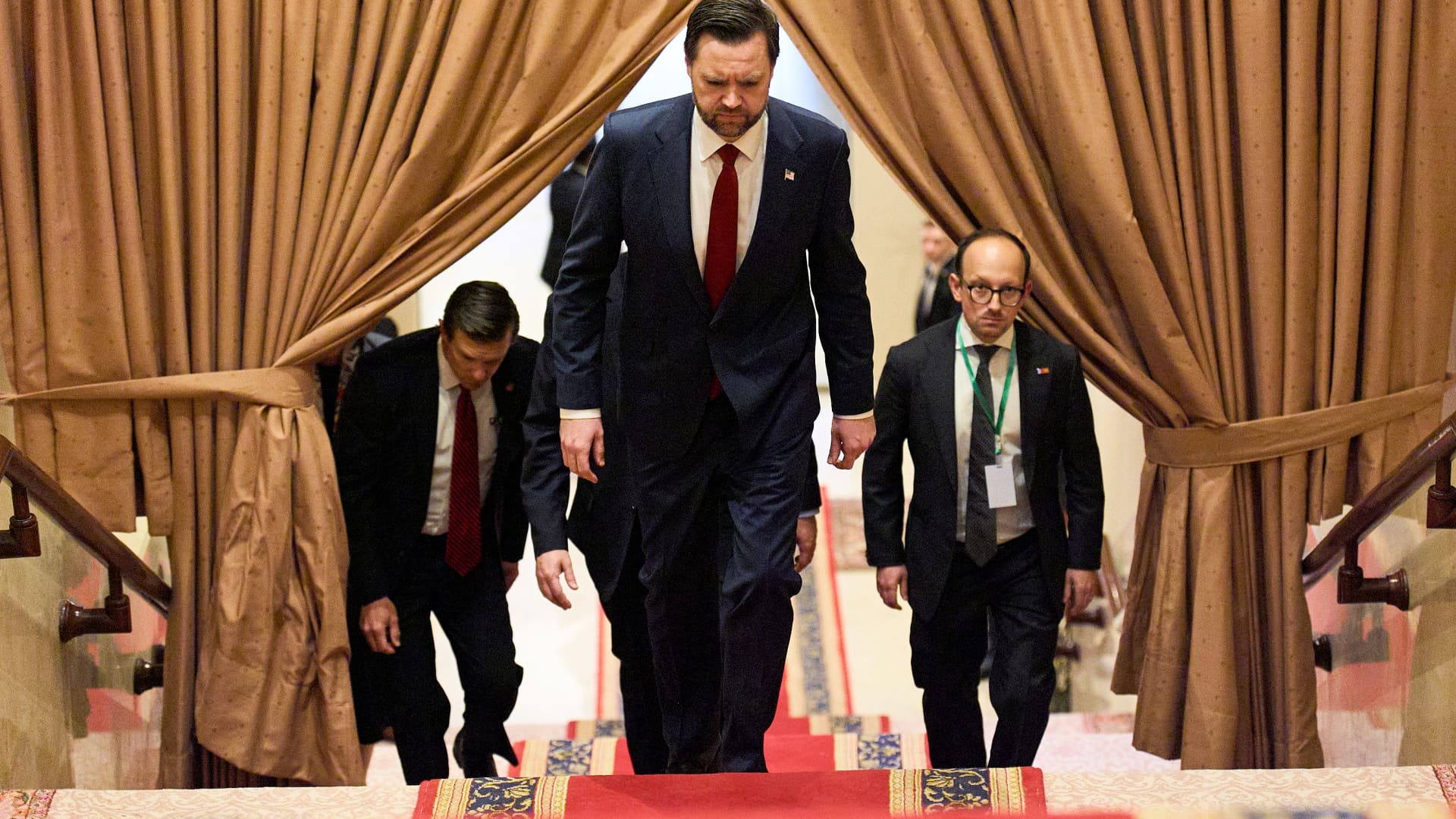
ISLAMABAD, PAKISTAN – APRIL 11: US Vice President J.D. Vance (centre) walks with Pakistan’s Chief of Defense Forces and Chief of Army Staff Field Marshal Asim Munir (left), Pakistan’s Deputy Prime Minister and Foreign Minister Mohammad Ishaq Dar and others after arriving for talks with Iranian officials in Islamabad, Pakistan on April 11, 2026. (Photo by Jacqueline Martin – Pool/Getty Images)
Pool | Getty Images News | Getty Images
Vice President J.D. Vance said early Sunday in Pakistan that U.S. officials were withdrawing from peace talks after the Iranian delegation refused to agree not to develop nuclear weapons.
“We’ve been talking for 21 hours now, and we’ve had a lot of substantive discussions with the Iranian side. That’s good news,” he said at a press conference after the meeting. “The bad news is we don’t have an agreement.”
Vance said the main sticking point is Iran’s unwillingness to give up its pursuit of nuclear weapons.
“We need to see a positive commitment that they don’t want nuclear weapons, they don’t want a means to quickly get nuclear weapons,” he said, noting that is a “central goal” that President Donald Trump hopes to achieve in negotiations. “They have chosen not to accept our terms.”
The vice president said he spoke with Trump “six to 12 times in the last 21 hours,” as well as Secretary of State Marco Rubio, Treasury Secretary Scott Bessent, and Adm. Brad Cooper, commander of U.S. Central Command.
“We were negotiating in good faith, and we were in constant communication with the team,” Vance said at the podium, joined by special envoy Steve Witkoff and Trump’s son-in-law Jared Kushner.
“We leave here with a very simple proposal. That’s how we understand that it’s our final and best proposal. We’ll see if the Iranians accept it.” Moments later, the vice president waved goodbye from the top of the stairs as he boarded a Second Air Force plane in Islamabad.
Various Iranian state media reports cited apparent differences in negotiations over broken talks, including the removal of nuclear material from Iran and the reopening of the Strait of Hormuz. Iran’s Tasnim news agency said the US’s “excessive” demands were hampering efforts towards a deal.
In a post on X, the Iranian government said talks “will continue for the next round after a pause on Sunday.”
The historic talks ended days after a fragile two-week ceasefire was announced. Vance’s comments did not address what would happen after that period ends or whether the ceasefire would hold.
The Iranian delegation, led by Parliament Speaker Mohammad Bagher Qalibaf, held talks with U.S. and Pakistani delegations on how to proceed with a ceasefire already threatened by deep differences and continued Israeli attacks on Iran-backed Hezbollah in Lebanon. Hezbollah’s Ministry of Health said the death toll was over 2,000.
The Iranian delegation arrived dressed in black to pay homage to the late supreme leader Ayatollah Khamenei and others who died in the war. According to the Iranian government, they were carrying the shoes and bags of some students who were killed in a U.S. bombing of a school next to a military facility. The Pentagon said it was investigating the attack.
“The mood on both sides fluctuated, and the temperature rose and fell during the talks,” a Pakistani source told Reuters about the first round of talks.
Islamabad, a city of more than 2 million people, was placed on lockdown and thousands of militias and troops stood on the streets for talks between the United States and Iran.
US destroyer passes through the Strait of Hormuz
The peace talks took place as two American warships passed through the Strait of Hormuz for the first time since the conflict began. U.S. Central Command said the warship was participating in a mission to clear mines in the waterway planted by Iran.
The ceasefire between the United States and Iran, which began on Tuesday, has heightened tensions as Iran continues to block most shipping traffic through the strait, the world’s most important chokepoint for oil and gas supplies.
U.S. Central Command announced that its forces have begun setting conditions for clearing mines in the strait as two U.S. Navy guided missile destroyers conduct the operation. Secretary of Defense Pete Hegseth said in a post on
“Today, we began the process of establishing a new sea route and will soon share this safe route with the maritime industry to facilitate free commerce,” CENTCOM commander Adm. Brad Cooper said in a statement.
As high-stakes negotiations continued into the night in Pakistan and the clock approached 2 a.m., US President Donald Trump told reporters: “We’re clearing the strait. It makes no difference to me whether we reach a deal or not.”
However, Iranian state media earlier reported that Iran had forced a US warship that tried to cross the strait to turn back. MS Now subsequently reported that the commercial maritime traffic system that showed the USS Michael Murphy crossing the Strait of Hormuz into the Persian Gulf was unreliable.
Late Saturday, Iran’s Islamic Revolutionary Guard Corps warned that any attempt by a warship to cross the Strait of Hormuz would be met with a “strong response.” In a statement carried by Iranian media, the Iranian Revolutionary Guards Corps said only non-military vessels would be allowed to pass based on certain regulations.
Separately, a senior Iranian government official told Reuters that the US had agreed to unfreeze assets held in Qatar and other foreign banks, but US officials quickly denied the report.
Tanker leaves the Gulf through the Strait
Three supertankers passed through the Strait of Hormuz on Saturday, shipping data showed, appearing to be the first ships to leave the Gulf since the cease-fire agreement between the United States and Iran.
Since the start of the Iran war in late February, Tehran’s blockade of the strait, a choke point for about 20% of the world’s oil and liquefied natural gas shipments, has disrupted global energy supplies and sent oil prices soaring.
The Liberian-flagged Very Large Crude Carrier (VLCC) Serifos and the Chinese-flagged VLCCs Cospar Lake and He Long Hai entered and departed from the Hormuz Route Trial Anchorage, bypassing Iran’s Larak Island, on Saturday, LSEG data revealed.

Each ship can transport 2 million barrels of oil.
The Serifos, carrying crude oil loaded from Saudi Arabia and the United Arab Emirates in early March, is scheduled to arrive at Malaysia’s Malacca port on April 21, according to data from LSEG and analysis firm Kpler.
The same data showed that Lake Kospar is rich in Iraqi oil, and the Herong Sea transports Saudi crude.
According to the data, both VLCCs are chartered by Unipec, the trading arm of Chinese energy giant Sinopec.
President Trump’s dissatisfaction with Iran
President Trump expressed frustration that Iran continues to block most shipping traffic through the Strait of Hormuz.
In an announcement Tuesday night, President Trump said the United States would agree to a two-week cease-fire conditional on Iran agreeing to fully and immediately reopen the Strait of Hormuz.
But since then, shipping traffic through the strait has remained almost as severely restricted as it has been since the war began on February 28.
In a post on Truth Social Thursday night, President Trump raged: “There are reports that Iran is charging tankers to transit the Strait of Hormuz. It better not be like that, and if it is, it needs to stop now!”
Iran “is doing a disgraceful, some would say, very poor job of allowing oil to pass through the Strait of Hormuz,” the president wrote in a follow-up post. “That’s not our agreement!”
Israel and Lebanon to enter into direct negotiations
Negotiations between Israel and Lebanon are scheduled to begin in Washington on Tuesday, the office of Lebanese President Joseph Aoun announced on Friday, following Israel’s surprise announcement approving the talks despite the lack of official relations between the two countries.
But thousands of people in Lebanon protested the planned talks, and Prime Minister Nawaf Salam said he had postponed a planned visit to Washington “in view of the current domestic situation.” It was not immediately clear what that meant for the talks.
Israel wants the Lebanese government to take responsibility for disarming Hezbollah, similar to what was envisaged in the November 2024 ceasefire. But it is unclear whether the Lebanese army will be able to confiscate weapons from extremist groups whose influence it has been trying to curb for decades.
Israel insists that Iran’s ceasefire does not include a cessation of fighting with Hezbollah, threatening to sink the deal. The extremist group joined the war in support of Iran at the beginning of the war. Israel pursued with air strikes and ground invasions.
On the day Iran’s cease-fire deal was announced, Israeli airstrikes on Beirut killed more than 300 people in Lebanon, the worst day since the start of the war, according to Iran’s Health Ministry.
Qatar to fully resume maritime navigation activities
Qatar’s Ministry of Transport announced that it will fully resume maritime navigation activities from 6am to 6pm local time on Sunday, extending the decision to “all categories of vessels and modes of transport.”
In a statement, the ministry asked operators to follow safety protocols.
It was not immediately clear whether the decision meant Qatari vessels would be able to transit the Strait of Hormuz, which remains effectively closed.
Pope Leo detonates the ‘illusion of omnipotence’ that fuels war
In his most powerful words yet, Pope Leo
Leo presided over an evening prayer service in St. Peter’s Basilica on the same day that the United States and Iran began face-to-face negotiations in Pakistan and a fragile ceasefire was reached.
The first American-born pope did not mention the United States or President Trump during a prayer scheduled before the announcement of the meeting. But Leo’s tone and message seemed directed at President Trump and U.S. officials, who have prided themselves on America’s military superiority and justified the war on religious grounds.
“Enough of the idolatry of self and money!” said Leo. “Enough display of power! Enough of war!”
In the cathedral seat was Cardinal Dominique Joseph Mathieu of Belgium, the archbishop of Tehran. The U.S. diplomatic corps was attended by Deputy Chief of Mission Laura Hochla, the U.S. Embassy said.
— Reuters and The Associated Press contributed to this report
