

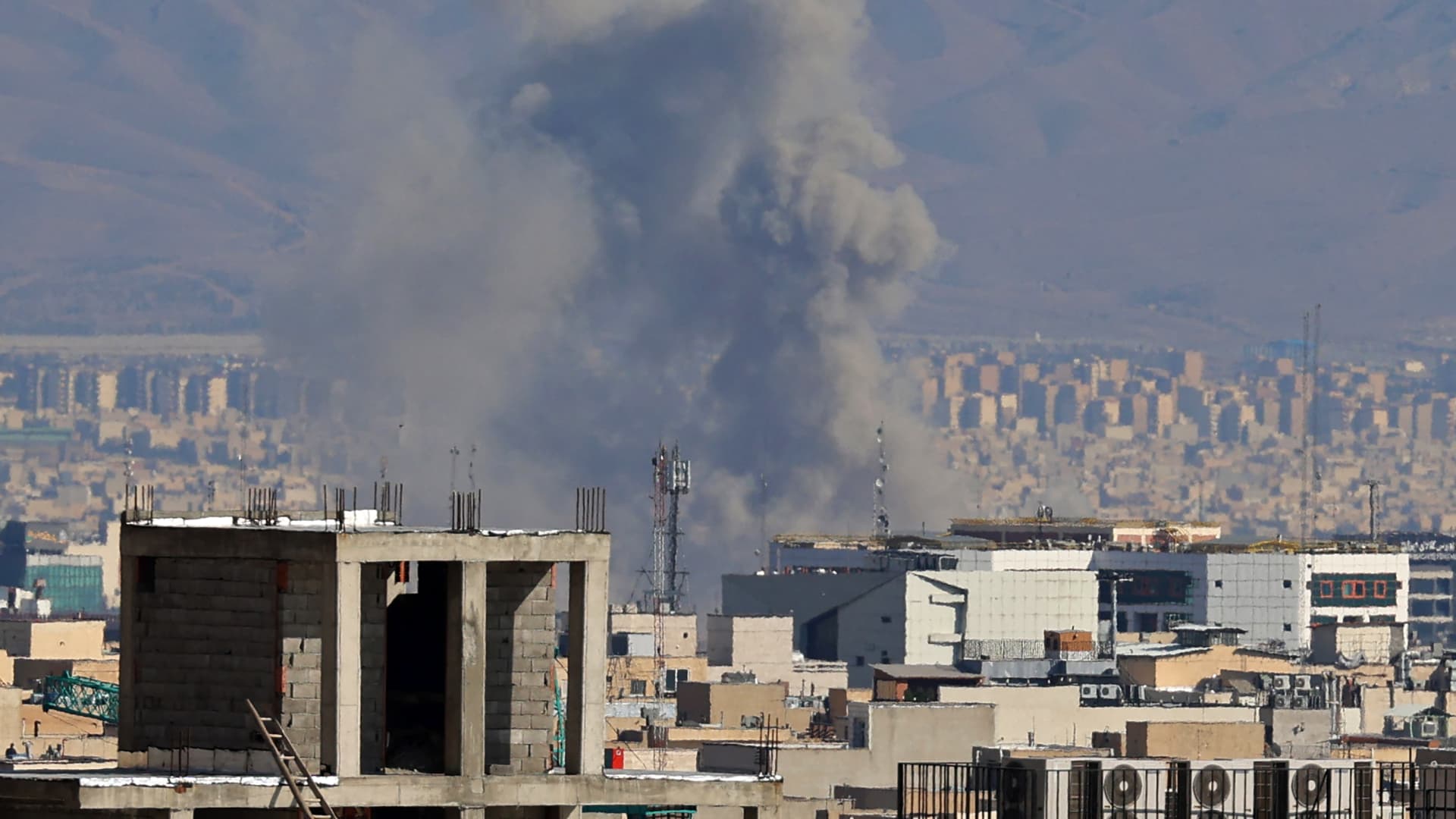
On March 6, 2026, smoke rises from an airstrike site in central Tehran, the capital of Iran.
Atta Kenare | AFP | Getty Images
The US government on Monday ordered non-emergency civil servants to leave Saudi Arabia as the war involving Iran spread across the Middle East. Iran has also ruled out an immediate ceasefire as attacks continue.
The U.S. Embassy in Riyadh cited heightened risks from armed conflict, terrorism, and missile and drone attacks from Yemen and Iran. This was the first evacuation order issued by the US government in Saudi Arabia since the war began.
The Israeli military announced on Monday that it had launched a new wave of attacks targeting the infrastructure of the “terrorist regime” in central Iran.
An Iranian Foreign Ministry spokesperson claimed on Monday that the United States was “targeting Iran’s oil reserves” and seeking to weaken and divide Iran, according to comments translated by Reuters.
Asked about the possibility of a ceasefire, the spokesperson said that as long as attacks continue, “there is no point in talking about anything other than defense and retaliation against the enemy.”
Attacks on several oil facilities in Iran on Sunday were followed by fires and thick smoke over Tehran and the nearby city of Karaj. The attack appears to be the first against the country’s energy infrastructure since the war began.
Oil prices soared above $110 a barrel on Monday morning after several energy producers in the Middle East announced plans to cut production. G7 finance ministers will discuss the possibility of a joint release of emergency oil reserves amid supply concerns, the UK Treasury and the French government confirmed to CNBC on Monday.

ICE brent crude oil
The jump in oil prices followed days of disruption in the Strait of Hormuz, one of the world’s most important oil chokepoints. Tankers are avoiding the narrow waterway after Iran’s government threatened to attack ships attempting to pass through the strait.
U.S. Energy Secretary Chris Wright said Sunday that traffic in the strait would resume once the U.S. destroys Tehran’s ability to threaten shipping.
“The grace period that the market had for much of last week, assuming this situation doesn’t get out of control and start to spill over into other parts of the economy, is clearly over,” said Clayton Seagle, CSIS chair of energy and geopolitics. “The duration of the crisis will probably last even longer. Markets…are scrambling to catch up.”

Iran’s next leader was chosen ‘unlucky’
Iranian authorities have appointed Mojtaba Khamenei, the son of late Supreme Leader Ayatollah Ali Khamenei, as the country’s new religious and political authority in a bid to tighten control over Iran’s Revolutionary Guards and other hardliners.
Israel has previously warned that any successor to Khamenei is a potential target, while US President Donald Trump has threatened that Tehran’s new leader will be short-lived if decisions are taken without his approval.
Former CIA Director David Petraeus said in an interview with CNN on Sunday that the selection of a new leader was “unfortunate” as Mojtaba is seen as “the successor to his father, a very hardline ideological cleric.”
Russian President Vladimir Putin congratulated Iran’s new leader in comments released by the Kremlin on Monday, saying “Russia has been and will continue to be a reliable partner of the Islamic Republic” and pledging Moscow’s “unwavering support” for Tehran.
Trump is also considering sending special forces to the ground to seize near-bomb-grade uranium from Tehran, as officials seek to identify the location of highly enriched material stockpiles, Bloomberg reported.
On Sunday night, shortly after the price of oil soared above $100 in the United States, President Trump posted on Truth Social that a “short-term increase in oil prices” was a “very small price” for defeating Iran’s nuclear threat. “Only a fool would think otherwise!”
Asian stocks tumbled on Monday, with European markets down more than 2% in early trade, as fears grew that the fighting would last longer than expected and investors rushed to reduce risk exposure.

Ukrainian interceptor drone
The escalation in hostilities comes after the Iranian government had previously signaled its intention to de-escalate tensions with its neighbors. In a pre-recorded video released on Saturday, Iranian President Masoud Pezeshkian apologized for the attacks on its Middle Eastern neighbors and said Tehran would stop firing on countries that did not support US-Israeli operations.
However, Saudi Arabia announced on Sunday that Iranian attacks continued. Riyadh warned that the attack was based on “flimsy pretexts with no basis in reality” and would lead to further escalation of tensions and harm “currently and in the future.”
Iran launched a swarm of Shahid “kamikaze” drones to overwhelm air defense systems across the Gulf, citing the presence of U.S. military bases and support for U.S. military attacks in the region. Drones have also become a staple in Russia’s arsenal over the years in its invasion of Ukraine.
Ukrainian President Volodymyr Zelenskiy told the New York Times that Kiev had agreed to a US request to send a team of experts and interceptor drones, which are much cheaper than interceptor missiles, to protect US military bases in Jordan.
Other countries are also considering asking Gulf states for help containing the attack. Australia said it was considering requests for defense military assistance from Gulf states, but reiterated that it would refrain from participating in any offensive action against Iran.
Last week, China sent a special envoy to the Middle East to broker a ceasefire. China’s top diplomat Wang Yi reiterated his call for an end to Beijing’s military action at a press conference on Sunday, lamenting that the conflict was a war that “never should have happened.”
