

Marine debris is a major environmental problem. Abandoned containers and fishing gear can trap or strangle animals, and plastic waste can break down into microplastics, releasing chemicals into the water and entering the food chain. Some studies suggest that eating microplastics can interfere with plankton’s ability to store carbon on the ocean floor, which could affect climate change.
According to one estimate, between 1950 and 2020, 32 million tons of plastic accumulated in the oceans. This is equivalent to the weight of over 200,000 blue whales. Without further measures, the amount is expected to reach 76 million tonnes by 2040.
A team of researchers and students is trying to change that with autonomous diving robots that can detect and retrieve debris on the ocean floor.
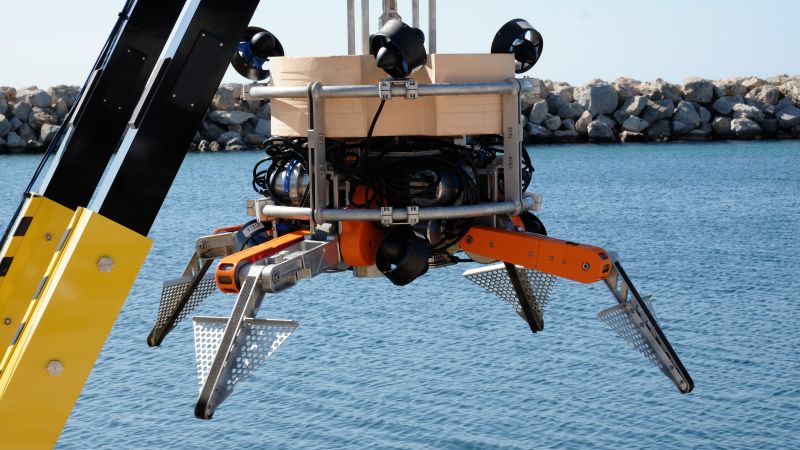
The smart grapple, developed at Germany’s Technical University of Munich (TUM), uses an AI system to identify individual pieces of debris using onboard cameras or, in murky water, sonar images.
They can then grasp the object with their four-fingered hands, which can be up to about 1 meter (3 feet) long and wide and weigh 250 kilograms (550 pounds), and lift it to a surface. There, the waste is loaded into small autonomous boats and taken to shore for recycling.
The diving robot is 115 centimeters (45 inches) high, 70 centimeters (28 inches) in diameter, and weighs 120 kilograms (265 pounds).
It is connected by cables that power the boat, but it can also move underwater via its own thrusters.
Stefan Sosnowski, head of TUM’s research team, said the cables could also help robots carry heavy objects to the ground.
“You can basically use the cable as a crane cable and pull the system up with a winch, which is more efficient than having a little robot try to swim things up,” he explains.

Once the smart grapple identifies a piece of debris, it displays it in 3D and shows you exactly how to grip it firmly with your strong hands. A complex set of sensors provides enough force to hold objects without shattering them.
Nicolas Huischen, a PhD student at TUM who has been working on the smart grapple for two years, says “the most satisfying part” was seeing the robot in action.
“Of course, you go back two years, and back then we only had one arm or a small joint, and then we saw a full grapple and to see how far we could go two years later is really breathtaking and amazing,” he says.
Huishen was drawn to this project because he wanted to actively apply his research on robotic systems to the real world.
“This is not only a fun project to work on here at the university, but also one that may help remove trash in our ports and across the country,” he says.
TUM’s innovation is part of the EU-funded project SeaClear 2.0, which aims to map and collect marine debris using unmanned robotic systems. Thirteen organizations across Europe are contributing to the effort, including universities and underwater technology companies.

SeaClear 2.0 project coordinator Bart De Schutter believes automated robotic technology has the potential to be transformative in tackling marine debris. Currently, most underwater trash removal is done by human divers, he said.
“They can’t do it 24/7,[and]there’s only a limited number of professional divers who can do it. So with this solution, you can significantly expand the range and scope of trash cleaning,” he explains.
De Schutter expects SeaClear’s robots to be ready for large-scale deployment between 2030 and 2033.
“This is not the solution to all our problems with marine debris,” Sosnowski warned, adding that we can’t just keep dumping trash in the ocean and rely on robots to remove it.
“(But) I think robotic systems can definitely be useful in certain areas where there can be significant ecological pressure on certain areas, such as ports or nature reserves,” he added.
The Smart Grapple has been demonstrated at the Ports of Marseille, France and Hamburg, Germany, successfully recovering a wide range of trash, from car seats to intact cloth handkerchiefs.
“In some of our trials,[the technology]is still remotely controlled simply because we’re still setting up the system and figuring out any kinks, but the functionality is such that it could also run completely autonomously,” Sosnowski said.

He explains that one of the most difficult challenges in developing the smart grapple was getting the system to correctly distinguish between waste and non-waste.
“What you really have to do is tell the system what’s garbage and what’s not,” he says. To do this, the smart grapple was trained on images of underwater objects classified as either trash or natural by TUM students. “That trains the neural network to recognize what you want to collect,” he explains.
The robot was given more than 7,500 images. “It’s surprisingly low, and that’s because there simply aren’t good underwater datasets available,” Dr. Sosnowski says. “We created the biggest thing ever.”
