


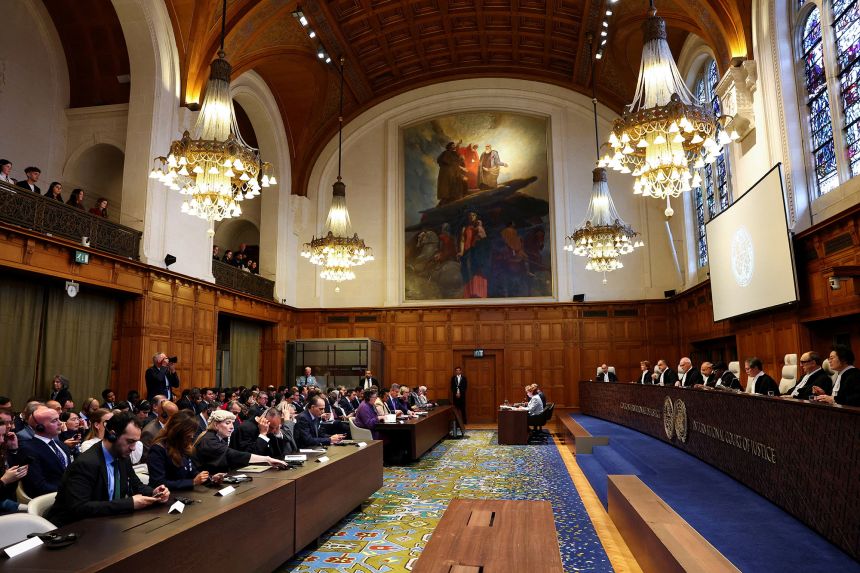
The United Nations Supreme Court issued a legal opinion Wednesday saying that Israel, as the occupying power, has an obligation to cooperate with U.N. agencies to facilitate humanitarian assistance in Gaza, a rebuke of the blockade it imposed on the Palestinian enclave earlier this year.
The International Court of Justice also said in an advisory opinion that the United Nations Relief and Works Agency for Palestine Refugees (UNRWA), the United Nations’ main agency serving Palestinian refugees, had not violated impartiality.
“An occupying force can never invoke security reasons to justify the complete suspension of all humanitarian operations based on the theory of occupation,” Judge Yuji Iwasawa said in his opinion. “After considering the evidence, the court finds that the supply of local residents in the Gaza Strip is insufficient.”
The opinion was requested by the United Nations General Assembly in December after Israel passed a law banning UNRWA’s operations in the country and drastically reducing its ability to provide aid to Gaza.
The advisory opinion, which aims to address Israel’s obligations to the United Nations, aid agencies, and third countries in the occupied West Bank and Gaza, is non-binding but carries political weight and is expected to increase pressure on Israel to cooperate with the United Nations and other aid agencies.
Israel accuses UNRWA of having more than 1,000 staff members with ties to Hamas and of teaching hatred against Israel in schools. UNRWA has repeatedly denied the accusations, saying there is no basis for a “blanket description” of the entire organization as infiltrated by Hamas. A United Nations investigation has found that nine of the 13,000 UNWRA personnel in the Gaza Strip “may have been involved” in the Hamas-led attack on October 7.
But the court said on Wednesday that Israel had not substantiated the allegations against UNRWA officials.
“The Court concludes that in the current circumstances, the United Nations, operating through UNRWA, is an essential provider of humanitarian relief in the Gaza Strip,” the judge said, detailing Israel’s obligation to support the UN agency’s aid efforts.
He added: “The court recalls Israel’s obligation, as an occupying power, not to use the starvation of civilians as a means of war.”
Israeli officials have accused the UN tribunal of being politicized and weaponized against Israel.
On Wednesday, ahead of the ICJ’s reading, Israeli Ambassador to the United Nations Danny Danon called the document a “political document,” arguing that “The Hague condemns Israel but deliberately ignores UNRWA’s role as a breeding ground for Hamas crimes and terrorism in Gaza.”
A cease-fire between Israel and Hamas has been in place for more than a week, with Israel allowing increased aid to Gaza in line with the ceasefire agreement’s goal of 600 trucks per day, U.S. and Israeli officials said.
Wednesday’s opinion is one of several Israel-related cases the U.N. tribunal has considered since the start of the war in 2023.
In July 2024, the ICJ said Israel’s presence in the West Bank and East Jerusalem is illegal, an unprecedented move that called on Israel to end its decades-long occupation of territory where Palestinians hope to form a future state.
This comprehensive opinion covers a list of Israeli actions that the ICJ held violate international law, including the confiscation of land, the construction of Israeli settlements in the territory, and the deprivation of Palestinians’ natural resources and right to self-determination. In cases before the Israel-Hamas war, the court said Israel had abused its position as an occupying power, demanding a halt to new settlement activity, evacuation of settlers, and compensation for damages caused.
Israeli Prime Minister Benjamin Netanyahu and other politicians at the time categorically rejected the ICJ opinion.
The ICJ also issued a series of emergency measures related to Gaza in 2024, including ordering Israel to immediately cease military operations in the controversial southern city of Rafah and classifying the humanitarian situation there as “dire.”
These measures are part of a broader lawsuit brought by South Africa against Israel, which accuses Israel of breaching its obligations under the Genocide Convention, an allegation that Israel has vehemently and repeatedly denied.
The ICJ case regarding genocide is ongoing and expected to last several years. This follows the conclusion of an independent United Nations investigation in September that Israel committed genocide against Palestinians in the Gaza Strip, a finding that Israel rejects and echoes findings from other genocide experts and human rights groups.
The Israeli government maintains that the war in Gaza was carried out in accordance with international law. The government has also repeatedly accused the United Nations of anti-Israel bias.
The U.N. tribunal proceedings are separate from the investigation into alleged war crimes in Gaza by the International Criminal Court, another international legal body based in The Hague, Netherlands.
Late last year, the ICC issued arrest warrants for Israeli Prime Minister Benjamin Netanyahu, former Defense Minister Yoav Gallant, and the deceased Hamas official Mohamed Deif, who Israel claimed was one of the masterminds of the October 7 attack.
Israel does not recognize the ICC, but as a member state of the United Nations, it is bound by ICJ rules.
