

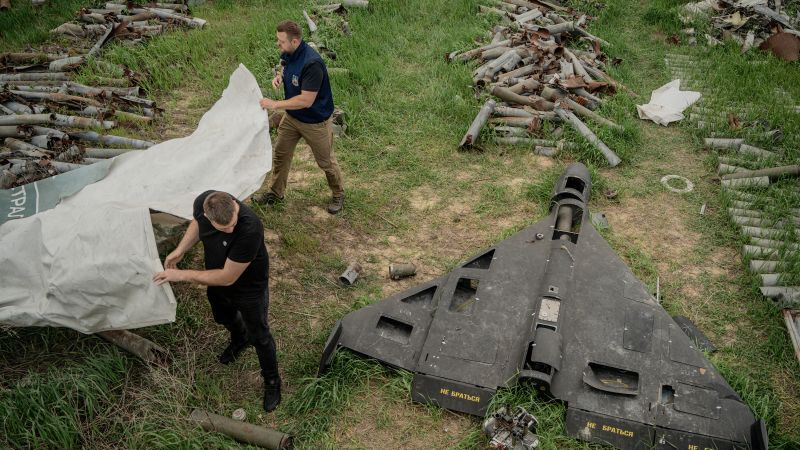
As Iran unleashes a wave of retaliatory drone attacks on critical infrastructure around the Persian Gulf, Ukraine’s expertise in countering these drones appears to be in demand.
Days into the war with Iran, the Trump administration has identified Iran’s Shahid one-way strike drone as a serious military challenge. In a closed-door briefing on Capitol Hill earlier this week, Defense Secretary Pete Hegseth and Chairman of the Joint Chiefs of Staff Dan Kaine acknowledged that relatively cheap, low-flying drones have become a bigger problem than expected, with the potential to saturate and overwhelm air defenses, according to two sources who attended.
This is a military challenge that Ukrainians are all too familiar with, four years after Russia’s all-out invasion. Cities around Ukraine are routinely attacked by a combination of drones and missiles, sometimes by the hundreds a night. But even as Moscow seeks to undermine Ukraine’s resolve by targeting its power generation facilities and energy grid, Kiev officials have suggested counter-drone know-how could be shared with Middle Eastern countries.
“Our partners rely on us, Ukraine, for help to protect themselves from Shahed. Our expertise and our practical approach,” Ukrainian President Volodymyr Zelenskiy said in remarks on Wednesday.
“There was also a request from the American side on this matter. Recently, I spoke with the leaders of the Emirates, Qatar, Bahrain, Jordan and Kuwait. We will have further discussions with other regional leaders. We are also coordinating with our European partners.”
The Shahed became Russia’s signature weapon in its war against Ukraine. Moscow began importing Shahed-136 attack drones (known in Russia as Geran) after the full-scale invasion of Ukraine in February 2022. When the war began, Russia began producing drones at a facility in Alabuga, 900 miles east of Moscow, to pump out more than 5,500 industrial-volume drones per month.

Drawing on lessons learned from combat, the Russians also upgraded their drones with more sophisticated anti-jamming equipment, more lethal warheads, and greater durability. The U.S. military has also taken notice, establishing its own squadron to field one-way attack drones created after developers reverse-engineered Shahed captured from Iran. These US drones were launched into combat against Iranian targets in a new war in the Middle East.
In the cat-and-mouse game of drone warfare, Ukrainians have also built a layered defense against Shahed and its variants, and claim great success in countering Russian drone swarms.
“We are ready to help and share our experience. There are more than 10 companies in Ukraine that produce interceptors and anti-drone systems,” President Zelenskiy’s strategic advisor Alexander Kamyshyn wrote to X. “We intercept about 90% of Russia’s Shahid drones, mainly using interceptor drones in parallel with other air defense systems, sometimes targeting our cities by hundreds a night.”
But for the United States and its allies, countering Shahid’s threat is a game of catch-up, some experts say.
“Russia has made extensive and pernicious use of one-way attack drones (the Guerin 2 and its successors) against Ukraine over the past four years, and although Ukraine continues to develop countermeasures to these capabilities, the types of low-cost defenses used by Ukraine do not appear to have been replicated across the Gulf or by U.S. forces in the region,” military expert Dara Mashkot said in an analysis published by the Carnegie Foundation earlier this week. international peace.

“So far in this conflict, Iran has launched hundreds of Shahed drones to attack the air defense systems of Israel, the United States, and its partners in the Middle East and damage critical facilities; Most of them are being intercepted at an alarming rate, requiring the extensive resources of near-constant defensive air patrols and the use of ground-based air defense systems to intercept incoming missiles from Iran.
Ukraine’s defense in depth against Shahed and its variants involves a full range of military technology. Helicopters equipped with miniguns and reconfigured cargo planes pursue the drones. Traditional air defense teams operate heavy machine guns at strategic points on the ground. It also shoots down shoulder-fired surface-to-air missiles. On the high end, Ukraine also has fighter jets, and in this dramatic recent video a Ukrainian F-16 is seen shooting down Shahed. There is also a U.S.-supplied Patriot missile battery.
However, as President Zelenskyy made clear in recent remarks, Ukraine’s inventory of Patriot batteries and its PAC-3 missiles is limited. And he suggested in comments Tuesday that there may be a quid pro quo when it comes to sharing Ukraine’s anti-drone countermeasures know-how.

“We are building relationships with Middle Eastern countries,” he said. “We can do the same thing. For example, today they have the Patriot air defense system and the PAC-3 missile. They have all this. This is important, very important to them above all. But it will be able to protect against hundreds of Shaheds. No, I know it’s not a viable model. But we lack PAC-3. For example, if we are talking about wartime weapons that we lack, we will provide them.” The (drone) interceptor is an equivalent exchange. ”
News that Russia may be providing wartime intelligence to Iran may also change the calculations in Washington and other Western capitals. As the war continued, Russia provided Tehran with information on the locations and movements of American troops, ships and aircraft, according to people familiar with U.S. intelligence reporting on the matter.
Ukraine’s expertise in countering Shahed is hard-won. But if it helps boost international support or replenish air defense missile stocks, it could prove to be a silver lining.
