

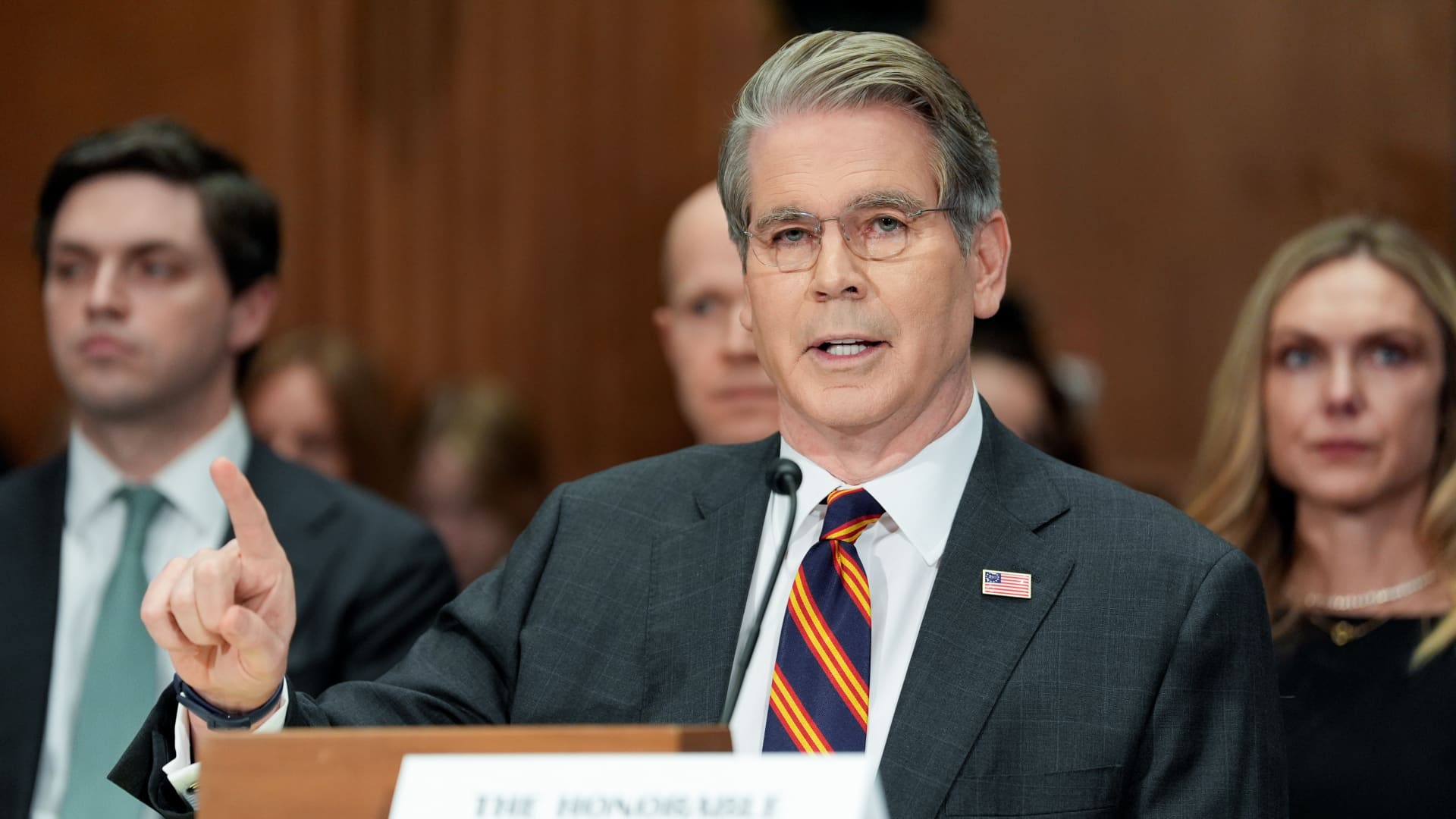
U.S. Treasury Secretary Scott Bessent speaks at a hearing of the Senate Banking, Housing, and Urban Affairs Committee on Thursday, February 5, 2026, in Washington, DC.
Kent Nishimura | Bloomberg | Getty Images
The United States on Thursday launched new trade investigations into 60 countries to determine whether they are failing to curb imports of products made with forced labor, a day after launching unfair trade practices investigations into 16 countries.
The new investigation will be conducted under Section 301(b) of the Trade Act of 1974 and will also include China, the European Union, India and Mexico, according to a statement from the Office of the U.S. Trade Representative.
“Despite international agreements against forced labor, governments have been unable to impose and effectively enforce measures that prohibit products produced with forced labor from entering the market,” said U.S. Trade Representative Jamison Greer.
“This investigation will determine whether foreign governments have taken sufficient steps to prohibit imports of products produced with forced labor and how their failure to eliminate these abhorrent practices has affected American workers and businesses,” he said.
Section 301 allows the United States to impose tariffs on countries found to engage in unfair trade practices without additional Congressional approval. This is the same legal authority that US President Donald Trump used during his first term to impose tariffs on Chinese goods.
The forced labor investigation follows a Section 301 probe launched on Wednesday that targets excess industrial capacity across 16 economies, including China, Australia, Indonesia, Japan, Malaysia, Singapore, South Korea, Switzerland, and Thailand.

The latest investigation expanded the list of countries subject to Section 301 surveillance to include more countries, including the United Kingdom, Brazil, and Russia.
The new study is expected to serve as an alternative to at least some of the “reciprocal tariffs” that the U.S. Supreme Court struck down last month.
“By eliminating reciprocal tariffs, the administration has made clear that Plan B will be implemented as soon as possible,” said Wendy Cutler, deputy director of the Asia Social Policy Institute and former U.S. Trade Representative.
Last month, the Supreme Court invalidated President Trump’s reciprocal tariffs, saying the president exceeded his authority. President Trump then immediately imposed a global blanket tariff of 10% under Section 122 of the Trade Act of 1974 and threatened to raise it to 15%.
The scope of the study is broad, and its feasibility and rationale are under scrutiny among trade experts.
The Office of the U.S. Trade Representative will hold hearings on the investigation from April 28 to May 1, an “unrealistic” schedule given the range of countries covered, said Deborah Elms, director of trade policy at the Heinrich Foundation.
Elmes said it “makes no sense” to spare countries with significantly weaker enforcement records while taking aim at the European Union, which has enacted its own legislative framework to ban forced labor practices.
Experts say a wide-ranging trade investigation also risks alienating partners and wasting the goodwill needed to build a collective response to address China’s industrial overcapacity.
“The administration is missing out on an important opportunity to work with partners to address the real overcapacity problem in the world (namely) China,” Cutler said.
He added: “By adding more than a dozen countries to the overcapacity investigation, our partners will be less willing to work with us to address the serious challenges that China’s overcapacity poses to the world.”
Is China in the crosshairs?
The investigation comes as U.S. Treasury Secretary Scott Bessent is scheduled to meet with Chinese Treasury Secretary He Lifeng in Paris this weekend to continue trade and economic talks. China’s Ministry of Commerce confirmed on Friday that the meeting was held in Paris from March 14 to March 17.
The meeting is expected to lay the groundwork for a summit between President Trump and Chinese President Xi Jinping.
“Starting a new trade investigation right before the summit will send the wrong signal,” said Wang Huiyao, founder of the China Center on Globalization, a think tank seen as aligned with Beijing’s thinking.
He added: “Section 301 has been on the table before, and what we both need now is to find ways to work together, including on what’s happening in the Middle East.”
A spokesperson for China’s Ministry of Commerce objected to the US labeling domestic industrial production as excess capacity, saying it was “narrow-sighted” to treat the gap between domestic production and demand as an unfair trade practice.
The official also called on the United States to “correct its mistakes and return to the right path of resolving issues through diplomatic negotiations.” Regarding the forced labor issue, China said it was currently evaluating the investigation, but did not elaborate.
“China is likely to use the upcoming meeting in Paris to express its displeasure,” said Stephen Olson, a senior visiting fellow at the ISEAS Yusof Ishak Institute and a former U.S. trade negotiator.
That said, both sides seem committed to getting the Trump-Xi meeting back on track, adding: “We don’t expect this (trade investigation) to upset the apple cart.”
The first Trump administration launched six Section 301 investigations into China and the European Union that led to tariff increases. The Biden administration is also conducting Section 301 investigations, with two investigations into Brazil and China currently underway.
