

He’s been reporting on aviation for CNN for 25 years, but he’s spent a lifetime as an avgeek — a lover of all things aviation. There are few airplanes CNN anchor Richard Quest hasn’t set foot on, either as a passenger or in a museum. “Nothing ever stands still in aviation because you’re always trying to improve that which went before,” he says.
But which are his favorites? From childhood memories on the BAC 1-11 to the glamor of the superjumbo era, he walks us through his top aircraft of all time, recounting memorable flights on the ones that made the list.
.
First passenger flight: April 9, 1965
Current status: Retired
The British Aircraft Corporation (BAC) was just five years old when its ‘One Eleven’ — the first aircraft to bear the BAC name — made its debut passenger flight. It was a strong start — the plane, powered by rear-mounted Rolls-Royce turbofan engines, roared into Europe’s new jetset era, swiftly becoming the aircraft of choice for flights across the continent (as well as across the pond, where American Airlines was a loyal customer).
Updated into a longer version in 1967, it continued to acquire clients across the globe, and rivaled the Douglas DC-9 and Boeing 737 in popularity. While it made a lot of noise, both literally and reputationally, eventually those noisy turbofans led to its demise. In 2003, it fell foul of EU noise restrictions. It rumbled on, but in 2010 its European safety certificate was revoked and the last model — owned by US aerospace company Norfolk Grumman — was retired in 2019.
Quest says: It was a little plane that you went on holiday to Spain on. It had two engines at the back and it was extremely noisy and, I’m guessing, environmentally unfriendly. But I can remember coming back as a kid, getting off the plane at Speke Airport in Liverpool — what they now call John Lennon Airport — coming down the stairs, turning around, looking at this BAC 1-11 and thinking, “How did it get in the air and stay there?”
And that wonderment has never left me.
It had two engines at the back and was extremely noisy and, I’m guessing, environmentally unfriendly.
Richard Quest
It’s the same today. Flying back to New York and sitting on an aircraft, taking off in London, all of a sudden, I think… “Can I tell the moment when we’re going to take off?” I try still to do it.
It still has me absolutely enthralled, the whole business. I cannot think of something more exciting to cover than aviation.
First passenger flight: June 25, 1936
Current status: Retired
In 1929, if you’d wanted to fly across America coast to coast, it would have meant a series of hops in slow aircraft — interspersed with train rides — on Transcontinental Air Transport, which would become TWA. That changed in June 1936, when American Airlines started flying the Douglas DC-3 twin-propeller plane. This “game changer,” Quest says, “allowed the US carriers to truly open up the domestic United States.”
American Airlines’ introduction of the DC-3 on a New York-Chicago route was the plane’s first step toward dominating air travel in the US. More than 13,000 of the airplanes would eventually be produced, according to the National Air and Space Museum. Designed as a rival to Boeing’s 247, which could fly 10 passengers at 160mph, the DC-3 swiftly took the lead in importance and popularity. It became so iconic that when Richard Branson launched his short-lived retro-themed Vintage Airways, which flew between Miami and Key West from 1992 to 1995, he used DC-3 aircraft.
Quest says: It’s a funny shape, but it was a real workhorse of an aircraft, propeller-driven long before jets came along. It was an absolute aircraft for its time and ushered in tremendous advancement for US aviation.
It’s a funny shape, but it was a real workhorse of an aircraft.
Richard Quest
Memorable flight: I did actually get to fly on the DC-3 on Vintage Airways. Richard Branson ran the aircraft in traditional livery. The flight attendants wore outfits inspired by the 1940s. The music of Glenn Miller from that era was played on board. The food that you got was of that time and even the magazines were from that period. So it was very much a tourist attraction.
First passenger flight: June 26, 1988
Current status: In service
As Boeing’s recent woes have slowed down its production line, Airbus has been going from strength to strength — and the narrowbody A320, the French company’s answer to the 737, became the most delivered aircraft in history in October 2025.
According to the manufacturer, an A320 takes off or lands somewhere in the world every two seconds. Quest calls it, along with the 737, an “engineering marvel.”
It is of course strong in its homeland, Europe — KM Malta Airlines opted for a fleet of A320s when it launched in 2024, for example, while the A320 family is the backbone of short-haul flights for the likes of easyJet and British Airways. But it’s rightly beloved across the globe. In the US, American Airlines is the aircraft’s biggest fan.
It triumphed over its inauspicious beginnings. The first passenger flight — a demonstration flight at the Habsheim Air Show for Air France, on June 26, 1988 — ended in a crash which killed three people.
One of my favorites because it was such an achievement to build and to get it going.
Richard Quest
Quest says: Airbus knew what it had to do — create a family of planes. It’s a lovely aircraft. It does have a very strange noise when you park at the gate — it’s the turbine underneath. But it’s an absolutely spectacular aircraft. And one of my favorites simply because it was an achievement to build it and to get it going.
First passenger flight: October 26, 1958
Current status: Retired
The 707 was the first passenger jet to be designed and produced by Boeing’s commercial arm. Another coup for Pan Am meant the airline was able to launch the plane’s first service. It even persuaded President Dwight D. Eisenhower to attend the aircraft’s baptism on October 17, 1958. Nine days later, it made its first commercial passenger flight from Idlewild, NY, to Paris Le Bourget. The 707 swiftly captured the market.
Quest says: The 707 was the aircraft that allowed Boeing to gain supremacy. It became the one you had to have. Pan Am had it, TWA had it — you weren’t a player across the Atlantic unless you had the 707. It was a narrowbody, with a single aisle. It had four engines — hellishly noisy. If you look at the sales literature and the travel films of the time, serving roast beef off the trolley and soup out of the terrine, the 707 was the way to go.
Serving roast beef off the trolley and soup out of the terrine, the 707 was the way to go.
Richard Quest
Memorable flight: The time that I was starting to fly was the end of the 707 era. I flew on it from Manchester in northern England to Tel Aviv. And it was again, incredibly noisy. But this was state-of-the-art! Those who could afford it, those who knew what they were doing, they traveled on the 707. It very rapidly became the workhorse of the transatlantic.
First passenger flight: September 8, 1982
Current status: On the way out
A steady worker who gets the job done without fanfare, Boeing’s 767, which debuted for United in 1982, left the glamor to the 747. Boeing’s first widebody twin-jet became the US manufacturer’s workhorse. It’s an uber-popular plane that Quest calls “an absolute mainstay of the fleet.” It’s been produced in all kinds of iterations — longer, and extended range models — and built a legion of fans thanks to touches of luxury in economy class. Its 2-3-2 configuration meant the majority of seats were either a window or an aisle.
Most airlines have phased them out, though United and Delta plan to fly theirs until 2028.
Quest says: In a certain way, the 777 is similar to Airbus’s A330. It’s an aircraft that does wonders for the economics of the airline, but passengers are never going to rapturously fall in love with it.
My love of the 767 is personal because I often fly United between New York and London, and they use 767s. It was the aircraft that became the standard widebody jet for crossing the Atlantic. On United 767s, business class stretches back beyond the wing — a profitable use of space other airlines now emulate.
It’s an aircraft that does wonders for the economics of the airline, but passengers are never going to fall rapturously in love with it.
Richard Quest
Memorable flight: On one of my recent journeys on a 767, the plane was 34 years old. Thirty-four! Now, of course, it’s going to fly safely, it’s going to fly magnificently — but that’s getting up there in terms of aircraft age.
First passenger flight: June 7, 1995
Current status: In use
Is this the most stealthily popular widebody ever built? Quite possibly. The middle child between the jumbo jet and the 767, the “triple seven” swaggered across an ocean for its first commercial flight, skimming over the Atlantic from London’s Heathrow to Dulles International Airport in Washington, D.C. The world’s largest twinjet, perhaps its popularity might be down to the way Boeing crowdsourced part of its design process, asking launch airlines for input. After its successful 1994 test flight, it debuted for United the following year.
It’s still going strong — so strong, in fact, that N777UA, the aircraft which made that first commercial flight, is still in United’s fleet.
Airlines around the world, including Emirates, Singapore Airlines and American Airlines, still have 777 fleets. And as this generation grows old, the legend will continue via the forthcoming 777X. Designed to challenge Airbus’ much-lauded A350, the 777X’s launch has repeatedly been delayed, but has been promised for delivery in 2027.
Quest says: I remember talking to the CEO of Continental Airlines. We were at a reception and they were about to get rid of their 747s for 777s, and I was saying, “Oh, but we love the 747.” And he turned around and said, “The 777 is a game-changer.” And it was, and it still is, in a sense, because it gave you range, it gave you numbers of passengers, and it gave you variance.
The 777 … is a plane that truly deserves its accolade as one of the best.
Richard Quest
I was on the 777-200LR when it got the Guinness World Record for the longest commercial flight. There were 34 of us onboard, and we flew from Hong Kong to London, but we went the long way, three-quarters of the way around the planet, nonstop. It was amazing. The 777, I think, is a plane that truly deserves its accolade as one of the best, because it enables new routes and more people to fly. It was fantastic and still is — and the same will be true of the 777X.
First passenger flight: October 25, 2007
Current status: No longer in production, but still in service on several airlines
Often dubbed “the whale,” the world’s largest passenger plane was Airbus’ attempt to challenge the Boeing 747’s dominance.
Planned since the 1980s, its conception was announced in 1990, and avgeeks feverishly awaited its maiden flight with Singapore Airlines in 2007. To date the only fully double-decker aircraft in the sky, it instantly became a passenger favorite.
But by the time the plane was in production, airlines were looking for smaller aircraft. The A380, which was capable of accommodating more than 800 passengers in an all-economy configuration (though it usually carried around 500 across multiple classes), was no longer what airline CEOs wanted.
In February 2019, Airbus announced the end of the program, with the last A380 delivered to Emirates — perhaps its biggest fan, given that it had around half the global fleet at the time — on December 16, 2021. Today, 10 airlines still fly the A380, from staunch long-haul specialists Etihad, Qatar, Qantas and Singapore Airlines, to European airlines Lufthansa and British Airways.
Quest says: It’s the most extraordinary piece of engineering. Some people say it was 20 years too late, some say it was 20 years too early, in terms of when it was constructed. By the time the A380 came along, there wasn’t the same need for giant aircraft that would carry large numbers of people. What was needed more were smaller planes that could operate with greater frequency and open up new routes — in other words, the 787s and the A350s.
Yes, I have taken the Emirates shower, and it’s quite an experience.
Richard Quest
But passengers adore the A380. You and I could be sitting on the wing next to the engines at full takeoff power and be talking like this — a normal conversation because it is so beautifully built. And yes, I have taken the Emirates shower, and it’s quite an experience.
First passenger flight: January 22, 1970
Current status: Being phased out
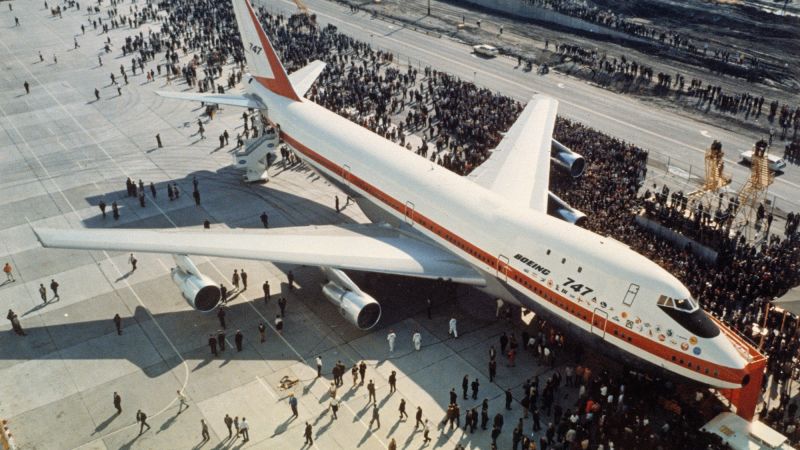
The bulbous hump of the Boeing 747 made her an instant icon when she debuted for Pan Am on a New York-London route, using one of the 25 aircraft ordered while the plane was still in development. The hump, Quest notes, was rumored to have been designed to make conversion into a cargo aircraft easier if the passenger version failed.
Fail it did not. TWA swiftly followed Pan Am. American Airlines was so keen to join the club that it leased some of Pan Am’s 747s before its own arrived. Soon she’d earned the nickname, “queen of the skies.”
Boeing’s long-haul flagship was the first widebody passenger aircraft, introducing generations of travelers to the glories of seating rows that stretched from seat A to K. And for elite flyers, its first-class passenger lounge on the upper deck added prestige.
But it couldn’t last forever. After 1,574 planes, the last 747 rolled off the production line in December 2022. The gas guzzler has gradually been phased out of service, but not all are gone. A few remain in the skies, operated by airlines including Lufthansa, Korean Air and Air China.
Quest says: From the very beginning, Boeing wanted to design a truly spectacular aircraft. And it was Juan Trippe, the then-CEO of Pan Am, who determined this aircraft was going to be his airline’s flagship. It was going to be like nothing else.
Initially, many people thought it was too big — how are airports going to cope? But it was well structured, well thought through, and very, very quickly, the 747 became probably the jet most people wanted to fly on, because they loved it. It was just a magnificent aircraft.
If you got to ascend those stairs and sit upstairs, it was wonderful.
Richard Quest
Only the early models had the spiral staircase, but climbing it was the epitome of glamor. It said “I’ve made it” like nothing else. If you got to ascend those stairs and sit upstairs, it was wonderful. Continental, which I used to fly across the Atlantic, operated the 747 with the spiral staircase. British Airways had it too. I walked up and down the spiral staircases many times. It was phenomenal. It really set the aircraft apart.
Memorable flight: The first time I went to the United States, I was an exchange student. I was flying out of London Gatwick on People Express, one of the first low-cost carriers in the 1980s. I remember waking up in the airport hotel, looking out of the window and seeing a 747 landing. On People Express you paid for your ticket on board the aircraft. The flight attendant came along with one of those old credit card machines that you rolled backwards and forwards with carbon paper. I can still remember the movie — “Chariots of Fire,” and it was shown on the big central screen in the middle of the cabin.
First passenger flight: January 21, 1976
Current status: Retired
All hail the revolution. When Concorde first sailed into the skies on January 21, 1976 — with sibling flights, from London to Bahrain and Paris to Rio de Janeiro — she showed that humans were capable of traveling faster than the speed of sound in style.
Not just faster, in fact, but twice as fast. Concorde had a maximum cruising speed of Mach 2.04, or 1,354 mph. Europeans could now reach New York in around three and a half hours — an extraordinary feat when you consider the eight-hour transatlantics that we still endure 50 years on.
A joint UK-France venture — with British Airways and Air France as the launch operators — Concorde’s astronomical development costs were her downfall. The project never broke even, and hemorrhaging funds forced both airlines to cut back their initial multiple routes to the single most popular one: across the Atlantic to New York. After the July 2000 crash in Paris, which killed 113 people, the aircraft was grounded for over a year, and despite resuming service, the writing was on the wall. In May 2003, Air France threw in the towel, and British Airways followed on October 24, 2003. For Quest, who flew on it multiple times, it remains the finest aircraft ever made.
Quest says: It was like nothing else. It didn’t matter how you got on board the damn thing, whether you robbed, stole, finagled or bought your ticket. I had a smile from here to here the first time I flew on Concorde. I was privileged to be on the last flight, New York to London.
I had a smile from here to here the first time I flew on Concorde.
Richard Quest
It was small — just 100 seats — cramped and noisy. The cabin was divided into two sections — they were exactly the same, but people always wanted to sit in the first section because it was perceived to be nearer the front. The carpet had to be specially made and it had to have elasticity in it because the fuselage stretched due to the heat. And if you put your finger into the gap by the door, you could feel the heat coming off the aircraft as you went twice the speed of sound. The seats were like office chairs — they weren’t big, luxurious things. And when they took you supersonic, you felt a kick in the back as the plane accelerated and you saw the Mach meter start to tick over.
Memorable flight: On the last flight, there were a hundred of us. And it didn’t really matter who you were, the star of the story was the plane. It was a sad day because I believe it was the first time in aviation that a technological development had not been built on — we were actually going backwards. There was no Concorde, there was no replacement, the plans weren’t there. It’s only in the last five, 10 years with Boom that it’s become a potential reality again. Yes, I shed a tear. If you ask me what my favorite story of my career has been, it was the last flight of Concorde.
