

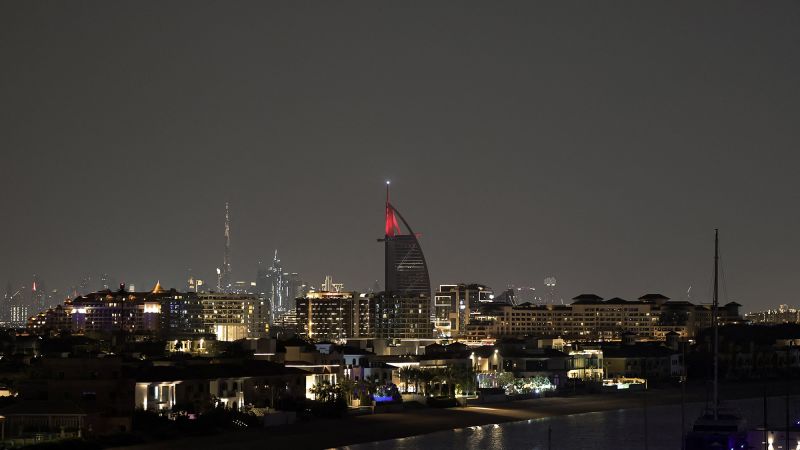
Iran warned that an attack on the country would spark regional conflict.
The US and Israel either didn’t believe them or decided it was worth the risk. Eleven days into the war, it is the Gulf Arab states, and above all the United Arab Emirates, who are paying the price.
More than 1,700 missiles and drones have been launched toward the UAE since the war began, and more than 90% of them were shot down by interceptors, fighter jets and helicopters, the country’s defense ministry said.
US President Donald Trump admitted in an interview with CNN’s Jake Tapper last week that Iran’s willingness to attack its Arab neighbors was the biggest surprise of the war.
On Sunday, Iran’s Islamic Revolutionary Guard Corps announced it was using 60% of its firepower against US “bases” and “strategic interests” in neighboring Arab countries, with the remainder directed toward Israel.
More projectiles have been launched into the UAE than any other country, and likely more than Israel, which started this war with the United States. Several people landed on homes, offices and roads in populated areas, killing four people, all civilians.
“Dubai is truly the epicenter of globalization,” says Fawaz Gerges, a professor of international relations at the London School of Economics. “Iran’s leaders see Dubai as the foundation of the Western world economic system…It is Dubai that shakes up the global economy, not just Dubai and the UAE.”
Awareness is key. As tens of thousands of expatriates and tourists prepare to leave the country, images of a fire burning in front of Dubai’s International Hotel and a strike on the grounds of Dubai International Airport have attracted international attention. No one was injured in either attack, but the psychological impact could be significant.
Gerges pointed to the irony that the UAE has long served as Iran’s economic lifeline while Tehran struggles under one of the toughest sanctions regimes in history. A UAE official told CNN that relations will eventually normalize, but it could take “decades” to rebuild trust.
The UAE is one of Iran’s largest commercial partners, second only to China. Business between the two countries was growing even as the United States continued to tighten sanctions against the regime. According to the World Trade Organization, bilateral trade in 2024 was $28 billion.
Approximately 500,000 Iranians call the UAE home.
Iran cited Abu Dhabi’s decades-long strategic alliance with the United States as justification for the attack. The UAE, which was designated a “major defense partner” by the US last year, has made clear who it trusts with its security.
It has spent tens of billions of dollars on American fighter jets, helicopters and air defense systems, and is now actively working to protect Emiratis and foreigners from an unprecedented Iranian attack.
Chatham House’s Sanam Vakil says the UAE has multiple checks on the Islamic Republic due to its desire to inflict pain on the United States and its allies.
“By attacking the UAE, Iran is not only targeting a major partner of the United States, but also demonstrating that the country, which hosts millions of foreigners and serves as a major global financial, aviation, and trade node, cannot be isolated.”
The extent of retaliation may indicate the extent to which the regime views the war as an existential threat. Israel bombed Iran’s nuclear facilities, and the United States joined in towards the end, but Iran’s response was limited, with the attack on Qatar’s al-Udeid air base, which appears to have been reported in advance.
President Trump signed an executive order after that attack that provided NATO-style security to Qatar, which is also a target of Iran during the current war.
Then there’s the geographic argument. Only about 100 kilometers (60 miles) of water separates Iran and the UAE. It doesn’t take long for missiles and drones to reach the shores of the Emirates.
“It’s literally next door. It’s much easier to attack Dubai or the United Arab Emirates than it is to attack other countries, such as Jordan or Israel, because Israel is well protected by air defense systems,” Gerges said.
The UAE had banned the use of its military bases and airspace in case of an attack on Iran.
That position did nothing to isolate the UAE.
UAE President Mohammed bin Zayed Al Nahyan visited some of the injured over the weekend, issuing an unusual warning to the country’s enemies. “I say to them: Don’t be fooled by the UAE’s appearance. The UAE has thick skin and bitter flesh. We are not easy prey.”
Shock at being number one on Iran’s retaliation list quickly turned to anger.
Mina Al Oraibi is the editor of the UAE newspaper The National. “The morning the war started, there was real upset among the people you spoke to that Israel and the United States had chosen the military option…But soon after, as Iran began attacking the UAE and other countries, the anger and sense of injustice really turned towards Iran.”
Hope and relief were short-lived after Iranian President Masoud Pezeshkian apologized over the weekend and said Iran would no longer target its neighbors, as a new salvo threatened the UAE and other Gulf states.
There’s always an alternate reality of ‘business as usual’ in times of conflict, and the beaches of Dubai are full of bikini-clad sun worshipers who won’t tolerate a war they don’t want to be a part of in order to change their lives.
