

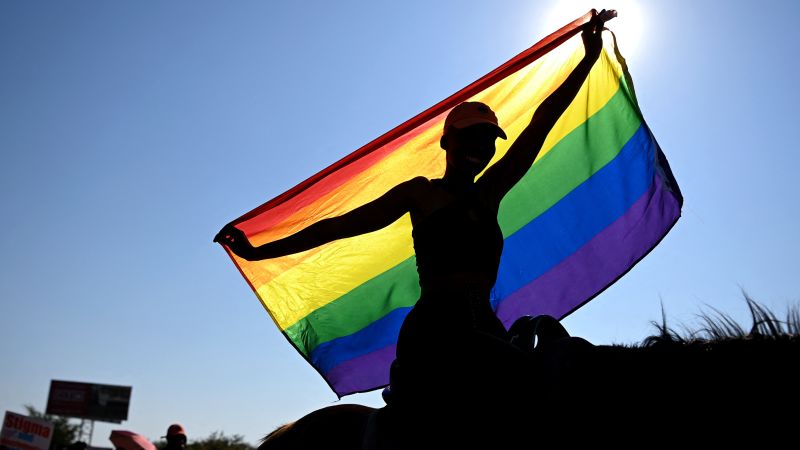
When 22-year-old Wendy Faith shares a Valentine’s Day kiss with 21-year-old Alesi Diana Dennis in Uganda, a country notorious for enforcing some of the world’s toughest anti-LGBTQ laws, both women’s lives are about to take a complicated turn.
Faith and Dennis, residents of the northwestern commercial capital of Arua, were charged with sodomy and lewd acts, according to an indictment obtained by CNN.
In the East African country, as in other countries on the continent, being LGBTQ also means risking imprisonment.
In Uganda, consensual same-sex relationships between adults can lead to life imprisonment. The law, which will take effect in 2023, also includes the death penalty for those found guilty of “aggravated sodomy,” which includes sex with minors, the elderly and the disabled.
If convicted, Faith and Dennis each could face up to seven years in prison.
Douglas Mawadri, one of the lawyers representing Faith and Dennis, said they were arrested and their apartment searched on February 18 after photos of them kissing were leaked online.
Frank Mugisha, president of Sexual Minorities Uganda, an LGBTQ advocacy group working to secure their release, said the women were under police surveillance even before their arrest.
Mugisha told CNN that one of the women was a content creator who organized a women’s dance group that frequently met at her apartment. He said the women’s neighbors reported the suspected relationship between the two to police.
Local police spokeswoman Josephine Angusia did not respond to CNN’s request for comment. However, she told Britain’s Guardian newspaper that the pair had been “seen kissing in broad daylight, as well as engaging in bizarre and unusual behavior that is believed to be sexual in nature.”

Mugisha, whose organization is in contact with the women, said he could not confirm Angusia’s claims and described them as “hearsay”.
Faith and Dennis pleaded not guilty in court on March 4, according to their lawyer, Mawadli. The two were denied bail and the case is scheduled for trial later this month.
This case is a stark example of the conditions faced by many people accused of being LGBTQ in Africa.
Attitudes vary, but the majority of African countries criminalize same-sex relationships. On top of that, hosts have even stricter rules. The reasons are complex. But activists and analysts say one factor is attitudes within the United States, which have only worsened during President Donald Trump’s second term.
In late February, Senegal joined a growing number of countries on the African continent whose leaders have advocated tougher anti-LGBTQ laws. The Muslim-majority West African country is considered one of Africa’s most stable and progressive democracies, but homosexuality has been illegal for more than 60 years.
Last week, Senegal’s parliament passed a bill that would double the penalties for same-sex relationships, raising the maximum prison term to 10 years. The law also imposes prison sentences of three to seven years for those who advocate for LGBTQ rights.

In Ghana, also in West Africa, lawmakers have revived a similar bill calling for up to three years in prison for identifying as LGBTQ, and advocates could face up to 10 years in prison.
The bill was first introduced in 2021 and originally passed in 2024, but it was not signed by the former president. Currently, same-sex relationships can be punishable by up to three years in prison in Ghana. The current president has said he intends to sign the bill into law if it passes Congress.
Anti-gay laws have also been introduced elsewhere in the region, most recently in Mali in 2024 and in Burkina Faso the following year. Until now, both countries had no laws banning consensual same-sex relationships.
Historically, many conservative-majority parts of the continent have strong anti-LGBTQ laws. Many people on the continent welcome such laws, which reflect their conservative religious and cultural views. Some of these regulations have their origins in British colonial laws that prohibited “sodomy” and “unnatural crimes.”
Hans Senhuma, a Ugandan LGBTQ rights activist, said he “lives in perpetual sadness” over his experience as a gay man in his country and said he believes the recent tightening of anti-gay laws across Africa is being fueled by a lack of political support for the LGBTQ community in the United States.
“When the most powerful country in the world signals that LGBTQ people don’t deserve protection, rolls back rights, removes gender from official documents, and cuts funding to programs that serve communities around the world, that message goes far beyond America’s borders. It tells leaders here[in Africa]that the international consequences they once feared may no longer materialize,” Senhuma told CNN from Uganda’s capital Kampala.
Trump has faced criticism for policies deemed harmful to gay, transgender and non-binary individuals.
In his inaugural address last year, President Trump said that through an executive order he signed the same day and an order ending federal diversity, equity and inclusion efforts, the U.S. government officially recognizes only two genders: male and female. In contrast, one of the Biden administration’s first acts of 2021 was to formally task government agencies to combat anti-LGBTQ laws around the world.
Concerns about President Trump’s stance on LGBTQ rights have been ongoing since the start of his first term in 2017. The American Civil Liberties Union (ACLU) has reported “years of sustained efforts to eliminate protections for LGBTQ people throughout the federal government” during that time.
Such criticism surfaced again in his second term.
Last month, the Trump administration removed the LGBTQ Pride flag from New York City’s Stonewall National Monument. Stonewall National Monument is the first national monument dedicated to LGBTQ rights in the United States. The measures follow a directive restricting the types of flags allowed in national parks.

Additionally, President Trump has cut funding to various global aid programs, including programs supporting LGBTQ people living with HIV in Africa.
Reuters reported that a prominent Ghanaian lawyer and anti-LGBTQ activist said after President Trump took office that, considering the president’s position, “Ghana is on the right side of the United States.”
America’s influence did not begin with President Trump. His positions on transgender rights in particular reflect what’s happening at the state level. More than half of U.S. states ban at least some gender identity care for transgender children and teens, according to a CNN tally.
And while President Trump’s policies and statements may have had an impact on Africa, some American Christian groups active on the continent have long been seen by critics as increasing anti-LGBTQ sentiment.
CNN previously reported on how a US-based Christian group allegedly played a role in enacting Ghana’s anti-LGBTQ bill, which one activist called a “homophobic dream bill.”
Activists said local anti-LGBTQ movements gained momentum following a 2019 conference hosted by the World Congress of Families, which promotes right-wing Christian values. At the time, he said the organization offered inspiration, not guidance. CNN has not received a response from the group regarding whether it supported or influenced Ghana’s revived anti-LGBTQ bill.
Similarly, another US Christian lobby group, Family Watch International, denied advocating for anti-LGBTQ laws in Uganda or other African countries, saying it opposes such efforts.
Weeks before Ugandan President Yoweri Museveni signed an anti-gay law in May 2023. Mr Museveni was photographed attending a sex education conference with Family Watch International co-founder Sharon Slater.
Some observers say anti-LGBTQ sentiment is deep-rooted in the country and that the population is used as a scapegoat to cover up other problems.
Takiwaa Manu, professor emeritus at the University of Ghana, argues that targeting the LGBTQ community diverts attention from issues of poor governance.
“This is a good thing because it takes attention away from the failures of many countries[in Africa][for example]bad governance and the dire conditions that people are in,” she told CNN.
Suwickani Ncube, a lecturer in public law at South Africa’s University of Johannesburg, suggested that rising anti-Western sentiment in parts of the continent, particularly in former French colonies such as Burkina Faso, Mali and Senegal, from which French troops were recently expelled, may be a contributing factor.
Senegal was removed from France’s list of “safe” countries in 2021 by the country’s Supreme Administrative Court, citing a lack of protection for LGBTQ people.
But Ncube believes the issue is more complex.
“Since the rise of the LGBTQ movement, Western countries and the United States have been at the forefront of denigrating perceived opponents. The Trump administration’s stance on the issue has also played a role, but the new crackdown may be due to a breakdown in the multilateral system and a lack of global solidarity,” he told CNN.
“For countries that have traditionally adopted a moderate approach as an expression of ‘goodwill,’ the current ‘to each man for himself’ approach lifts the veil and allows states to return to anti-gay positions,” he added.
Activist Senhuma, who lives in constant fear in Uganda and faces threats and harassment for being gay, believes politics are the main reason for the worsening climate.
“When governments suffer from inflation, corruption and failing public services, it is very convenient to blame us. LGBTQI people become a scapegoat, a distraction, a means to create national unity around hatred,” he explained. “Politicians have been doing this for centuries with different targets, and we just happen to be the target now.”
