

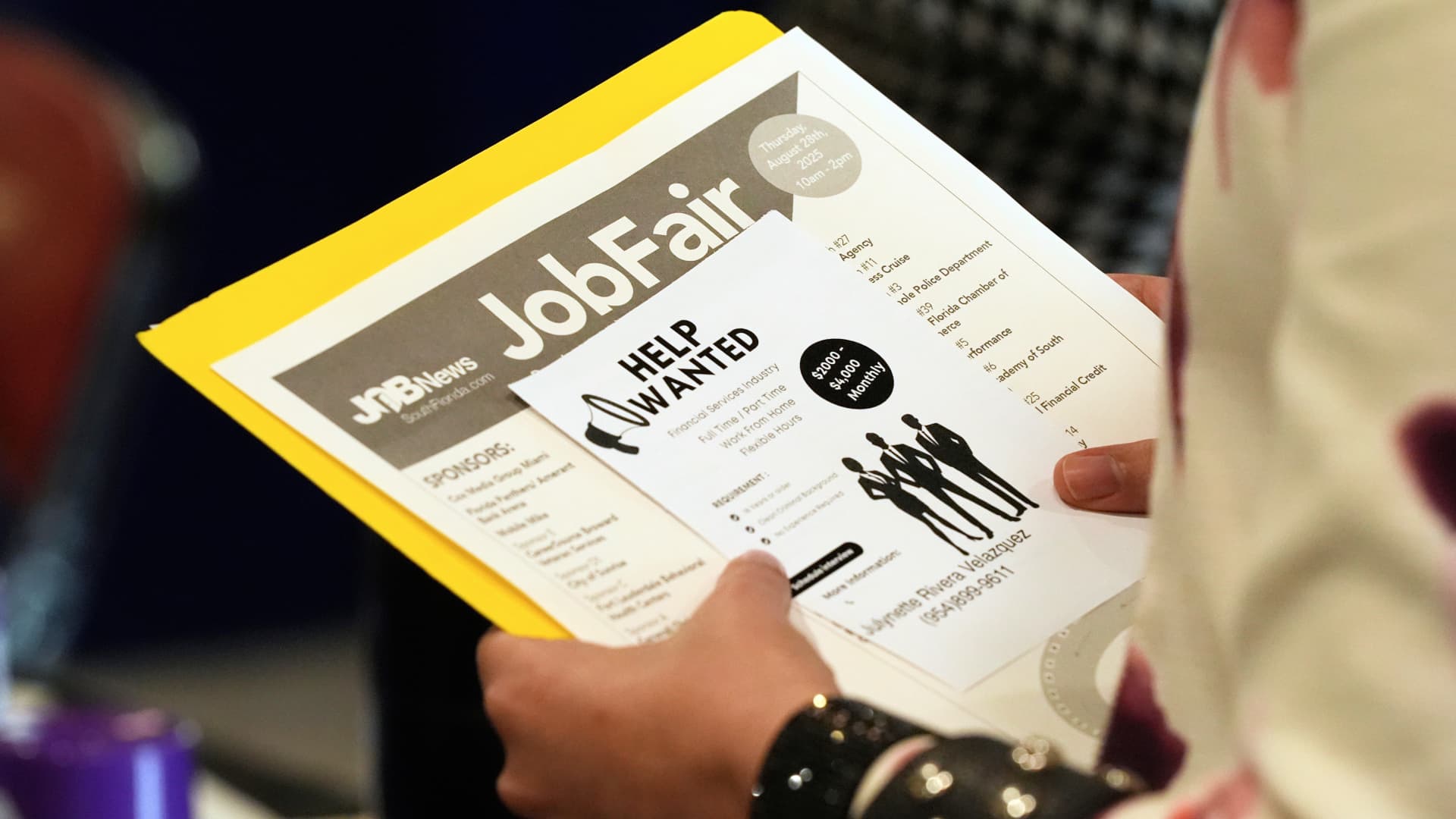
A job seeker waits to speak with a recruiter at a job fair on August 28, 2025 in Sunrise, Florida.
Marta Lavandier | AP
Experts say the U.S. unemployment insurance system is unprepared for a recession, with benefits in many states falling far short of workers’ wages.
Most states currently offer maximum benefits that fall well below the bipartisan recommendation that maximum benefits cover at least two-thirds of a worker’s historical average weekly wage, according to an analysis provided exclusively to CNBC by Michelle Evermore, a senior fellow at the National Academy of Social Insurance, a nonprofit organization focused on the nation’s safety net.
“The takeaway here is that the weekly maximum is stagnant, so the UI will not be able to act as a stabilizer in 2026 as it did in 2008,” Evermore told CNBC.
The maximum weekly benefit in Alabama is $275, but if you replace two-thirds of the state’s average weekly wage, it would be about $615, according to Evermore’s research. In California, the maximum weekly benefit amount is $450, but the recommended amount is approximately $918. The maximum weekly payment in New Hampshire is $427, but the maximum proposed benefit is more than $1,008.
Evermore said some states, such as California and Florida, haven’t raised weekly benefit caps in decades, even as the cost of living has skyrocketed.
Benefits may not cover basic costs
The findings come at a time when the job market is depressed and many Americans are struggling with rising costs of daily living.
“When benefits are grossly disproportionate to wages, unemployed workers are unable to pay rent, food, health care and other basic expenses,” said Rebecca Dixon, president and CEO of the National Employment Law Project, a nonprofit advocacy group.
The UI safety net will be particularly stressed if the economy goes into recession or if unemployment rates rise significantly due to artificial intelligence-enabled layoffs.
“AI poses serious risks to jobs, and we are not ready for them,” Dixon said.
The unemployment rate rose slightly to 4.4% in February from 4.3% in January as employment fell in major regions. Economists have also warned that a prolonged war with Iran could push the global economy into recession.
Inadequate benefits can cause widespread economic distress
The Federal National Unemployment Compensation Program was signed into law as part of the Social Security Act on August 14, 1935 (by this time Italy, Poland, and Great Britain had already established their own unemployment insurance systems). According to the U.S. Department of Labor, it was the height of the Great Depression, and between 11 million and 15 million Americans were unemployed.
The purpose of this insurance program was to protect the economy during economic downturns and allow the unemployed to continue paying their bills and have the time they needed to find another suitable job.
However, Evermore said current advantages may not allow those goals to be achieved.
His analysis found that nearly all states fall short of the recommended maximum benefit amount, which is set at two-thirds of average weekly wages.
Even this proposed formula may be outdated. Congressional Democrats last year recommended a 75% replacement rate.
“Our bill delivers long-overdue improvements to our unemployment system and helps families and the broader economy more easily weather future economic shocks,” Rep. Don Beyer, D-Virginia, said in a statement at the time.
Dixon also said a two-thirds replacement rate to maximize benefits is a “conservative recommendation.”
“Recent research shows workers are spending more money on essentials and we have been calling for wage increases,” Mr Dixon said.
Republican lawmakers in some states and conservative think tanks say higher unemployment benefits could discourage people from rejoining the workforce. Supporters of higher pay say it gives people more leeway to find new jobs that match their skills and experience.
AI poses significant risks to jobs, and we are not ready for it.
rebecca dixon
Resident and CEO of the National Employment Law Project
But Moody’s chief economist Mark Zandi said insufficient unemployment benefits risked worsening the economic downturn.
“UI benefits are the foundation of economic support for workers and the economy during difficult economic times,” Zandi said.
“That support is being eroded by stricter eligibility rules, fewer real benefits, and an outdated UI system,” he added. “This almost certainly means the next recession will be longer and deeper.”
Short-term benefits are “not meaningful support”
The duration of UI benefits is also becoming shorter, according to Dixon. She added that AI-driven changes could make finding a new job especially difficult.
According to the U.S. Bureau of Labor Statistics, as of February 2026, nearly one in four unemployed people is considered “long-term” unemployed, meaning they have been out of work for more than 27 weeks. It took the average unemployed person about 25 weeks to find a new job.
Most states offer 26 weeks of benefits, but some states provide much less assistance. For example, in Florida and Arkansas, insurance payments expire after just 12 weeks.
“When benefits are this short, they do not provide meaningful support to workers who have permanently lost their jobs,” Dixon said.
