

Seoul, South Korea
—
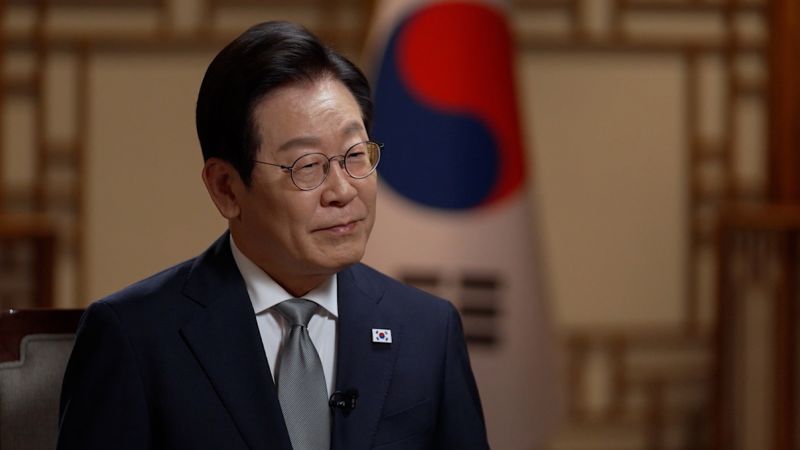
South Korean President Lee Jae-myung praised the country’s relationship with the United States in a CNN interview on Wednesday, setting aside lingering trade concerns and hailing US President Donald Trump as a “peacekeeper” as he prepares to visit Asia.
Speaking hours after North Korea tested a ballistic missile in its first show of force since taking office in June, Mr. Lee acknowledged that tensions on the peninsula had “worsened” in recent years.
But he downplayed the risks, reiterated the need to pursue peace and dialogue, and raised the possibility of President Trump bridging the gap between North and South.
“I hope that (President Trump and North Korean leader Kim Jong Un) will be able to have a dialogue,” he said. “I also believe that President Trump wants to achieve world peace, which is why I have recommended that he take on the role of peacemaker.”
Although it remains unlikely that President Trump will meet with Kim during his multiple trips to Asia later this month, Lee said it would be “a good thing” if “the leaders of the United States and North Korea could suddenly come together.”
Trump met with Kim several times during his first term, holding a landmark summit, but ultimately failed to produce meaningful progress. However, during a meeting with Lee at the White House earlier this summer, the US president said he was willing to meet Kim again.

President Trump is also scheduled to meet with Chinese leader Xi Jinping next week when South Korea hosts the Asia-Pacific Economic Cooperation (APEC) summit in Gyeongju, attended by leaders and delegations from around the region.
President Trump has said by Friday that he intends to meet with Xi on the sidelines of a key summit, but it is not clear when or where that will take place. Tensions between the two rival powers remain high following new trade disputes and the threat of a raft of tariffs.
South Korea has always walked a fine line in its relations with the United States and China. South Korea and the United States have been staunch allies for more than 70 years and have grown closer in recent years in joint efforts to counter China’s growing influence in the Asia-Pacific region. South Korea is also home to the US military’s largest overseas base, home to 41,000 people, including soldiers and their families.
However, South Korea and China also maintain strong trade ties.
“We have different ideologies, we have different governance systems… (but) we can’t keep China out,” Li said, adding that the “important” alliance with the United States made managing China relations “a little delicate.”
“When it comes to relations between countries, you can’t just cut it with a knife and say, ‘This country is our friend, but this country is not our friend.’ It’s not that simple, it’s much more complicated and complicated,” Lee said.
China’s ambitions and growing capabilities in high-tech industries pose challenges for South Korea, which has long been considered a world leader in these important sectors.
Although Lee acknowledged that Chinese companies are catching up (and in some cases overtaking) South Korean companies, he said, “There are still many areas where Korean companies can win,” such as semiconductors and automobiles.
Lee said South Korea is committed to sharing this expertise with the United States as well, highlighting bilateral ties that include economic, technological, and military cooperation.

“We have received tremendous support from the United States, so we would like to support the United States’ manufacturing reform efforts as much as possible,” he said.
His tone was strikingly warm, even as U.S.-South Korea relations have been strained in recent months by President Trump’s immigration crackdown. Last month, an ICE raid at a Hyundai plant in Georgia arrested and detained nearly 500 people, mostly South Koreans, sparking outrage in the country. The car manufacturer is one of the largest companies in South Korea.
After the detainees were repatriated to South Korea, President Trump posted online: “I do not want to scare or discourage foreign countries and businesses from investing in the United States.”
South Korea also had to deal with President Trump’s tariff demands. The move came as the country was dealing with the fallout from former President Lee’s brief declaration of martial law, which was followed by a revolving door of interim leaders amid economic turmoil.
In late July, just a month after taking office, Lee negotiated a trade deal with the Trump administration to avoid high tariffs on South Korean exports, including $350 billion in investment flows from South Korea to the United States. But detailed negotiations have dragged on, leaving the country’s main auto manufacturing industry subject to a 25% tariff from the United States, putting rivals in Japan and Europe at a disadvantage, having already secured much lower rates.
Lee acknowledged that there are “differences of opinion” between South Korea and the United States in the ongoing talks, but said, “I believe that ultimately an agreement will be reached because the United States is the leading country when it comes to the values of democracy and the free market system.”
Some critics have called Trump’s tariff demands outrageous, especially for a longtime ally and friend like South Korea. When asked what he thought about this, Lee just laughed.
“Ultimately, I believe we will be able to reach an acceptable and reasonable outcome,” he said with a smile.
