

tel aviv
—
In any other year, it would be nearly impossible to drive through Tel Aviv’s Dizengoff Square on the Jewish holiday of Purim. Children and adults in costumes fill the streets, rooftop parties blare music, and residents party until dawn. Tel Aviv, which boasts of being the “city that never stops,” lives up to its nickname on this holiday.
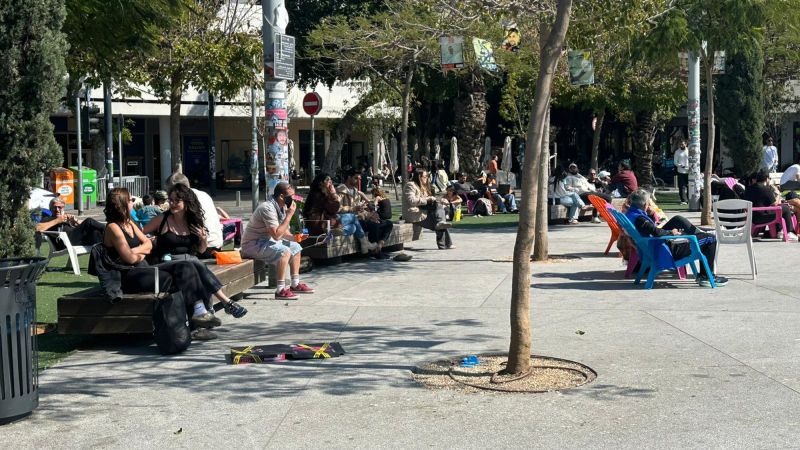
But this year, the square was quiet because the public holiday begins Monday night. The streets have been largely empty since Israel and the United States launched attacks on Iran on Saturday. Several partially costumed people sat in an outdoor cafe, looking out of place among closed shops and empty sidewalks. Many of those who ventured out of their homes were able to catch a brief glimpse of sunlight between air raid sirens.
“If this was a normal Purim, I wouldn’t have been able to move here,” said Daphna Lustig, a writer in her 40s whose house overlooks the square. At that moment, an alert from the Home Front Command rang on her cell phone. Within minutes, the square was empty.
Iran has fired dozens of ballistic missiles at Israel since Saturday, forcing its citizens into shelters and safe rooms, some sharing underground spaces with strangers.
“There’s no sense of panic,” Lustig said. “Unlike previous rounds, people know they have time. They don’t jump up in fear. It’s depressing to call this a ‘routine,’ but there’s a routine of sorts.”
The drill is familiar to Israelis, who are accustomed to the sound of sirens after nearly two and a half years of conflict. Since the Hamas-led attack on Israel on October 7, 2023, Israel has faced rocket attacks from Gaza and missiles from Hezbollah, as well as drones and ballistic missiles from Iran and Yemen’s Houthis.
“It’s calmer than previous rounds,” said Robin Isberg, a Boston native who was relaxing in the plaza with two friends in their 20s. “The atmosphere is not so grim. The last Iran war (June 2025) was like boot camp for us. We had to be ready in seconds with backpacks, portable chargers, snacks and water. I don’t know if it’s because we’ve built resilience or if it’s just become the new normal.”

The Israeli public so far generally supports the military operation. A February poll by the National Security Institute, a Tel Aviv-based think tank, found that 78% of Israelis consider Iran the security issue of greatest concern, and 50.5% of those surveyed said they would support an independent Israeli strike even if a nuclear deal was reached between the United States and Iran.
The prospect of a new conflict with Tehran has been growing for weeks, after US President Donald Trump pledged aid to Iranian anti-government protesters in early January. This allowed the Israelites to prepare both physically and mentally.
Taylor Sanchez, who immigrated to Israel from Orlando, Florida, two and a half years ago, said she has plans for Purim. Her costume is ready at home, and despite the lack of celebrations, she was thinking of using it “just to walk around. We try to get out as much as possible. We know where shelter and safe places are.”
But Sophie Reb, also from Florida, said she pitched a tent overnight at the nearby Dizengoff Center mall. “This time, unlike previous rounds, I’ve known this day would come for weeks. I finally feel like I’m at least less anxious,” she said. Still, she added, she has mixed feelings. “My body reacts to every noise and sound. It’s tough training my body to get used to this situation.”

After more than two years of conflict, some Israelis say a prolonged war will only increase public discontent. “At some point, if you feel like the goals are starting to become less important, people will lose patience like they did in the last round,” said San Breicher, a Tel Aviv resident.
“But for now, we feel this is a necessary war and a regional opportunity that Israel had to seize. It feels right and moving in the right direction.”
