

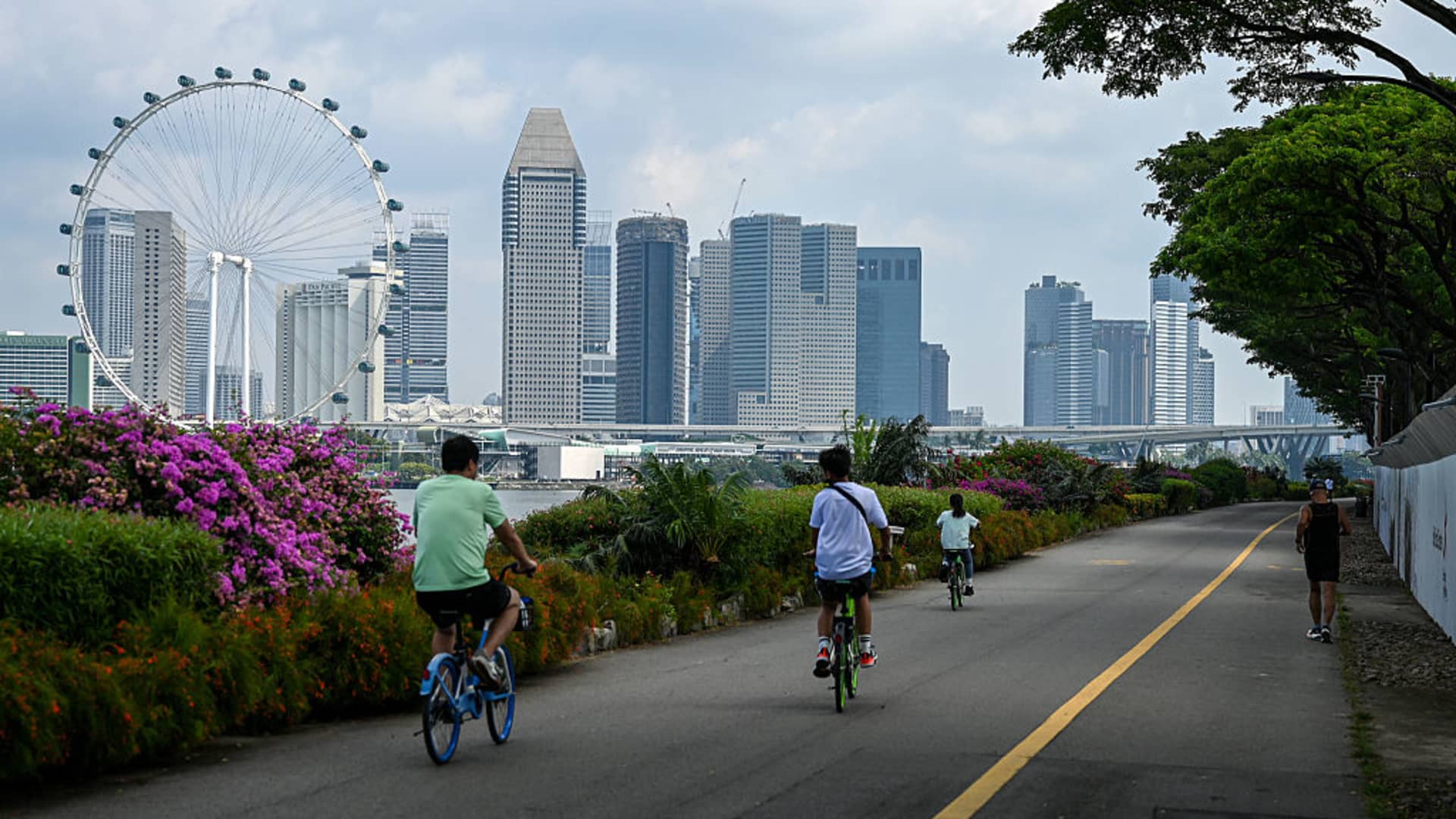
People riding bicycles with the Singapore skyline in the background on June 27, 2025.
Roslan Rahman | AFP | Getty Images
Singapore on Friday raised its economic outlook for 2025 after strong third-quarter growth, but warned that economic expansion is likely to slow in 2026 as U.S. tariffs weigh on global demand.
The Ministry of Trade and Industry has raised Singapore’s 2025 GDP forecast to around 4% from the previous range of 1.5% to 2.5%, mainly due to better-than-expected economic growth in the third quarter.
“Global economic conditions have proven more resilient than expected,” MTI said in a statement, citing rising demand from major trading partners, increased demand for semiconductor exports due to the artificial intelligence boom, and easing trade tensions between the United States and China.
According to government data, the economy grew 4.2% in the July-September period from a year earlier, extending the 4.7% increase in the second quarter. Growth in the third quarter also beat the official October forecast of 2.9% and the 4.0% expected by economists polled by Reuters, despite trade headwinds that have strengthened over the past three months.
Authorities have predicted that Singapore’s economic growth rate will be between 1% and 3% in 2026.
Seasonally adjusted GDP rose 2.4% sequentially, up from 1.7% in the second quarter.
The government said growth in the third quarter was driven primarily by manufacturing and export demand, noting that electronics manufacturing expanded 6.1%, supported by increased demand for AI-related semiconductors and servers.
“Demand for AI-related electronics will continue to support manufacturing and wholesale trade for the remainder of the year,” the ministry said.
In the first nine months of 2025, the economy grew by 4.3% compared to the previous year.
Singapore’s economy is expected to perform relatively well this year, but officials warned that growth prospects for 2026 remain uncertain.
“GDP growth in most of Singapore’s major trading partners is likely to be lower than in 2025 as the impact of US tariffs is expected to become more pronounced,” MTI said, warning that global economic uncertainty remains elevated.
trade headwinds
Singapore’s exports to the US are subject to a basic customs duty of 10%, which is relatively low compared to the rates imposed by its Southeast Asian neighbors.
However, sectoral taxation, including the pending 100% tariff on branded medicines, remains a major concern for Singapore’s economy.
Prime Minister Lawrence Wong noted last month that trade talks between Singapore and Washington were at a “very early stage” and said: “Right now, there is still not a lot of clarity on how the US intends to apply these sectoral tariffs, for example on pharmaceuticals.”
Implementation of the tariffs was delayed to allow time for pharmaceutical companies to negotiate exemptions with the US government.
Non-oil domestic exports (NODX) fell by 3.3% in the third quarter, after rising 7% in the April-June quarter, weighed down by weak exports of pharmaceuticals and petrochemical products. Shipments to the United States fell 30.7% over the same period.
However, NODX recovered in October, rising 22.2% year-on-year, driven by exports of non-monetary gold and electronic products. Shipments to the US in October decreased by 12.5% compared to the same month last year.
Lloyd Chan, a strategist at Bank of Mitsubishi UFJ, said in a note on Friday that the Monetary Authority of Singapore is not expected to change its monetary policy stance at its next meeting in January as growth momentum is largely maintained.
The central bank left policy unchanged at its final review of the year in October, citing stable economic performance and subdued inflation.
Singapore’s consumer price inflation rate rose 0.7% in September from a year earlier, in line with the central bank’s forecast of 0.5-1% this year.
