

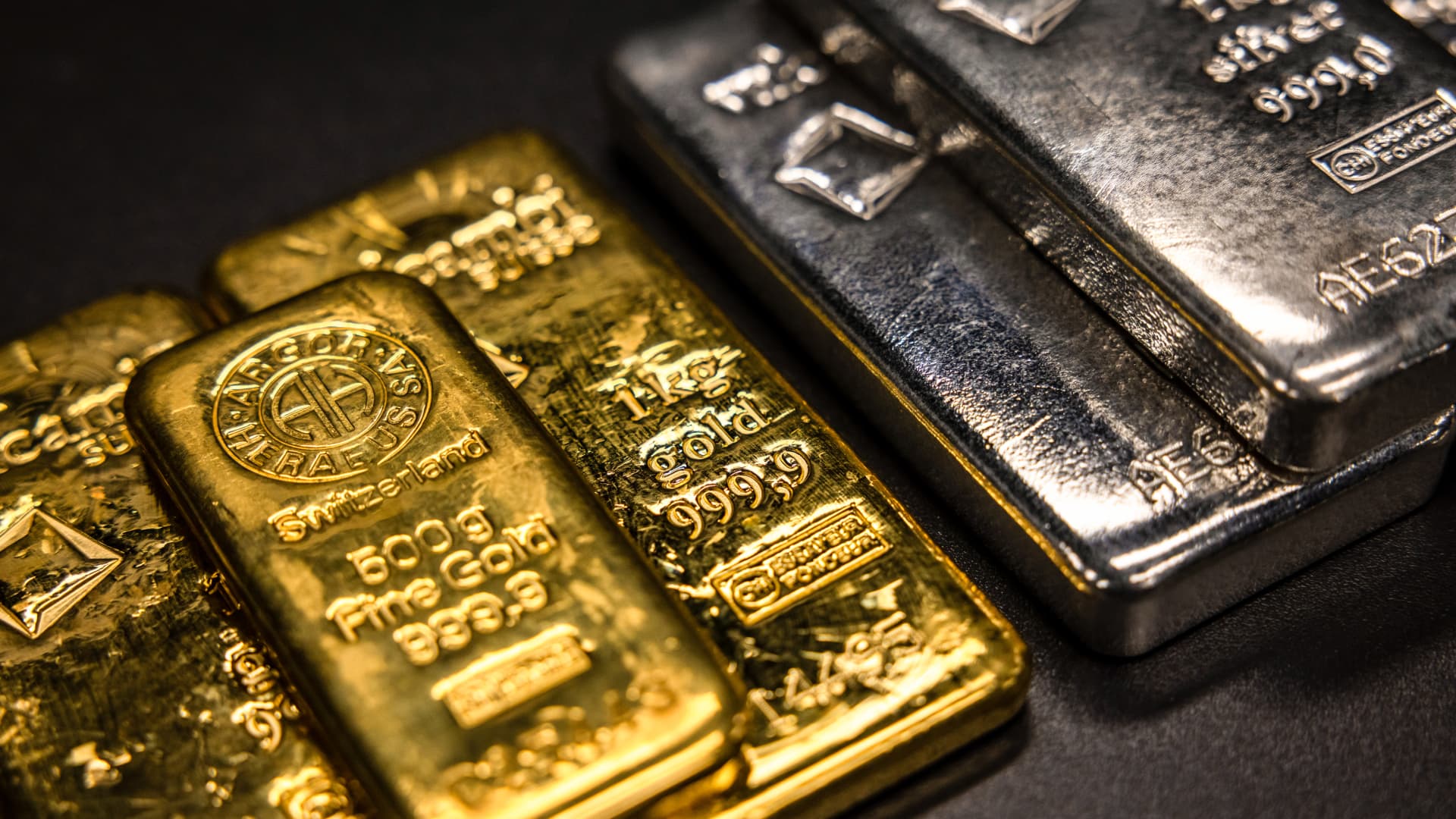
Gold and silver ended 2025 on a record high after a record rally, but money managers are betting on the metals to reach a new milestone this year as supply constraints, geopolitical tensions and concerns about central bank independence fuel demand. Gold soared to a record high of more than $4,600 an ounce on Monday following news that Federal Reserve Chairman Jerome Powell is under criminal investigation in connection with the $2.5 billion renovation of the central bank’s headquarters. By early Wednesday morning, spot gold had moved higher, trading around $4,633.46 an ounce. Meanwhile, physical silver, which breached the $90 mark for the first time on Tuesday, was last trading 3.5% higher at $90.42 an ounce. XAU= Year-to-date Gold Price ‘Resource nationalism’ drives metal prices higher Daniel Casali, investment strategy partner at British asset management firm Evelyn Partners, said on Tuesday that his team was very positive about both gold and silver. He said geopolitical instability, such as Russia’s full-scale invasion of Ukraine in 2022 and US President Donald Trump’s so-called “Liberation Day” tariff announcement last April, created uncertainty, which continued to support gold prices. As major countries continue to step up trade war tactics, an environment of “resource nationalism” is emerging that continues to boost precious metals markets, Casali said. “When President Trump started raising tariffs, China started reacting, which sparked what I would define as a battle of resource nationalism between the United States and China,” he said on a CNBC phone show. “China responded[on Liberation Day]by restricting the export of rare earths, and what the US discovered is that those rare earths are absolutely essential for its defense, technology, AI, everything,” he added. “And… fast forward a little bit. There are export restrictions on silver. And again, silver is essential for AI technology, EVs, renewable energy, and is a key part of industrial production in the United States and the Western world.” Casali said investors are currently awaiting the outcome of a face-to-face meeting between President Trump and Chinese President Xi, scheduled for April. “What’s going to happen? I have no idea,” he said. “But there is no doubt that the bottom (export controls) will be a key discussion point.” In just the first week of 2026, White House talk of possible military action for the United States to oust Venezuelan President Nicolás Maduro and take control of Greenland further heightened the political stakes and added uncertainty to support the rally in precious metals. “Both presidents are positioning their countries to (try to) gain influence over the other country,” Casali said of the leaders of the United States and China. “China will export rare earths and silver, among other things. And what Trump is doing now is trying to limit the resources that go to China, such as Venezuelan oil. Most of China’s energy goes to China, and Trump wants American companies to control that oil.” He said: “All the pieces in the geopolitical chess are moving, but I think the important message here is that resource nationalism can drive up the price of gold and silver.” $100 Silver, $5,000 Gold? Ned Naylor Leyland, an investment manager in Jupiter Asset Management’s gold and silver team, said in an interview on CNBC on Tuesday that it’s “absolutely” possible for gold to hit the $5,000 mark this year and for silver to cross the $100 milestone. He added that given the underlying factors driving metal prices higher, investors “should definitely assume that’s the case this year.” In 2025, spot gold rose about 65%, breaking multiple price records throughout the year, while silver rose about 150%. Gold is currently up 7.1% year-to-date, and silver is up 26.6% so far in 2026. Naylor-Leyland told CNBC he expects gold to follow a similar trajectory this year, with silver outperforming again in 2026. Like Casali, he pointed to a shortage of physical silver due to export restrictions imposed by the Chinese government last year. “Silver is basically disappearing into China and India right now, with about a $10 premium being paid in Shanghai,” he said, adding that the silver market is now physical bullion only, suggesting prices could rise “significantly.” “If we continue to see such a wide disparity between the price paid in Shanghai and the price on Western screens, the remaining physical silver sitting around, whether in the New York futures market or the London futures market, should continue to head east.” “The thing about silver is that you can’t build anything without it,” Naylor Leyland said. “Whether it’s electronics, white goods, missiles or cars, you don’t have it and you can’t have it.” On gold, Naylor Leyland said the yellow metal was likely to continue rising due to growing geopolitical uncertainty. “Gold’s base case assumes (central banks) remain dovish, which we think is very likely. That should support continued upside in USD gold prices,” he said. “We’re in a rate-cutting environment with unconventional policy and Fed Chairman Powell in a corner. Unless we change policy and they don’t get hawkish and start raising rates, we can expect gold to move as much as last year or more. This is a deteriorating forecast, and the impact remains significant.” Invesco EMEA Paul Sims, head of ETF fixed income and commodity product management, also told CNBC that the trends that drove metal prices up last year may be more prevalent now. “Yesterday, Federal Reserve Chairman Jerome Powell’s statement regarding the investigation into testimony and rationale for renovations to the Federal Reserve Building heightened concerns about the independence of Fed and U.S. monetary policy and further fueled interest in gold, which is seen as a safe-haven asset and inflation hedge,” he said in an email. More than a dozen global central bankers, including the presidents of the European Central Bank and the Bank of England, defended Powell in a statement Tuesday, saying they stood in “full solidarity” with the Fed and the chairman. “Gold and silver are near all-time highs, but there doesn’t seem to be any catalyst that could cause prices to fall in the short term,” Sims told CNBC. “Indeed, the US dollar, fiscal deficits (in the US and other developed markets), the prospect of lower interest rates while geopolitical tensions remain high, and, for silver, continued concerns about rising industrial demand all seem likely to support precious metals.”
