

Tom Cruise and Brad Pitt engage in hand-to-hand combat on a rooftop strewn with debris. Donald Trump takes on kung fu warriors in a bamboo forest. Kanye West dances around China’s imperial palace while singing in Mandarin.
Over the past week, dozens of movie videos have circulated online showing celebrities and characters in absurd situations, but they all have one thing in common. The videos were created using new artificial intelligence tools from Chinese developer ByteDance, raising concerns about the rapidly evolving capabilities of AI.
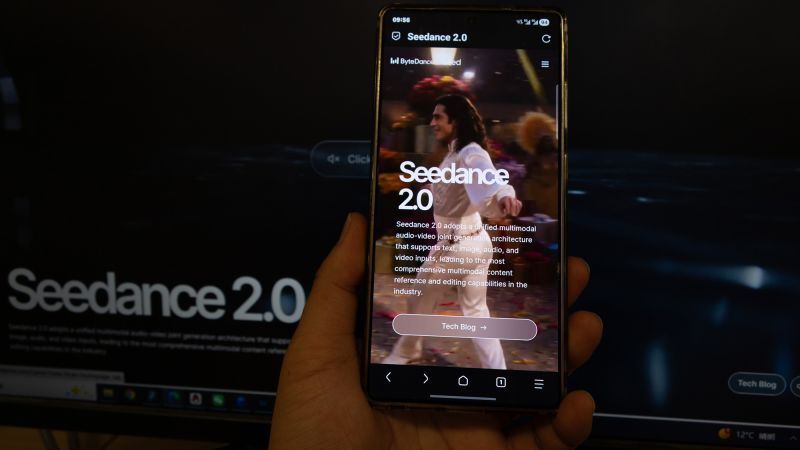
The new model, named Seedance 2.0, is one of the most advanced of its kind and quickly garnered praise for its ease of use and the realistic nature of the videos it can produce in minutes.
However, shortly after the release, media giants Paramount and Disney sent a cease-and-desist letter to ByteDance, the company best known for developing the video-sharing app “TikTok,” accusing it of infringing on their intellectual property. Hollywood’s main trade group, the Motion Picture Association of America and the labor union SAG-AFTRA, also accused the company of using American copyrighted material without permission.
ByteDance responded with a statement saying it would introduce better safeguards to protect its intellectual property.
Seadance 2.0 has quickly become the most controversial model in a series of models launched by Chinese technology companies this year as competition to dominate the AI industry intensifies.

The Chinese government has placed advanced technology as an important concept in its national development strategy. The country’s newest humanoid robot stole the show with its martial arts skills, spin kicks and backflips during a Lunar New Year celebration broadcast this week.
Such improvements are often met with anxiety, especially in the United States, China’s biggest technological and political rival, in a spiral of one-sidedness reminiscent of the 20th century space race with the Soviet Union.
“There’s a kind of nationalistic frenzy about who will ‘win’ the AI space race,” said Ramesh Srinivasan, a professor of informatics at the University of California, Los Angeles. “That’s part of what we see unfolding over and over again every time this news breaks.”
Here’s why ByteDance’s latest technology is shaking the world.
Although not yet available to everyone, this AI video generation model was hailed by many as the most sophisticated of its kind to date, using images, audio, video, and text prompts to rapidly churn out short scenes with sophisticated characters and motion editing controls at low cost.
“My glass-half-empty view is that Hollywood has been revolutionized and is on the verge of decline,” Rhett Reese, the writer and producer behind the Deadpool films, wrote to X after watching the Cruise and Pitt video.
A Chinese technology blogger using Seedance 2.0 said that Seedance 2.0 is so advanced that it can generate realistic audio of his voice based solely on his image, raising concerns about deepfakes and privacy. ByteDance has since rolled back that feature and introduced authentication requirements for users who want to create digital avatars with their own images and voices, according to Chinese media.
Rogia Creamers, an assistant professor at Leiden University in the Netherlands who studies China’s domestic technology policy, said part of the concern stems from the rapid pace at which Chinese companies are releasing new AI technology this year.
As a result, China is also lagging behind in assessing the potential negative impact of each improvement, he said.
“The more sophisticated these apps are, the more potentially harmful they automatically become,” Creamers said. “It’s a bit like cars: If you make a car that can drive faster, it gets you there faster, but it also means you might crash sooner.”
In response to the outcry from Hollywood, ByteDance said in a statement that it respects intellectual property rights and will strengthen safeguards against unauthorized use of intellectual property and likeness on its platform, but did not say how.
User complaints prompted ByteDance’s recent rollback, and popular Chinese Instagram-like app Red Note was also forced to restrict AI-generated content that wasn’t properly labeled.
And the arrival of Seedance 2.0 coincides with stricter regulations on AI content in China.

China’s domestic regulation of AI exceeds the efforts of most other countries in the world. One reason for this is the long-standing censorship system. Last week, the Cyberspace Administration of China announced it was cracking down on unlabeled AI-generated content, penalizing more than 13,000 accounts and removing hundreds of thousands of posts.
But restrictions on AI-generated content on China’s internet are often unevenly enforced, Nick Corvino said in China Talk, a China-focused newsletter. He attributed the problem in part to the difficulty of policing content across different apps and incentives for tech companies to encourage user content.
“Chinese social media platforms are locked in fierce competition with each other and with Western markets, and while no one wants to be the strictest enforcer, there are others who are allowing content to flow freely,” he said in a post after the launch of Seadance 2.0.
Analysts say China is walking a fine line between encouraging the domestic development of AI models and maintaining strict control over how those models are used.
“People in the AI industry always say that what the Chinese government is doing is slowing down the development of AI,” said Leiden University’s Creamers. “It’s clear that content management systems like China inherently limit what you can create, which is never fun.”
Pressure from major U.S. media outlets and other sources to stop using certain images and data could also impact efforts to improve AI. Disney, which accused ByteDance of illegally using its IP to train SeaDance 2.0, recently signed a deal with U.S. company OpenAI to give Sora, a SeaDance competitor with OpenAI’s video generation model, access to trademarked characters such as Mickey Mouse and Minnie Mouse.
“These contracts are all about what kind of data you can access that you don’t have access to under other contracts or that your competitors don’t have access to,” said UCLA’s Srinivasan. “The better the data for training models, the more likely it is that Sora products will become more sophisticated and advanced.”
At the same time, restrictions on how AI is used and trained can also foster greater innovation, he said, pointing to how Chinese company DeepSeek, which had a much smaller budget than industry leaders, built a competitive AI-powered chatbot.
“When it comes to China’s breakthrough in AI, the DeepSeek revelation was very important because it showed there are other ways to train language models in a more economical way,” he said.
