

Saudi Arabia has publicly accused the United Arab Emirates, a fellow Gulf Arab nation and former partner in the Yemen war, of undermining its national security, an unusually blunt accusation that exposes a rift that has been maintained behind closed doors for years.
The language is among the harshest Riyadh has used against its allies and reflects growing Saudi anxiety over the UAE’s increasingly independent foreign policy, tensions that reached a climax last week with a Saudi attack on a UAE-linked transport ship in Yemen.
CNN has learned that Riyadh is particularly concerned about the UAE’s role in Yemen, which shares a long border with Saudi Arabia, and Sudan, which is across the Red Sea from Saudi Arabia’s west coast. Saudi officials are concerned that instability and state collapse in both countries could have serious implications for their national security.
These concerns extend beyond Yemen and Sudan. Riyadh is also wary of the UAE’s policies in the Horn of Africa and Syria, where it believes Abu Dhabi is fostering ties with members of the Druze community, some of whose leaders are openly discussing secession.
UAE officials told CNN that the country’s foreign policy prioritizes international cooperation and long-term prosperity, as part of a broader commitment to “responsible leadership” and “enduring progress.”
The official did not address allegations about Abu Dhabi’s role in Syria. The UAE does not publicly support the Druze desire for internal autonomy or separation.
For the UAE, southern Yemen’s strategic importance lies in its location along major maritime trade routes and the Red Sea shipping route, and its proximity to the Horn of Africa, where Abu Dhabi has established military and commercial interests. The UAE says its role in Yemen is linked to a broader strategy to combat extremism. ISIS and al-Qaeda have had a presence in the country for many years.

But Yemen, Sudan and the Horn of Africa are much closer to Saudi Arabia than the UAE, making Riyadh feel even more at risk.
Analysts do not expect the rift to escalate into direct conflict, but even a limited escalation could have far-reaching effects. Saudi Arabia and the UAE are among the world’s largest oil exporters and are located near two of the most important maritime checkpoints for global trade, the Strait of Hormuz and Bab al-Mandab, through which a significant portion of the world’s offshore oil flows and many of the ships passing to and from the Suez Canal. Even a limited conflict between the two US allies will be watched closely by energy markets.
They are also the largest and second largest Arab economies, respectively, and their long-term investment commitments to the United States run into the trillions of dollars, particularly in defense and technology, and include access to Washington’s most advanced military systems.
Just a decade ago, Riyadh and Abu Dhabi were closely aligned around the region’s most pressing threats: Islamism, Iran’s growing influence, and the challenges to the regional status quo posed by the Arab Spring-inspired uprisings. Together, they launched a military intervention in Yemen to halt the advance of the Iranian-backed Houthis, supported counterrevolutionary forces in the region, and imposed a punitive blockade on fellow Gulf state Qatar over its alleged support for Islamist movements.

Since then, that alignment has frayed. As some of those threats receded, Saudi and UAE priorities began to diverge and competing agendas came to the fore. In recent years, both sides have found themselves supporting opposing sides in regional conflicts, particularly the civil wars in Yemen and Sudan.
Saudi Arabia is now leveling the UAE with the same accusation that Riyadh and Abu Dhabi once made against Iran: that its support for non-state actors in the region threatens its security. The reversal comes as Iran’s government’s influence weakens and competition for power intensifies.
“How can actions taken to protect shared security be reframed as a responsibility?” Influential lawmaker Ali al-Nuaimi wrote on X, referring to Abu Dhabi’s role in the Saudi-led coalition in Yemen. “Why do those who assume the risks and costs end up being suspect rather than partners?”
UAE officials also noted the “huge sacrifices” made by Abu Dhabi in Yemen “at the behest of the legitimate Yemeni government and the Kingdom of Saudi Arabia.” Dozens of Emirati soldiers have been killed in Yemen during operations in Yemen.
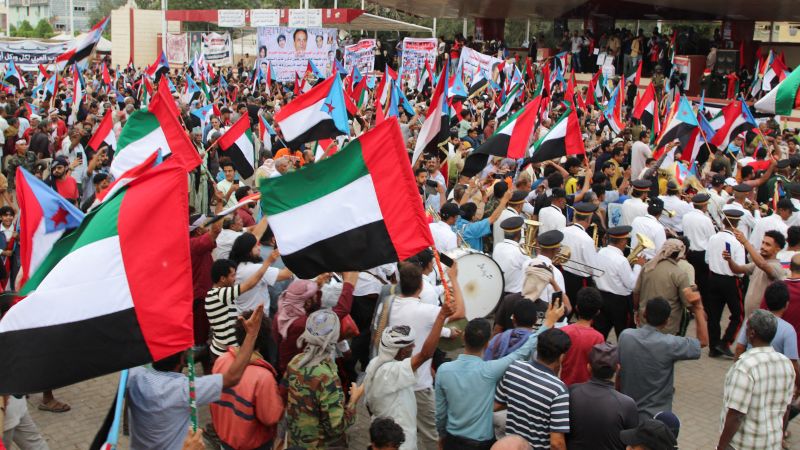
Conflicting interests in Sudan and Yemen finally came to light in early December after Yemen’s UAE-backed separatist Southern Transitional Council (STC) seized control of the country’s south, seizing territory and expelling Saudi-backed Yemeni government forces from those areas.

CNN believes Saudi Arabia mobilized Yemeni separatist forces in states bordering the kingdom following false information that Saudi Crown Prince Mohammed bin Salman, during a visit to the White House in November, asked US President Donald Trump to impose sanctions on Abu Dhabi over its alleged support for warring parties in Sudan’s civil war. Riyadh contacted the UAE and explained that it had not made any such request.
UAE officials contacted by CNN did not directly address the issue in response to questions.
Underscoring its message of zero tolerance against instability on its borders, Riyadh launched airstrikes against UAE shipments in Yemen on Tuesday, supporting the Yemeni government’s call for UAE troops to leave the country. Although the UAE has pledged to withdraw, anti-UAE rhetoric in Saudi state media and influential commentators has only intensified.

CNN understands that further Saudi attacks targeting the STC remain under consideration if the separatists do not withdraw. The STC moved to leave after the UAE withdrew its troops from Yemen last week, but came under intense military pressure from Riyadh and local allies, losing territory and being forced to concede to entering talks with Saudi Arabia, a potential setback for Abu Dhabi.
The message from Riyadh is clear. Saudi Arabia sees itself as the pinnacle of the Arab and Islamic worlds and expects other countries to follow suit.
“[In the Gulf Arab states]we are seeing a recurring phenomenon resulting from structural imbalances between one very large state, Saudi Arabia, and a large number of much smaller states,” Ali Shihabi, a prominent Saudi commentator, wrote in X. As they gain more power, they often begin to operate under the illusion that they are equal partners in the kingdom rather than beneficiaries of an ultimately stabilized system.To assert their individualism, they regularly adopt and signal contrarian political positions. Independence. ”
In particular, the UAE has sought to emphasize its independence from regional powers in recent years, pursuing policies that break with traditional regional agreements, such as normalizing relations with Israel before establishing a Palestinian state and intervening in countries far beyond its neighbors to counter the perceived threat of Islamism.
Late last year, in an interview with CNN’s Becky Anderson, Anwar Gargash, the diplomatic advisor to the UAE president, outlined Abu Dhabi’s geopolitical vision for the region in relation to Sudan, framing it in terms of countering extremism and promoting regional stability.
“We are an influential country in the region,” he said. “Maybe some people don’t like that, but the fact is we do. As a result, I think we have a regional perspective on what we want from the countries around us.”
Gargash has previously said Abu Dhabi’s independent approach stems from the idea that “a country of our size risks being alienated if it becomes isolated.”
“Illuminate the dark earth”
The UAE bills itself as a paragon of Arab modernity, an island of stability in a turbulent region, and has built a record that supports that narrative. In the 54 years since its founding, the country, roughly the size of Austria, has grown to become the Arab world’s second-largest economy, diversified more successfully than many of its oil-rich neighbors, and emerged as a major global investor with influence in Washington, Europe and beyond. Home to some of the region’s most cosmopolitan cities, their ambitions also reflect space.

Surveys consistently rank the UAE as the top destination for young Arabs seeking opportunities abroad, eclipsing Western countries that once dominated those aspirations.
“We are in a volatile region. It is a difficult region with challenges and different perspectives,” UAE President Mohammed bin Zayed Al Nahyan said in a speech to Emirati youth in 2019, when he was Crown Prince of Abu Dhabi. “But I am convinced that our country, the UAE, today is like a light shining in a dark land and an example for other countries. I salute all our neighbours.”
Despite the unprecedented nature of the rift between Riyadh and Abu Dhabi, experts do not expect it to widen significantly – at least not to the scale of the previous intra-Gulf crisis, when Saudi Arabia and the UAE led a blockade of Qatar from 2017 to 2021.
“There is likely to be more economic competition, and there will inevitably be competition in how to explain and finesse both countries’ foreign policy approaches to the White House,” said Karen Young, a senior research fellow at Columbia University. “Both countries will seek US support and this will be a tension point for future tensions between the US (and) Israel and Iran.”
Under Crown Prince Mohammed bin Salman, Saudi Arabia has made economic transformation a top priority, and that change is increasingly shaping its foreign policy calculations. Christian Coates-Ulliksen, a researcher at Rice University in Houston, Texas, said the focus is likely to make Riyadh less escalatory.
“While both countries have the financial power and economic clout to match each other, one of the lessons of the Qatar blockade is that attempts to isolate Qatar have failed unless Doha is forced to make concessions,” he said. “The fact that both Saudi Arabia and the Emirates are investing heavily in deepening ties with the Trump administration means that Washington could become a competitive proxy if the situation escalates.”
