

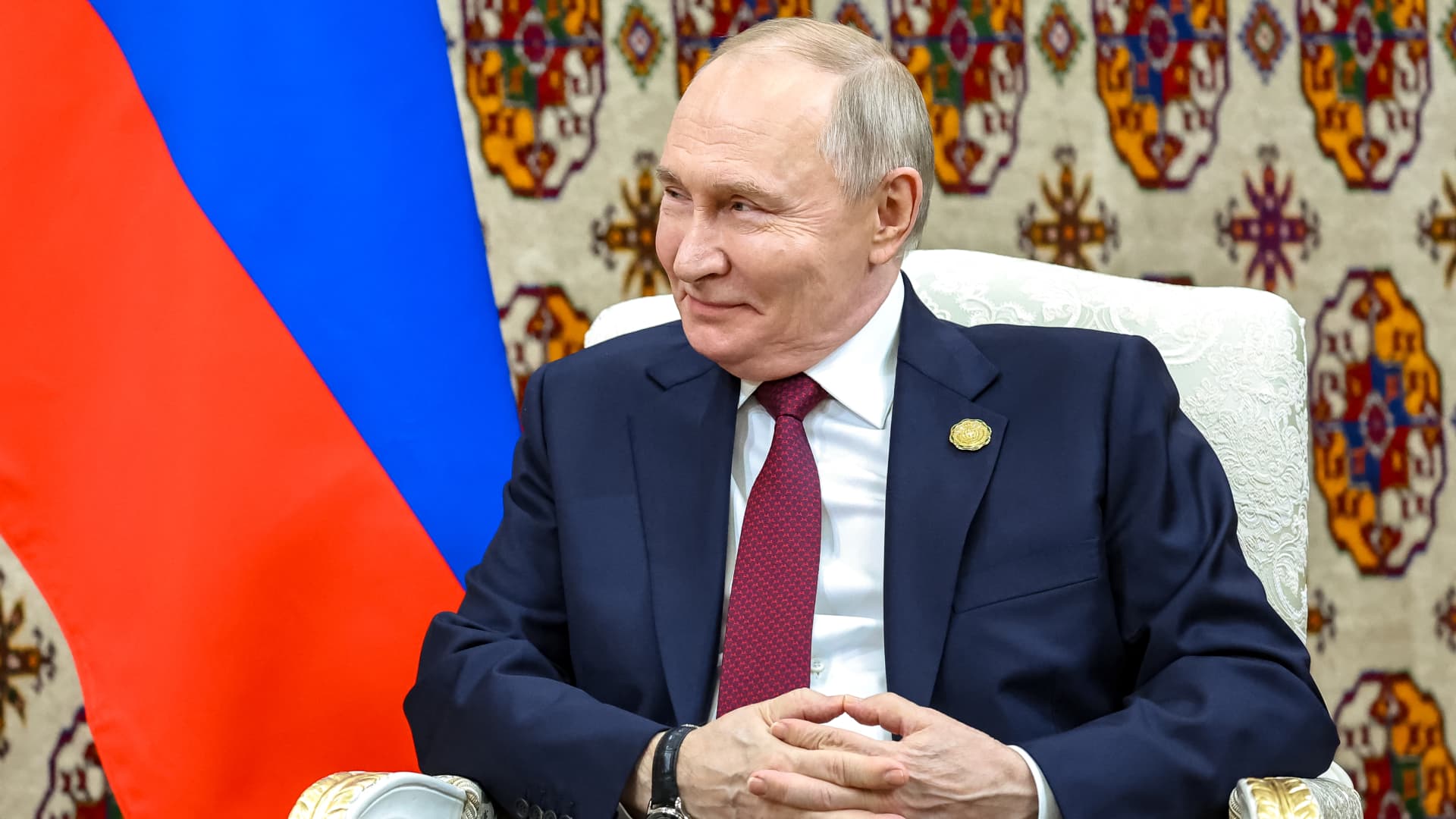
This pool photo distributed by Russia’s state agency Sputnik shows Russian President Vladimir Putin attending a meeting with the Iranian president in Ashgabat on December 12, 2025.
Alexander Kazakov | AFP | Getty Images
Russia is in the strange position of benefiting from the turmoil hitting Iran, its partner and ally in the Middle East.
The Iranian government’s near-total blockade of the Strait of Hormuz has caused a spike in global oil and gas prices, filling the coffers of major oil and gas producers such as Russia.
Sergey Vakulenko, a senior fellow at the Carnegie Russia and Eurasia Center, told CNBC on Tuesday that Russia’s windfall from rising energy prices from the Iran war was in the billions of dollars.
“So far, oil prices, especially Ural prices, have increased by more than $60 per barrel, which gives the Russian state almost $9 billion per month, which is a significant amount,” he told CNBC’s “Squawk Box Europe.”
“Even countries that were considering cutting back on oil from Russia, such as India, are increasing their purchases again, and the United States has issued waivers to do so,” he said, referring to a 30-day waiver issued by the White House in early March that allowed countries to buy sanctioned Russian oil and oil products stranded at sea to curb soaring global energy prices.
The price of Russian Ural crude oil was $115 per barrel as of Tuesday. On February 27, the day before the US and Israel began bombarding Iran, the price per barrel was $57. Russia’s exports of helium, aluminum and nitrogen fertilizers also boost state revenues, but they are “an order of magnitude smaller” than oil, he noted.

Brent futures and WTI futures May contract
Vakulenko said Russia’s state budget had its own problems, with a deficit of about $35 billion in the first two months of this year, but the tailwind from the Iran war was “obvious”.
Vakulenko said Russian President Vladimir Putin received a windfall that allowed him to postpone plans to cut state spending in various sectors of the economy that would have been unpopular.
“The amount of time he was spending on wars meant he was basically pawning the country. Now he doesn’t have to do that anymore,” the analyst said.

The longevity of this windfall for Russia will depend on the duration of the conflict, but the turmoil in the Middle East not only relieves some of the fiscal pressure, but also serves as a distraction from the problems that have dogged the Russian economy since the 2022 invasion of Ukraine.
Inflation, currently at 5.9%, remains a thorn in Russia’s central bank, and interest rates must remain stubbornly high at 15%. Russia’s central bank is struggling to contain price increases caused by the Kremlin’s massive military spending and an economy pivoted to serving the country’s war machine, rising food prices, labor shortages and sanctions.
Retired Gen. Richard Shirreff, former NATO Deputy Supreme Allied Commander Europe, told CNBC on Tuesday that the short-term gains Russia was making from the Iran war belied the predicament it was in.
“This is an economy in the realm of death. We are in the exact same position as a climber above 8,000 feet. His body begins to eat away at itself and faces long-term existential damage. But he (Putin) is (now) benefiting economically,” Shalev told Squawk Box Europe.
Ukraine is naturally concerned about the extent to which the war with Iran is benefiting its arch-enemy Russia, not only from an economic but also a geopolitical perspective. Ukrainian President Volodymyr Zelenskyy this week claimed that some of his country’s partners had called on Kiev to scale back strikes on Russia’s oil sector, citing soaring global oil prices.
The Iran war has proven to be a significant distraction from Iran’s own conflict, directing military resources it might have received from the United States toward Iran.
“In the first four days of the war, the U.S. military launched nearly four times as many Patriot missiles as it had delivered to Ukraine in four years,” added Shirreff, co-founder and managing partner of Stratesia Worldwide.
“So Putin benefits because he has less equipment to provide to the Ukrainians,” he said.
