

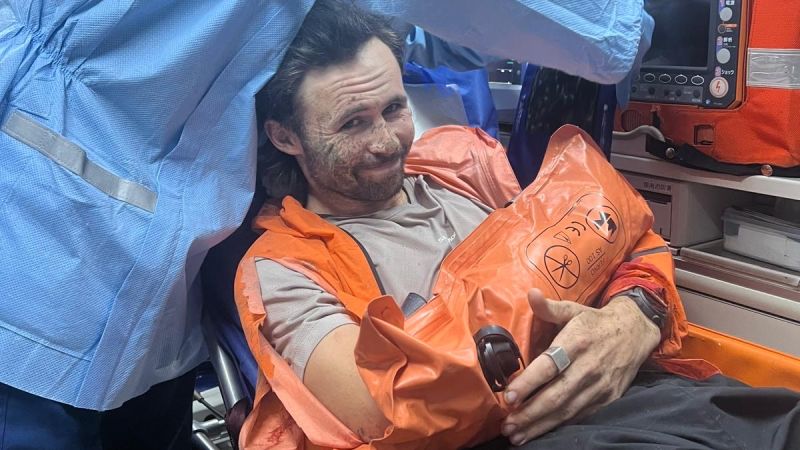
Billy Halloran is no stranger to Japan’s Myoko Forest. He went there regularly to walk, run, and even competed in ultramarathons through the rugged wilderness. But two weeks ago, he was attacked by a bear in the same woods and narrowly escaped with his life.
In early October, Halloran was on his daily run when he spotted something he had never seen before: two black bears.
He quickly realized that he was in trouble. Bear attacks are on the rise across Japan, with more than 100 people injured and at least seven killed so far this year, the highest since records began in 2006. The latest deadly attack occurred just a few miles from where he lives.
Now he was alone on the trail, a few kilometers from where he had parked his car, trying to figure out how to escape two bears staring at him from the bushes less than 30 meters away.
The 32-year-old man from Auckland, New Zealand, said he slowly tried to back away when a bear started moving towards him. “It was about the same size as me, at least 60 or 70 kilograms (about 132 to 154 pounds) as an adult,” he said.

Mr. Halloran decided not to run, fearing that he would be chased from behind and jumped on him. So he tried to yell at it to scare it away instead. “I could see it charging towards me, and it did.”
He held his arm in front of his face, but “he grabbed his arm and pushed him to the ground,” Halloran said.
“And in one bite my arm was gone.”
The bear then attacked his leg, leaving claw punctures and scratches before he backed away. Fueled by adrenaline, Halloran managed to get back to his feet and engaged in a brief standoff with the bear before it disappeared into the bushes.
Fearing it would happen again, Halloran called his wife to come pick him up. With a broken arm and a seriously injured leg, he managed to run a kilometer to meet her and wait for an ambulance.
He spoke to CNN from the hospital, where he has been recuperating for the past two weeks after undergoing three surgeries, including a hip graft to replace a chunk of bone that was bitten off and a metal plate inserted into his arm.
He still has a long road to recovery, including rehabilitation. After his last ultramarathon, he wanted to train for more races – and still plans to do so – but knows it won’t be the same.

A bigger challenge may be facing the lingering trauma of the attack. He likened it to “the desire of a person who has been attacked by a shark to want to go back to surfing.”
But he’s determined to get back to running in the woods, which he credits to the local runner community who supported him throughout his recovery. And he said he feels lucky because “there have been a lot of attacks, but some people weren’t so lucky.”
In recent months, bears have rampaged through supermarkets, roamed outside daycare centers, and seriously injured a man cleaning an open-air bath.
Experts say bears are increasingly venturing out of their traditional habitats into urban areas in search of food because climate change is preventing some animals’ traditional food sources from flowering and pollinating.
In response to this deadly surge, the Japanese government announced Friday that it would take tougher measures to control the bear population.
Many residents are taking precautions such as carrying bells and playing loud music to scare away bears. Halloran said she might consider carrying bear spray next time.
“I’m just a little bit more cautious about what I’m going to do,” he said. However, he jokingly said that with winter coming soon, he is looking forward to “snowboarding and getting my mental state back a little bit more and getting back to nature” once he recovers from his illness.
