

Even though it was covered in chocolate and warm fluffy dough, it was still a wrecking ball.
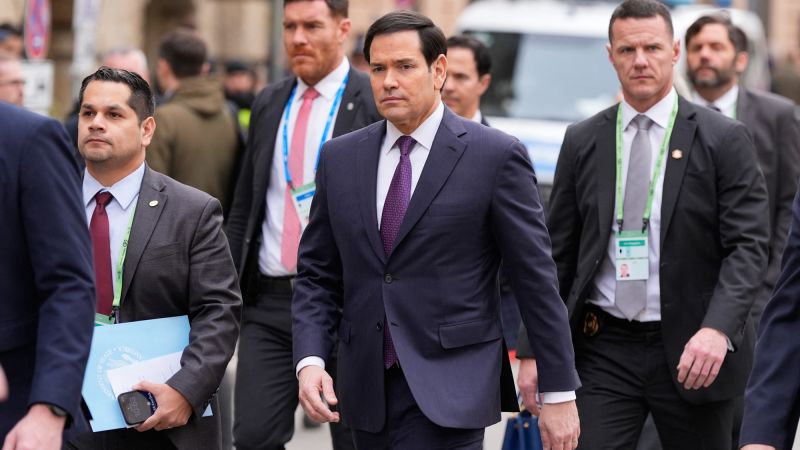
The rapturous applause that US Secretary of State Marco Rubio received when he told the Munich Security Conference that the US was a “child” of Europe and that Europe’s fate would always be “intertwined” belied his tough policy message. These were applause of relief and encouragement from European audiences who were bracing for an onslaught like last year’s J.D. Vance.
But Vance’s false accusations from last year’s conference — that Europe is suppressing free speech and democracy and facing civilizational decline — are now incorporated into the U.S. national security strategy. Rubio didn’t have to do much to act friendly.
Rubio said this year that the United States was prepared to “rebuild” only in accordance with its values, relentlessly evoking America’s historic ties to the continent. These values include sharing our Christian and cultural heritage, closing borders, and abolishing climate crisis policies. The United States needs to see reform in Europe, he told the decades-old ally, not just in the details of its defense budget, but in a sea change in the continent’s value system.
He also said that Europe and the United States “belong together.” But during the therapy phase of this couple’s abusive relationship, the message was clear: change or be dumped.
In a report released just before the conference, conference organizers warned that the world was entering an era of “wreck-ball politics” with Europe on the sidelines. Now Mr. Rubio has told liberal-centrist foreign leaders that their outlook is all wrong, echoing the views of his far-right populist opponents who could oust them in future elections.
Speechwriters for America’s top diplomats left no room for previous claims from key allies on the same Munich stage. A day earlier, German Chancellor Friedrich Merz said the MAGA culture war was not a war Europe needed to fight. Emmanuel Macron equated territorial sovereignty with the right of the French to police their own misinformation and democracy.
Two hours later, the urgent plight of Ukraine, the defining security crisis of the post-World War II European era, was passionately described by President Volodymyr Zelenskiy, raising the issue above the MAGA noise to take center stage. In his fourth appearance at the conference, the leader, who provided a startling reminder of Ukraine’s limitless ability to survive and adapt to Russian atrocities, made the summit’s strongest case for Europe having its own defense strategy.
President Zelenskiy reminded the audience that all of Ukraine’s power plants were attacked and that for every kilometer occupied by Russia, Ukraine calculated that 156 lives were lost. He spoke in English and in a tone that suggested he had little interest in angering U.S. President Donald Trump. He lamented the spirit of the peace process, which appears to be pressuring Ukraine, the victim of four years of aggression, to make concessions rather than Russia, the aggressor. He also mocked what the Russian government calls the “Anchorage Spirit.” The term was coined to suggest a secret agreement between Putin and Trump when they met in Alaska last year.
As President Zelenskiy spoke, video footage played on the wall behind him showing new Ukrainian technology dislodging Russian drones. This is a harsh reality that stands in stark contrast to the policy confusion within the chamber. He brought a purpose and urgency that had been somewhat lacking in previous beleaguered European leaders.
That was almost the same as emphasizing Mr. Rubio’s point that Europe needs to get in shape. Perhaps his audience would prefer to recreate the energy and determination of Ukraine rather than Hungary.
Overall, European leaders’ positive reception of Mr. Rubio’s speech reflects how badly transatlantic relations have been damaged by the past year’s turmoil over Ukraine and the month-long firestorm over Greenland.
Danish territory was not mentioned in the speech, and negotiations over its fate are progressing slowly. Perhaps that sudden omission, the disappearance of the crisis that nearly tore the alliance apart a few weeks ago, was gift enough.
Rubio pandered to the audience’s suspicions by mentioning Ukraine only once during a post-speech question, suggesting the Trump administration doesn’t yet know whether Russia really wants peace. (His boss, US President Donald Trump, insists that Putin wants a deal and that Zelensky should cede diplomatic positions).
The Europe that was on display was uninspiring. Instead, it seemed to lack the funds to achieve its ambitions, drowned out by internal political scandals and the ticking clock of a leadership that was coming to an end. Munich meets annually to hear European countries’ pledges to do more. Year after year, an astonishing increase in defense spending appears to be on the horizon, but no change is being brought about.
British Prime Minister Keir Starmer may be absent from next year’s Munich conference, France under Macron is about to hold a presidential election, and Trump will have to survive the midterm elections. No matter how these races go, the transatlantic contest is likely to suck up much of the oxygen. Ukraine can only hope that a sustainable and just peace has broken out by then, but perhaps it will need to discuss new episodes of Europe and America’s complex and continuing bitter disengagement to be heard.
