

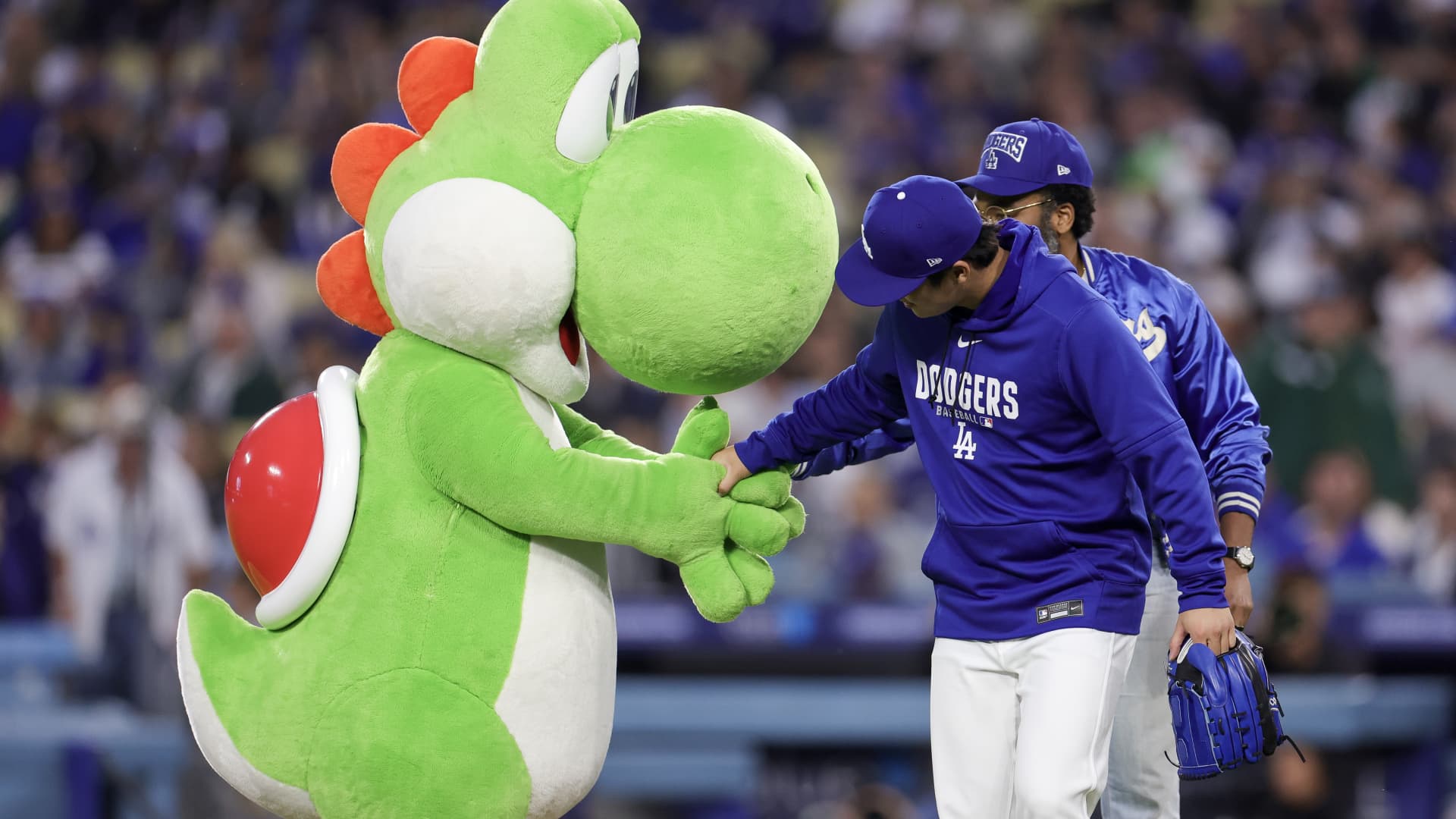
Los Angeles Dodgers pitcher Yoshinobu Yamamoto and actor/musician Donald Glover greet Nintendo’s Yoshi after the ceremonial first pitch before a baseball game against the Cleveland Guardians at Dodger Stadium in Los Angeles on March 31, 2026.
Ryan Sirius Sun | Getty Images Sports | Getty Images
A group of regional sports networks is shrinking, ending a once-lucrative business and determining the fate of local baseball, basketball and hockey broadcasts, even though live sports boasts the highest television ratings.
RSNs are perhaps feeling the most pressure from the losses plaguing pay-TV bundles as consumers turn to streaming. Currently, this model is rapidly declining.
Last week, the league announced it would take over media distribution for 14 teams as the 2026 MLB season begins. This is largely a result of the inevitable downsizing of Main Street Sports (formerly Fox Sports Network), which has changed hands since 2019 and changed names several times since 2021.
Despite Main Street emerging from bankruptcy protection at the end of 2024 and touting subscriber growth as recently as last spring, the operator faced another liquidity crisis earlier this year as MLB rights payments loomed, according to the people, who requested anonymity because they were not authorized to speak publicly.
Main Street owned about 15 channels and at one point aired 30 MLB, NHL and NBA teams after emerging from bankruptcy.
According to people familiar with the matter, the company held sales negotiations with streaming platforms DAZN and Fubo earlier this year, but no agreement was reached.
There were rumors of liquidation midway through the NBA and NHL seasons, but Main Street has so far been successful in containing them. Instead, MLB teams went their separate ways at the beginning of the season, with some transitioning to MLB distribution and others, like the Los Angeles Angels and Atlanta Braves, taking over the production and distribution of their own regional channels.
The NBA and NHL regular seasons are scheduled to be completed through the current Main Street-owned network, currently branded as the FanDuel Sports network. But after the NBA regular season and the first round of the NHL playoffs, Main Street plans to begin the process of going out of business in earnest, one of the people said.
The futures of the remaining NBA and NHL teams have not yet been determined, but some teams are likely to sign deals with station owners like Scripps that hold regional broadcast rights, according to a person close to the negotiations, who asked not to be identified because the matter is confidential.
The end of the RSN model doesn’t end there.
The fees networks have long paid to host games have long supported professional sports leagues, especially MLB, which is known for having some of the highest rights fees and most local games. Changes to the RSN model are sure to have ripple effects across these teams.
Companies that have already moved away from the RSN model are seeking refuge through direct-to-consumer streaming apps, which come at significantly higher monthly or annual costs for fans, and through deals with station owners that claim they offer the broadest reach of any platform for sporting events.
There’s also been an increased focus on advertising, but industry officials say that revenue stream, while helpful for the NBA and NHL, doesn’t do much to support MLB.
And because of the cost and number of games, MLB teams rarely, if ever, crossed over to member networks, said people familiar with the matter who asked not to be identified because they were not authorized to speak publicly.
go it alone
Not all channels are created equal, but even those that broadcast big market team games are subject to the same pressures as Main Street-owned channels, albeit to a lesser degree.
Last year, MSG Network, which broadcasts games between the NBA’s New York Knicks and the NHL’s New York Rangers, Buffalo Sabres, and New Jersey Devils, faced financial turmoil as it had to refinance huge debts and deal with a buggy dispute that caused power outages for nearly two months. Bankruptcy was reportedly being considered until the James Dolan-owned company refinanced its debt.
In the New York area, SNY, home of the New York Mets, was exploring options including a sale last year, said the people, who requested anonymity because the negotiations are private. No deal was reached, but some sources said Mets owner Steve Cohen had been involved in negotiations as a possible candidate.
This network, which is majority supported by the Wilpon family, former Mets owners, also comcast and charter communications As an investor for a while. But Comcast sold its shares to Charter in recent months for an undisclosed amount, said the people, who requested anonymity because the deal is confidential.
Comcast owns a small number of networks, but is slowly moving away from the RSN world.
Comcast has also been one of the most difficult distributors for RSNs to work with recently, pushing the network toward a tiered model. This means that subscribers opt-in to local channels and automatically pay for them, rather than automatically receiving them.
This was the deadlock in freight negotiations last year between Comcast and YES Network, a top-tier RSN that airs games between the New York Yankees and Brooklyn Nets and boasts the highest rates and largest viewership.
Comcast wanted to move YES to a tiered model. Yes refused, arguing that the Mets’ SNY would be exempt from such contract changes.
Comcast has a long-term transportation contract with SNY that prevents it from becoming phased in until at least 2030, said the people, who requested anonymity because the matter is internal.
Industry observers speculated that Comcast’s departure from SNY’s ownership structure freed it from the deal. But people with direct knowledge of the agreement, who requested anonymity because the matter is private, said nothing had changed in that regard. Comcast won’t be returning to the “yes” table anytime soon, some people said.
It’s not all bad news. Independent RSNs with large market teams typically have a stronger foothold. The Los Angeles Dodgers have a notoriously expensive media rights deal that Charter inherited from the Time Warner Cable deal.
And then there’s the New England Sports Network (NESN), which has the added benefit of broadcasting local games to a passionate fan base in New England as well as Pittsburgh.
Networks have rapidly changed the landscape. NESN was the first RSN to offer a streaming service and has offered deals including Red Sox tickets. Additionally, recently appointed CEO David Wisnia describes himself as an “outsider” who “has a new perspective on everything.”
Wisnia said in an interview that NESN is changing its cost structure and exploring new revenue opportunities.
“It’s about reallocating resources and getting out of businesses that we don’t want to be in,” he said.
NESN also revamped its look and expanded the channel’s programming. The channel is usually filled with basically no wind outside of old matches and games.
In recent weeks, NESN has enjoyed record-breaking victories in streaming subscription and engagement growth. A late-season playoff run by the NHL’s Boston Bruins was a boost, as was the start of the 2026 season for the Boston Red Sox.
Correction: This article has been corrected to reflect that the Los Angeles Angels are one of the MLB teams that has taken over the production and distribution of their own regional channels. Previous versions had team names listed incorrectly.
