

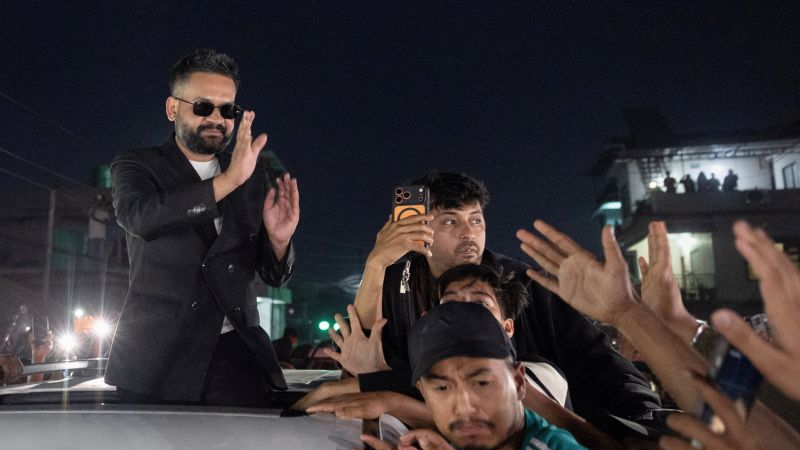
Before Balendra Shah dismantled Nepal’s political elite, he was destroying his opponents in underground rap battles.
More than a decade ago, he armed himself with a microphone and his signature sunglasses and spewed out poems about Kathmandu’s corruption, broken roads, and social inequality. Those in power ignored it as noise, but the country’s youth were listening.
Now the kids who were streaming his music have grown up. And last week’s national election handed the 35-year-old the keys to the country.
Shah, popularly known as Baren, is on track to become the Himalayan nation’s next prime minister after youth-led protests ousted the previous government. His Rastriya Swatantra Party (RSP) created history and secured the biggest mandate in Nepal’s modern electoral era.
Shah is expected to take office within a few days after the official results are announced.
“Thanks to Baren, this country is happy and tears of joy are flowing,” Sakcham Sanglaula told Reuters at a celebration rally in Nepal. Cheers and bells rang out in victory. “The Burrens will build this country, they will definitely do so.”

Shah is currently expected to lead Nepal, a country of more than 30 million people that is notorious for its political turmoil. The country has established more than a dozen governments since 2008, when it abolished its 239-year-old monarchy and transitioned to a republic after decades of civil war.
Many see the rise of his party as a harsh rebuke to Nepal’s political elite. It has faced corruption allegations for years, but anti-government protests last year ousted the regime’s control, killing more than 50 people and toppling the country’s longtime communist government of former leader Sharma Oli.
Born in 1990 in Kathmandu, Nepal’s vibrant capital, to an Ayurvedic doctor and a housewife, Shah took a highly unconventional path to the highest echelons of political power.
Before entering politics, he trained as a structural engineer and holds degrees in both Nepal and India. However, even though he was buried in his studies, he was building a solid reputation in his home country’s rap scene.
Influenced by hip-hop icons like Tupac Shakur and 50 Cent, Shah starred in the 2013 YouTube series “Raw Barz.” There he wrote lyrics that shed light on the deep-rooted inequality and systemic corruption plaguing this country.

His cousin Prashant Shah told The Kathmandu Post in 2022 that this movement to highlight local issues started in his childhood.
“From an early age, he was dissatisfied with the way the big city was run,” Prashant told the Nepali newspaper. “He often said that Kathmandu could develop into a beautiful and livable city.”
In the same year, Shah ran as an independent candidate for mayor of Kathmandu. He relied heavily on a grassroots online campaign and surprised the political world by defeating a candidate fielded by traditional conservatives.
“The road ahead will not be easy. The real test of our campaign is just beginning,” his team wrote in a Facebook post at the time.
“Please warn me if I go off track.”
Clean-up movement and controversy
Shah’s tenure as mayor was defined by a crackdown on corruption and a clean-up campaign. He launched a campaign to demolish illegal structures, livestreamed city council meetings to ensure transparency, and promoted the preservation of Indigenous heritage.
He also made headlines for his fiercely nationalistic and provocative stance regarding Nepal’s large neighbors China and India.


In June 2023, Shah kept in his office a controversial map of “Greater Nepal” depicting Indian territory as part of Nepal. The move was a direct response to India’s own “Akhand Bharat” map unveiled at the new Parliament House, which depicted ancient Indian civilizations including modern-day Pakistan, Bangladesh and Nepal.
He was equally belligerent towards his northern neighbor. According to local media reports, Shah canceled his planned visit to China in 2023 after the Chinese government released a new standard map that does not recognize Nepal’s latest 2020 political map, which includes parts of disputed areas in the Himalayas.
Mr. Shah’s no-frills style reached a peak late last year when he posted expletive-filled messages on Facebook aimed at the United States, India and China. He later deleted the post, but emphasized his image as a leader unfettered by diplomatic convenience.
Mr Shah’s victory came after a wave of mass unrest.
Public anger over corruption, which many see as rampant for decades, has been simmering for years and spilled onto the streets of the capital last September when the government blocked major social media platforms including Facebook, Instagram, WhatsApp, YouTube and X.
But the protests were more than just a digital blackout. They reflected deep generational dissatisfaction with a lack of economic opportunity. According to the World Bank, Nepal’s youth unemployment rate (15-24 years old) will reach 20.8% in 2024.
“There aren’t many opportunities to explore here, so there’s a lot of brain drain,” said Mahaharsha Rawal, a 23-year-old protester. “A lot of people are out.”
Nepal’s economy is highly dependent on remittances from Nepalis living abroad. According to the World Bank, about a quarter of Nepal’s GDP comes from personal remittances, a figure that has steadily increased over the past 30 years.
“We didn’t expect to be shot at…We went there for a peaceful protest,” Lawal said.
Police fired water cannon, tear gas and live ammunition at crowds gathered at Kathmandu’s parliament building as angry protesters ignored curfew.

Shah provided the soundtrack for the protests, releasing the song “Nepal Haseko” which has over 11 million views on YouTube. In it, he raps: “I want to see Nepali smile, I want to see Nepali hearts dance. I want to see Nepali smile, I want to see Nepali people live happily.”
This uprising made the shah nationally famous.
Crowds in the streets demanded he take over as prime minister immediately, but Mr Shah bided his time, waiting for formal elections this month to ensure a truly democratic mandate. When he actually ran for office, he made a symbolic choice. It was a contest for a seat held by former Prime Minister Oli, a 74-year-old establishment stalwart who would soon be defeated.
As tens of thousands of young people celebrated in the streets and on social media, Mr. Shah’s party said it would not hold a victory rally to “pay homage to the martyrs of the revolution.”
While maintaining his characteristic mysterious aura, he has not made any major statements on social media.
There is palpable excitement on the streets of Kathmandu.
“We finally have the world’s youngest prime minister,” Ayush Bhattarai told Reuters.
“I hope he remembers all his promises and works for the people…We trusted you and now you should not toy with our trust.”
