

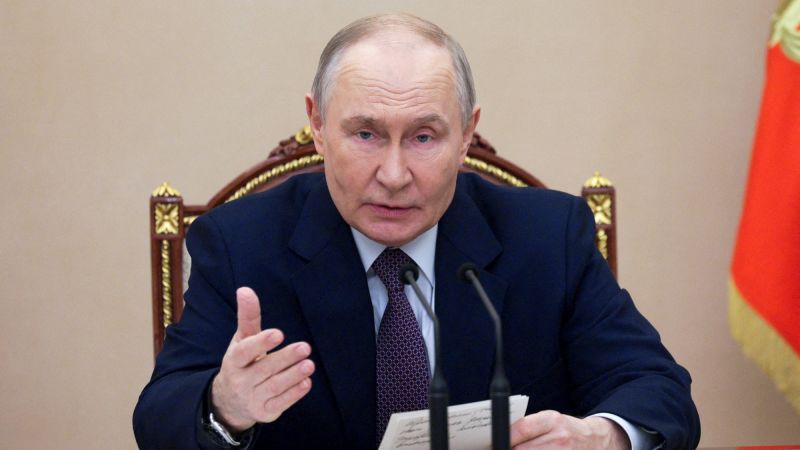
Russian President Vladimir Putin knows how to find opportunity in crisis, and the metastasizing Iran war is a prime example.
Earlier this year, President Putin expressed confidence in his campaign to conquer Ukraine, despite gradual progress on the battlefield. But in early January, the Trump administration ousted President Nicolás Maduro of Venezuela, Russia’s strategic partner, in a bold special forces raid, dealing a blow to Russia’s prestige.
And when a new war broke out in the Gulf, Putin initially looked like the loser. A decapitation attack by the United States and Israel killed Iran’s Supreme Leader Ayatollah Khamenei, another longtime Russian ally, and destroyed Iranian military targets. The strategic partnership that the Russian government signed with Iran last year seemed like a mere piece of paper.
The only one worth remembering is Khamenei, the Kremlin’s most recently fallen friend. In early December 2024, just one year before Maduro’s overthrow, the regime of Syrian dictator Bashar al-Assad, a longtime client of Moscow, collapsed.
However, despite his geopolitical views, Putin appears to have his eye on his main goal: dismantling an independent Ukraine.
On Monday, Kremlin leaders spoke by phone with President Trump for the first time since December. The hour-long conversation, read out by Russian presidential aide Yuri Ushakov, was about the main issues of the day: the US-Israel war with Iran, which Ushakov described as “very substantive.”
Importantly, the conversation also touched on Putin’s own goals. Ushakov said the US president “reiterated his interest in ending the conflict in Ukraine as soon as possible with a ceasefire in order to achieve a long-term solution.”
Trump’s own take on that part of the conversation was a little different. Asked about the call, Trump said the Kremlin leader “wanted to be helpful” in the Middle East, but added: “I said, ‘I can help you more by ending the Ukraine-Russia war.'” That would be more helpful. ”

Russia officially condemned the US and Israeli military operations. President Putin expressed his condolences for what he described as the “assassination” of Iran’s former supreme leader in an official message. However, as several observers have noted, Putin has avoided criticizing Trump personally.
“In the end, the substance of any of[Putin’s]proposals may not really matter,” Hannah Notte, director of Eurasia at the James Martin Center for Nonproliferation Studies, said of X. “If President Putin offers to play a constructive role, he will be able to achieve his main objective of flattering President Trump and staying on his good side, which is important (with respect to Russia’s goals in Ukraine).”
The call with President Trump came as Russia’s economic fortunes appear to be changing amid a growing global energy crisis due to the de facto closure of the Strait of Hormuz.
Oil prices soared above $100 a barrel on Monday, with experts warning they could reach $150 a barrel by the end of March if disruptions to the vital waterway continue.
This is welcome news for Russia, a major oil exporter. Additionally, the Trump administration temporarily reversed its pressure campaign against India, one of Russia’s most important customers, by granting Indian refiners a 30-day exemption to purchase Russian crude currently stranded at sea.
Last year, the U.S. Treasury Department imposed sanctions on two major Russian oil companies and imposed secondary tariffs on India’s purchases of Russian crude oil. All of this is part of an effort to stem the flow of funding to Moscow’s war machine.

President Putin sounded optimistic during a meeting Monday with top advisers to assess the situation in the global oil and gas market.
“The current situation has increased competition among buyers for energy suppliers to ensure a stable and predictable supply of oil and gas,” he said. “In this regard, I cannot but say, not only to my colleagues in this room, but also to all ordinary consumers, that stability is exactly what Russian energy companies have always been known for.”
In recent months, soaring inflation and widening budget deficits have called into question whether Russia’s state finances can maintain its wartime footing. The prospect of increased revenues from oil and gas exports is giving the Russian economy a potential adrenaline boost.
Russia may also have other geopolitical influences regarding the Iran war.
In addition to defense and security ties between Russia and Tehran (people familiar with U.S. intelligence reporting say Russia provides information to Iran about the location and movement of U.S. assets in the Gulf), Putin has long-standing personal relationships with many Middle Eastern leaders.
After the launch of the US-Israel campaign, President Putin held telephone talks with King Hamad bin Isa Al Khalifa of Bahrain, President of the United Arab Emirates Mohammed bin Zayed Al Nahyan, Emir of Qatar Sheikh Tamim bin Hamad Al Thani, and Crown Prince Mohammed bin Salman of Saudi Arabia.
Ukrainian President Volodymyr Zelenskiy also has a trump card in the region. In recent days, the Ukrainians have advanced offers to provide expertise to counter Iran’s Shahed drones, which attack targets around the Gulf region.
But whether that aid translates into goodwill in Washington is another matter. President Trump appears to be ignoring reports that Russia is providing information to Iran. And while international attention is focused on the Middle East crisis, Putin may find Western policymakers distracted from Ukraine, where war continues. In recent days, Russian drones and missiles have attacked Ukrainian cities without making headlines.

Sam Green, a professor of Russian politics at King’s College London, suggested in an analysis published in X that Putin’s long game remains focused on his relationship with Trump.
“First, the idea that Putin would suffer the loss of an ally, whether Assad, Maduro or Khamenei, exists entirely in the minds of Western analysts and has no basis in tangible facts,” Green wrote. “There is (zero) evidence that he is concerned about it affecting his authority at home or his legitimacy abroad.”
Green added that regardless of what Putin thinks about the death of Iran’s supreme leader, “Putin is not going to ruin his relationship with President Trump. First of all, he is not going to bring back Khamenei. But more importantly, President Trump is President Putin’s biggest source of influence in Europe. He will keep his eye on the ball.”
For the time being, therefore, the global energy crisis may provide new benefits for President Putin in his war against Ukraine.
