

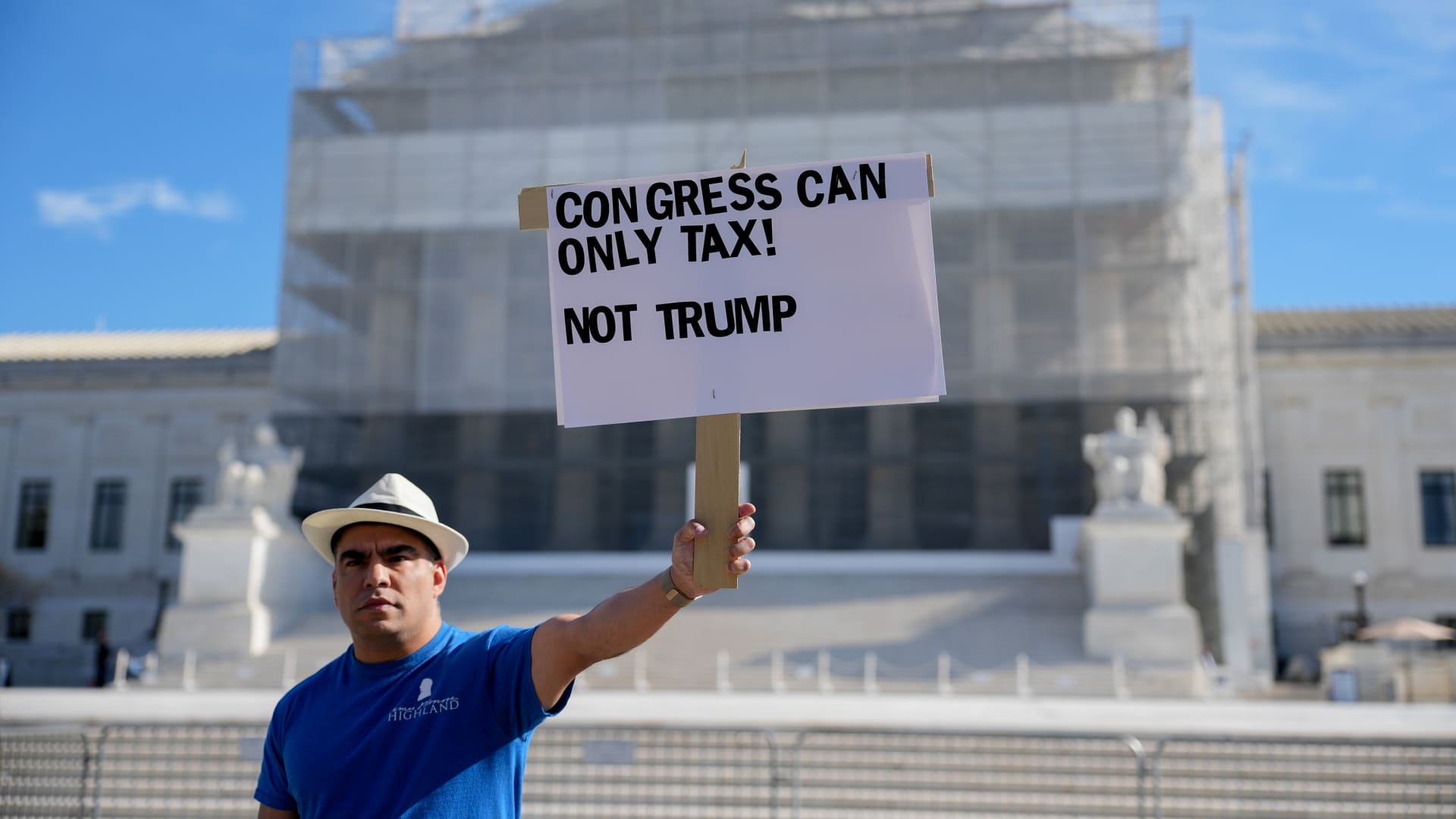
Demonstrators in front of the U.S. Supreme Court on Wednesday, November 5, 2025, in Washington, DC.
Eric Lee | Bloomberg | Getty Images
A growing number of supply chain managers say President Donald Trump’s tariffs and related costs are leading to job cuts and declining confidence in the investments needed to grow their businesses.
A new survey conducted by the Supply Chain Management Institute and CNBC shows that the percentage of supply chain managers reporting layoffs (32%) has doubled compared to April (16%).
“Tariffs don’t hurt the balance sheet; they hurt the people,” said ASCM CEO Abe Eshkenazi. “Attrition is occurring as companies try to manage their cost structures. If they don’t have the necessary resources and the ability and knowledge of qualified staff, there will be long-term effects.”
While the national unemployment rate has been rising rather than spiking since April, when the Trump administration introduced its first broad-based tariffs, job growth last year was the lowest since the early 2000s, excluding recessions, according to the Bureau of Labor Statistics’ December jobs report. What some are calling an “jobs recession” is epitomized by rising long-term unemployment rates and meager job creation, which has stalled since April.
The majority of respondents (65%) reported cost increases of at least 10-15%, which ASCM says could be a “significant shock” that reshapes budgets, strategies and the viability of some businesses. 34% of respondents cited cost increases of 15% or more.
As businesses across the economy await a Supreme Court ruling on the legality and possible refunds of many of President Trump’s tariffs, Eshkenazi said the broader business impact will not be easily reversed.
“While the Supreme Court’s decision may resolve many legal issues, it does not resolve many of the operational, financial and human impacts that we have already seen,” he said. “Investments will be affected because planning cycles and time frames will become shorter, making it harder for organizations to plan. They are now in constant fire-fighting mode rather than planning mode,” Eshkenazi added.
The survey was conducted with more than 220 respondents from December 15, 2025 to January 7, 2026, targeting supply chain managers in sectors across the economy. This is ASCM’s third customs-related investigation in the past year, and the first conducted jointly with CNBC.
Companies large and small told CNBC that even if court-ordered refunds recoup some of the costs caused by President Trump’s trade policies, they won’t make up for the time lost in lost productivity due to the added paperwork required to complete the expanded tariffs.
“It’s an administrative burden to overcome the tariffs,” Eshkenazi said. “We spend countless hours tracking rule changes, examining lots of code, and trying to figure out the most effective way to operate in the short term without long-term planning.”
Customs bonds are “dead money”
In addition to the time-consuming paperwork, business owners told CNBC that some costs associated with the tariffs will not be eligible for reimbursement. Baby products company Lalo, which paid limited tariffs prior to the tariffs imposed by President Trump under the International Emergency Economic Powers Act, was required by U.S. Customs to post collateral to secure a tariff bond as guarantee that the company would pay its tariff bill.
“We’ve never had to do that before,” says Lalo co-founder Michael Wieder. “That was millions of dollars on top of the customs duty we paid. We have hundreds of thousands of dollars in collateral for the customs bond,” he said.
According to Eshkenazi, these capital challenges are not uncommon. “These bond money is essentially dead money,” he said.
The customs bond price covers 10% of duties and taxes payable over a 12 month period. “So if duties and taxes go up, the duty bond will go up as well,” said Lori Mullins, director of operations at Rogers & Brown Custom Brokers. The importer must provide the bond guarantor with audited financial statements from the previous year showing that it has funds to support the bond amount. “If the importer does not have the funds, the bond guarantor will require collateral, often in the form of a letter of credit. This is why the funds remain tied up,” Mullins said.
Typically, funds are held by Customs for 314 days until the paid duty is reviewed and government approval is obtained.
During that period, cash from the business invested in the bond does not earn interest. “They could have used that money to grow their business or put it in an interest-earning account. This is depriving small businesses of money that they could use for working capital and sell more products. That’s hurting our business,” Wieder said.

Business owners have previously told CNBC that it is unrealistic to think that even if the Supreme Court’s ruling reverses the tariffs, they will receive complete relief, and that many are also exposed to high-interest, predatory loans taken out to pay for the tariffs.
Eshkenazi said members of his association say the money they spend on customs duties and related fees is just a tax that slows down the supply chain. “You can’t re-resource or re-qualify staff overnight,” he said. “This is not just about resilience and how we respond to court decisions. It’s about having certainty in the U.S. economy and what pricing models we can plan for.”
Survey respondents had a mixed economic outlook, with 38% of supply chain professionals negative. 27% neutral. and 35% are positive. More than half (56%) are concerned about a recession, but about one-third of respondents have a neutral or negative view of the economy, with what ASCM calls “the current state of the U.S. economy ambiguous and uncertain.”
“This disconnect reflects confusion and lack of confidence in companies’ future plans,” Eshkenazi said. Of the 56% of ASCM members concerned about a recession, two-thirds believe it could start in the second quarter. “This is bad for companies looking to invest,” he added.
