

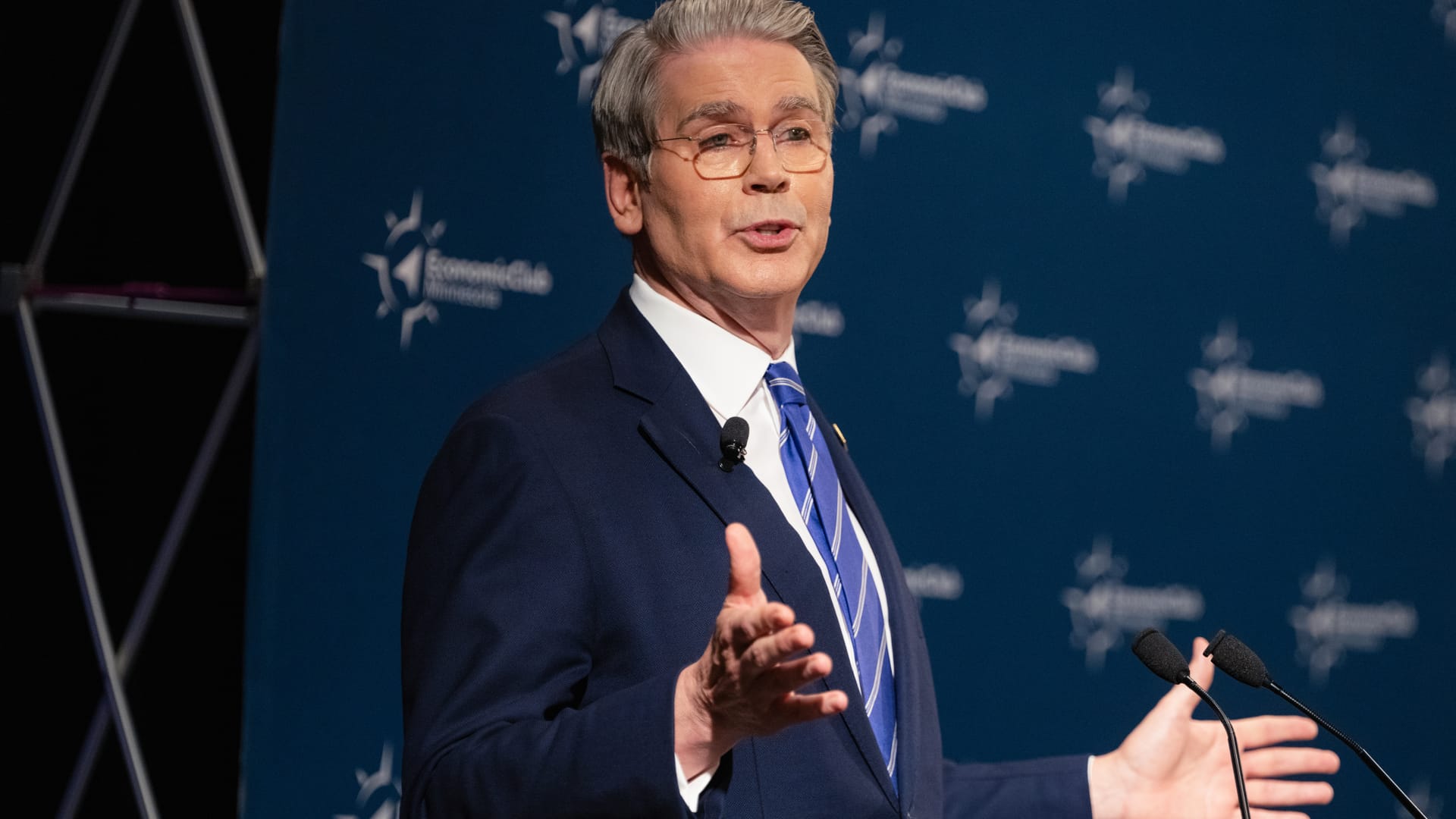
U.S. Treasury Secretary Scott Bessent during a Minnesota Economic Club event on Thursday, January 8, 2026 in Golden Valley, Minnesota, USA.
Ben Brewer | Bloomberg | Getty Images
Treasury Secretary Scott Bessent said Sunday it was “very unlikely” the Supreme Court would overturn President Donald Trump’s use of emergency powers to impose tariffs, and said a ruling could come as early as this week.
“I think it’s very unlikely that the Supreme Court will overturn the president’s signature economic policies,” Bessent said on NBC’s “Meet the Press.” “They didn’t overturn Obamacare. I think the Supreme Court doesn’t want to cause confusion.”
In June, the Supreme Court upheld a key provision of the Affordable Care Act that creates a commission to recommend preventive health services that insurance companies must provide free to patients.
Bessent’s comments came a day after President Trump said he would impose new tariffs on goods from Europe until there is “a complete and comprehensive purchase agreement for Greenland.”
Although President Trump did not specify in his Truth Social post what laws he was invoking to impose the tariffs, the move appears to reflect the “Emancipation Day” obligations he imposed on dozens of countries under the International Emergency Economic Powers Act.
President Trump said tariffs on products from Denmark, Norway, Sweden, France, Germany, the United Kingdom, the Netherlands and Finland will begin at 10% starting February 1. The rate will then increase to 25% on June 1, Trump said.
The Supreme Court is expected to rule on President Trump’s use of IEEPA to impose tariffs before the end of his term, but a decision could come as early as this week. IEEPA gives the president wide discretion to use economic tools in response to “extraordinary and unusual threats.”
Bessent said President Trump’s new tariffs on Europe regarding Greenland were a response to an emergency situation.
“A national emergency is avoiding a national emergency,” Bessent said. “This is a strategic decision by the president…He can use America’s economic power to avoid a violent war.”
President Trump has long sought to capture Denmark’s Arctic territory of Greenland, and in recent weeks has stepped up his pressure campaign for a U.S. takeover of Greenland. Leaders from Greenland, Denmark and across Europe have broadly rejected President Trump’s demands to occupy the island.
European leaders from countries targeted by the new tariffs responded on Sunday.
The leaders of Denmark, Finland, France, Germany, the Netherlands, Norway, Sweden and the United Kingdom said in a joint statement: “The threat of tariffs threatens to undermine transatlantic relations and risks sending us into a dangerous downward spiral. We will continue to respond unitedly and collaboratively.”
“We stand in full solidarity with the Kingdom of Denmark and the people of Greenland. Building on the process launched last week, we stand ready for dialogue based on the principles of sovereignty and territorial integrity that we uphold,” the statement said.
Vice President J.D. Vance and Secretary of State Marco Rubio met with Danish Foreign Minister Lars Lökke Rasmussen and Greenlandic Foreign Minister Vivian Motzfeldt at the White House last week in a meeting that Rasmussen described as “frank but constructive.”
Following the meeting, the group announced that the United States and Denmark would establish a high-level working group to chart Greenland’s future.
The Trump administration has argued that the U.S. acquisition of Greenland is critical to national security as it counters Russian and Chinese expansion in the region.
CNBC reached out to the White House and Treasury Department to find out what legislation President Trump is using to impose new tariffs on Europe.
Correction: Vivian Motzfeldt is Greenland’s Minister of Foreign Affairs. A previous version of this article misstated her title.
This story is developing. Please check back for the latest information.
