


Last-minute changes to new port fees enacted by the Trump administration’s Office of the U.S. Trade Representative have left one U.S.-based ocean carrier with an estimated annual tariff bill of $34 million after being reclassified under new Section 301 program provisions.
On October 14, the first day of the toll program, Atlantic Container Line paid $1.4 million in tariffs due to its unique container ship structure. ACL’s vessels carry 80% of its cargo in the form of shipping containers, 10% in roll-on/roll-off cargo (such as tractors, construction equipment, and passenger cars), and 10% in bulk cargo such as aircraft wings and transformers for power plants and data center machinery.
Additional changes include pricing structures for vehicle carriers, also known as roll-on/roll-off (Ro/Ro) vessels, which are useful for transporting automobiles, farm equipment, and other heavy equipment. From now on, you will be charged based on the net tonnage of your vessel, rather than the number of vehicles you transport. This is on top of new standard USTR port fees that took effect Tuesday, sparking confusion among ship owners about the potential financial hit.
Atlantic Container Line vessels. It carries not only containers (80% capacity) but also various types of large cargo cargo, from tractors to aircraft wings and power plant equipment.
atlantic container line
Section 301 of USTR regulations allows the USTR to take action against discriminatory trade practices internationally, and the investigation began under the Biden administration with a focus on Chinese port facilities, among other things, and continued into the new Trump term. Ocean-going carriers are subject to five charges per year per vessel. ACL’s ships sail along the transatlantic route and use five ships in its fleet servicing U.S. trade lanes to ensure weekly service.
“We’re going to be billing 25 vessels for $1.4 million a year,” Atlantic Container Line CEO Andrew Abbott told CNBC. “We believe the total annual tariff will be $34 million.”
Mr. Abbott says his company has been hit hard by bureaucratic blind spots. Of the 10% of roll-on/roll-off cargo ACL handles, only 1% are passenger vehicles. “Ships should be classified by the bulk of the cargo we move. That’s containers. We’ve always been considered container ships. Now Customs and Border Protection has changed that to Ro/Ro containers.”
Abbott says he can visually see the difference between his container ships and Ro/Ro ships.
“Traditional Ro/Ro looks like a floating parking lot, but we are not,” he said.
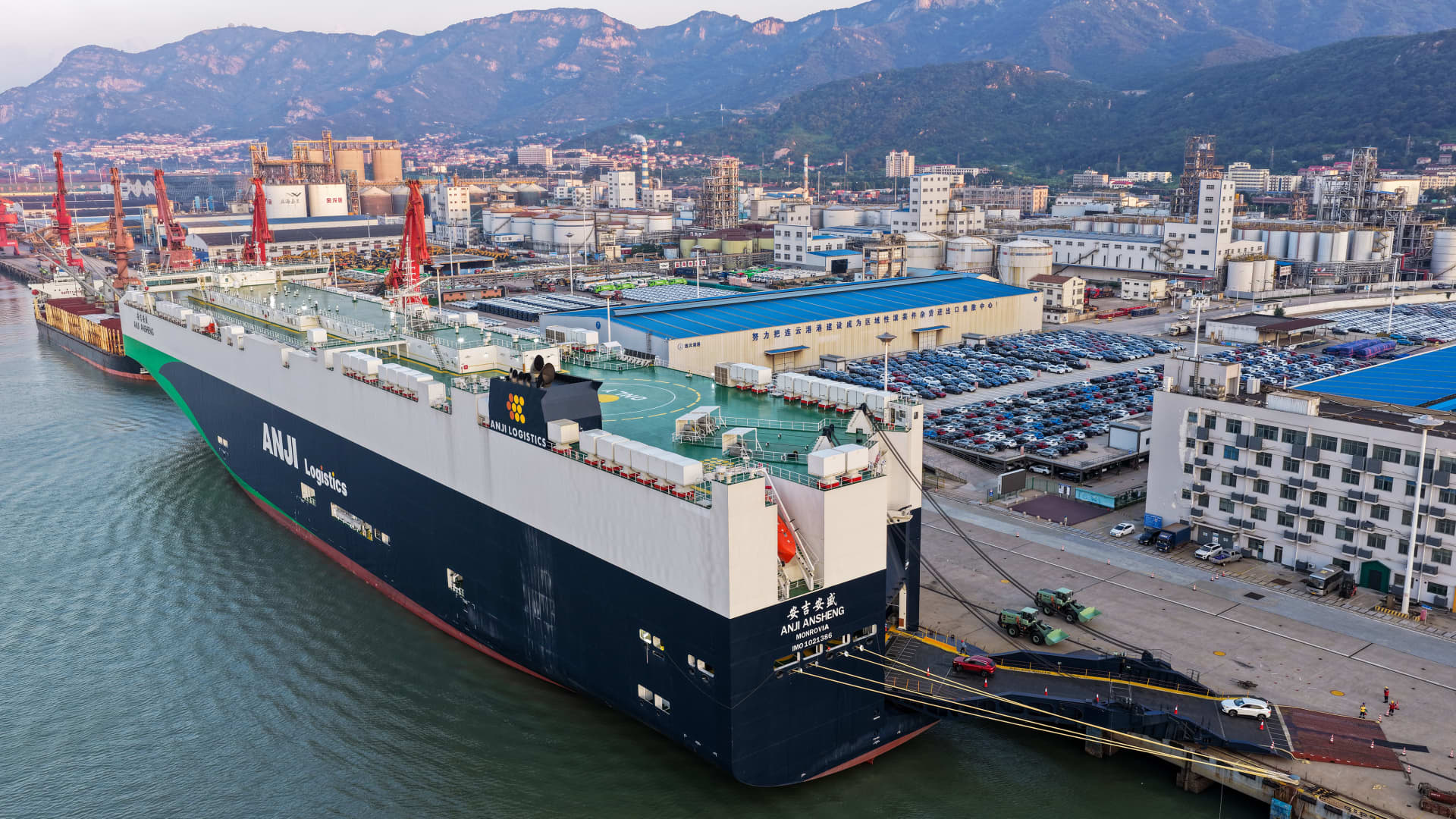
A large roll-on/roll-off ship docks at Lianyungang Port to load new energy vehicles for export, August 19, 2025, in Lianyungang City, Jiangsu Province, China.
Null Photo | Null Photo | Getty Images
Mr. Abbott warned that if the company has to continue paying tariffs, it could be unable to continue operating its operations in the United States and be forced to relocate, potentially impacting U.S.-based importers and exporters in the long term.
“A lot of the cargo we bring in is going not only for export but also to manufacturers in the United States,” Abbott said. “They’re afraid they’re going to lose their main carrier to bring that product in. So a lot of times they shake their heads and call it just shock,” he said.
Mr. Abbott said his company handles few other cargoes, so if it leaves the market, U.S. importers and exporters will likely look for charter services that are more expensive and cannot offer weekly service.
“To give you a simple example, a few years ago a major American automaker wanted to move an assembly line from Germany to Kentucky, and we moved it,” Abbott said. “We moved containers of parts, we moved big, big machines. They didn’t have to charter a ship. As the German factory was shrinking and the Kentucky factory was ramping up, they were able to ship weekly on our ship. That was unique to us, but that disappeared and the company didn’t have that option anymore,” he said.
Inside an Atlantic Container Line ship carrying train cars as cargo.
atlantic container line
Since the new fees took effect, ACL has been talking with customers about the cost of the fees and the possibility of passing them on, Abbott said.
“They can’t believe it,” he said. “They never thought in a thousand years that we would be affected. And we’re trying to tell people now that the magnitude of what’s at stake is shocking people. At the moment importers are dealing with tariffs, but this is on top of that, so it could potentially shut them out,” Abbott said.
Mr Abbott described what he described as a “tough economic climate” and said unexpected fees were adding to the uncertainty.
“This is another straw that breaks the camel’s back,” he said. “I hope we can talk to someone in the administration who will listen. I think we can make our case. It should be pretty clear.”
According to a statement from USTR to CNBC, no changes to the program’s rules and fee application are currently being considered.
“Ships have long been required to report their International Classification of Ships (ICST) codes to CBP. USTR’s response leverages this existing reporting to CBP as a mechanism for determining the application of service fees under Section 301 measures,” a USTR spokesperson wrote. “For clarity, please note that the International Classification of Ships by Type (ICST) is based on the structural characteristics of marine structures and not on the specific use or cargo carried at any given time.”
“A full container ship is a full container ship. A vehicle carrier is a vehicle carrier. Our ship is a unique hybrid that exists nowhere else in the world,” Abbott said after CNBC shared the USTR statement. “Container carriers that continue to order ships from China are exempt from fees. Major ‘Ro/Ro’ carriers are able to spread the fees across their ships. Even though our ships only have 1% of cars on board, they are now paying the full amount. We thought USTR wanted to encourage people to stay in the United States rather than kick them out. But they’re just showing us the door.”
Abbott told CNBC that if the situation were the same, “we’re going to have to start thinking seriously about repositioning next year. Even if we don’t want to, we have to do it. It’s the end of a very long history for a company that offers a unique service in the Atlantic trade lanes. We beat out all of our competitors that were 15 times bigger than us. I just hope the government does a good job.” It won’t put us out of business. We fought everyone else,” he said.

