

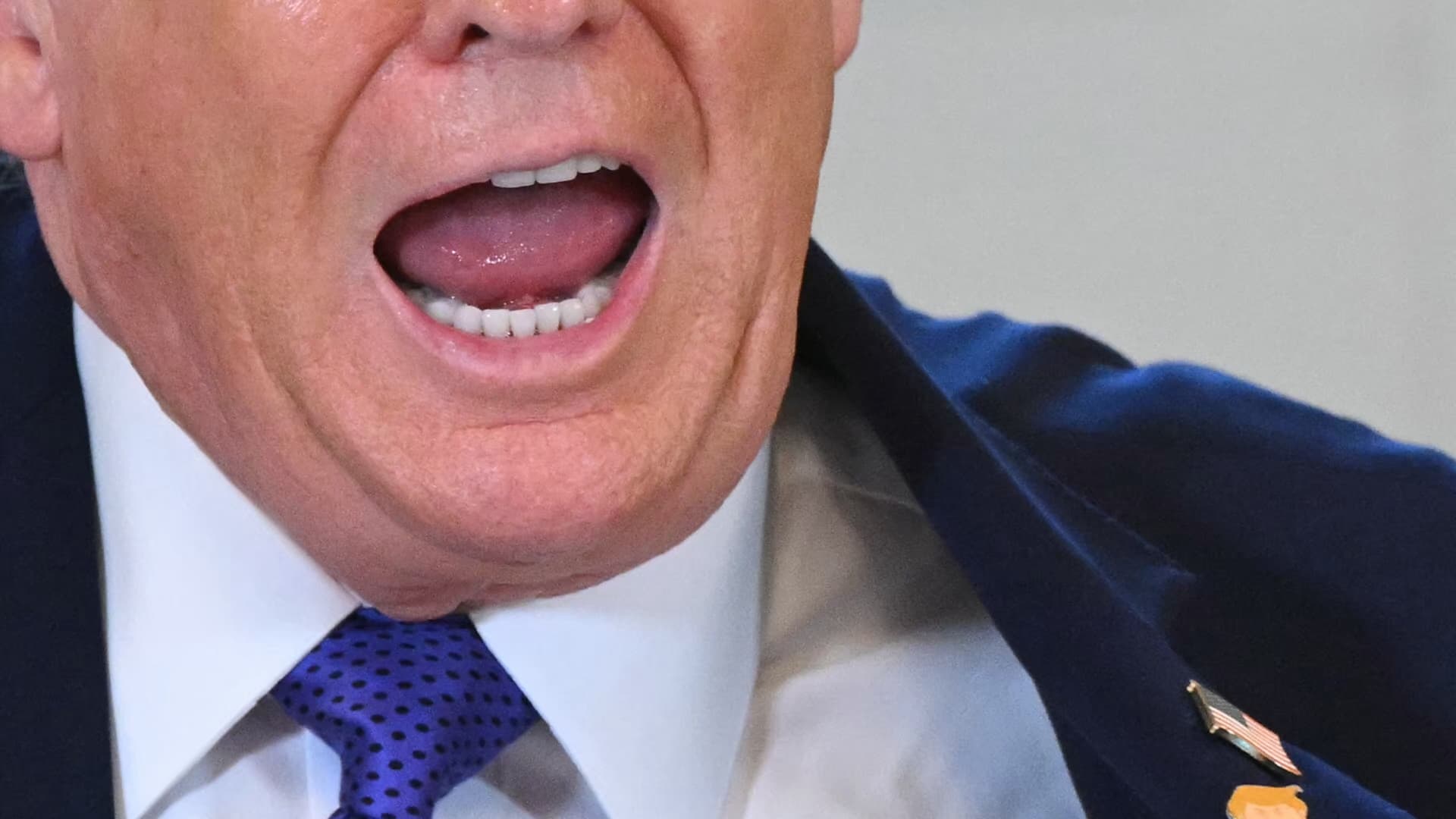
U.S. President Donald Trump shows off his lapel pin and speaks during a meeting with U.S. oil company executives in the East Room of the White House in Washington, DC, on January 9, 2026.
Saul Loeb | AFP | Getty Images
The current conversation in Washington is centered around President Donald Trump’s new national security strategy and the so-called Donroe Doctrine (a modern-day corollary of the Monroe Doctrine), which frames the primacy of the Western Hemisphere. This debate was already smoldering in policy circles by the end of last year, and was further accelerated by the recent US operation in Venezuela. Almost immediately, the frequently asked questions resurfaced. “What will China do now?”
Much of the speculation centers on Taiwan. Will the Chinese government use the US campaign against Venezuela as a justification or precedent for its opposition to Venezuela? The question may be understandable, and here’s what it means. However, many also believe that it is the wrong question.
China has no intention of using Venezuela as an excuse to invade Taiwan. That is not the way the Chinese government thinks or does things. Serious analysis requires setting aside the distraction of viewing China as a reactionary power and addressing more serious and far more unpleasant issues. This will require reading and discussing China’s own strategic document for the region and taking it seriously from its own perspective with the same rigor currently applied to the United States’ national security strategy.
China’s newly released third policy document on Latin America and the Caribbean is neither a press release nor a reactive, reflexive impulse triggered by Washington. This is a long-standing, well-considered, forward-looking, and purposefully structured approach to achieving China’s long-term goals. It includes a wide range of instruments of state power that China seeks to exploit and the channels through which it maintains its influence. It is an institutional blueprint, chock-full of political mechanisms, funding channels, commercial incentives, and a theory of legitimacy for engagement and presence in the region that is rooted in the solidarity of the Global South rather than overt claims of regional hegemony or 18th-century cosplay.
NSS is clear in its intentions. The article commits the United States to protecting the hemisphere from “hostile foreign intrusion or possession of major assets,” ensuring access to “vital strategic locations,” and denying non-hemispheric competitors control over “strategically important assets.” Venezuela is evidence in this statement. It is evidence that the U.S. government is prepared to act vigorously to change political realities when it determines that its access, stability, and strategic position are at risk.

But the Trump NSS also reveals a central analytical weakness. It implicitly assumes that the United States can give a sphere of influence, cede a region here, integrate an area there, and that so-called “regional powers” will accept the arrangement. China does not consider itself a regional power. The country sees itself as a global power with global interests, ambitions, investments, and supply chain demands, and it sees itself as having the institutions to protect and expand those interests in America’s so-called backyard. NSS can declare inevitable results. It cannot declare the existence and objectives of other great powers, especially those already deeply embedded in the hemisphere, such as China. China’s Latin American strategy is designed to be resilient to just this kind of temporary shock.
How China exerts influence around the world
Let’s start with the political structure. The Chinese government has not restricted trade or involvement in hydrocarbons, both of which are very important to the Chinese government. Instead, it seeks deep institutional embedding (in the case of Latin America and the Caribbean) through CELAC (Community of Latin American and Caribbean States), a 33-nation regional political bloc that coordinates head-of-state diplomacy, intergovernmental committee exchanges, parliamentary exchanges, interparty engagement, and cooperation across trade, finance, infrastructure, technology, and people-to-people links. The purpose is clear. The goal is to institutionalize influence across “multi-level, multi-channel” channels with structures that undermine single pressure point campaigns by the United States. It is much more difficult to “upend” a region when influence reaches deep and simultaneously into the president, political parties, parliaments, technocrats, students, consumers, and local actors.
Economics strengthens that architecture. China frames its involvement, accurately or not, as co-production and co-dependence, rather than exploitation or charity. The strategy focuses on infrastructure connectivity, logistics management, digital infrastructure, smart cities, industrial parks, manufacturing cooperation and export support. These projects create domestic constituencies: local jobs, contracts, port throughput, wages, and broad political wins. Financial cooperation further strengthens this model through the provision of local currency settlements, renminbi settlement arrangements, credit and debt swap lines, and even panda bonds. The objective is straightforward: to reduce U.S. exposure to financial leverage, political pressure, and sanctions risk over time.
President Trump’s push for U.S. oil companies to invest in Venezuela provided a series of security guarantees but exposed familiar constraints. Executives emphasized that investment also depends on long-term financing, risk-sharing, and enforceable contracts (support that China regularly provides to its companies through policy banks and export credits), but the U.S. government has yet to demonstrate a clear appetite for implementing equivalent tools through the U.S. International Development Finance Corporation, the Export-Import Bank, or multilateral finance.
And these financial support and assistance tools should not be pursued in isolation. When done well, it is designed to anchor influence in physical strategic assets such as natural resources, ports, logistics hubs, energy infrastructure, and transportation corridors, where economics and geopolitics inevitably intersect.
$500 billion trade, Panama Canal standoff
Scale matters. Trade between China and Latin America will exceed $500 billion in 2024, and the region is home to more than 670 million consumers, many of whom are attracted to Chinese products due to their improved price, availability, and quality. These are not marginal markets. These are structural aspects of China’s global growth model and export strategy.
The Chinese government has also been transparent about its interest in strategic resources, albeit selectively. Energy and critical minerals feature prominently, along with language on long-term supply arrangements and local currency pricing. Access spans the entire value chain from extraction to utilization. For U.S. policymakers, investors, and CEOs, this is the commercial backbone that the NSS must address. This is not about nostalgia for the Monroe Doctrine. This is a 21st century strategy aimed at achieving many of the same results through more modern means and more seductive rhetoric.
The Panama Canal brings these strategies into direct conflict. China’s policy documents treat ports, logistics, and maritime cooperation as primary means of development and influence, and as potential strategic assets to be leveraged in times of crisis and military confrontation with the regional hegemon (the United States). The NSS, on the other hand, explicitly flags “important strategic locations” and acknowledges how commercial infrastructure can be repurposed for military use. Even more than Venezuela, these approaches clash most sharply in Panama. The ongoing debate over port concessions and terminal management highlights that both Washington and China view the canal itself and the assets adjacent to it as strategic rather than merely commercial in nature.
Crew members of China’s Cosco Shipping Rose container ship wave Chinese and Panamenian flags as Chinese President Xi Jinping and Panamanian Juan Caruso Varela arrive at the Cocoli Locks of the expanded Panama Canal in Panama City, Panama, December 3, 2018.
Luis Acosta | AFP | Getty Images
So will U.S. action in Venezuela change the calculus? In the long run, not so much.
It will increase risk premiums, complicate logistics and supply chains, and further weaponize market access for many companies, Chinese companies, regional leaders, and global companies caught in the middle of compliance regimes. This could lead some governments to hedge more carefully, demand higher levels of “insurance” from Beijing, or seek stronger economic and security guarantees from Washington. But that doesn’t erase the foundations of what China has spent two decades building. That means trade corridors, financing relationships, political networks, and now a clear push for high-tech cooperation, from EVs, AI, and satellites to aerospace and digital trade, closely aligned with the direction many Latin American economies are headed.
Zooming out one more level extends the logic north. Greenland and the Arctic are not separate stories. These are the same set of arguments, just on ice. Washington frames Greenland through minerals, shipping routes, and military access. The Chinese government views the Arctic as an international space governed by international law and with global interests, in which non-Arctic states have legitimate interests. If the United States believes it can secure territory through doctrine and decisive action, China’s operational assumptions are the opposite. The party believes it focuses on countering the arguments that the United States has used for decades to justify its presence in the Asia-Pacific region: that nations have a right to the world’s commons, that great powers have global interests that must be protected, and that their long, well-established, and durable presence in the region should be respected. China has a similar position regarding Latin America and Greenland.
Actions in Venezuela show that the Trump administration is more serious than its predecessor about reasserting hemispheric supremacy, and that the NSS is more than just fancy rhetoric. However, China is in no hurry to withdraw from the Western Hemisphere. It’s deeply rooted. Even small powers have independence. They will not be commanded without much richer incentives, protection, or more sustained pressure than a single special forces operation can provide.
If Washington wants a hemisphere that chooses the United States rather than submits to it, it must compete with China’s full-stack approach: finance, infrastructure, technology, people-to-people exchanges, affordable products, political access, and a compelling partnership narrative. A declaration and one dramatic operation in the NSS is a short-term event. China’s involvement in Latin America is a long game, and the competition it provokes is neither quick nor simple.
—Dewardrick McNeil, Managing Director and Senior Policy Analyst, Longview Global, CNBC Contributor
