

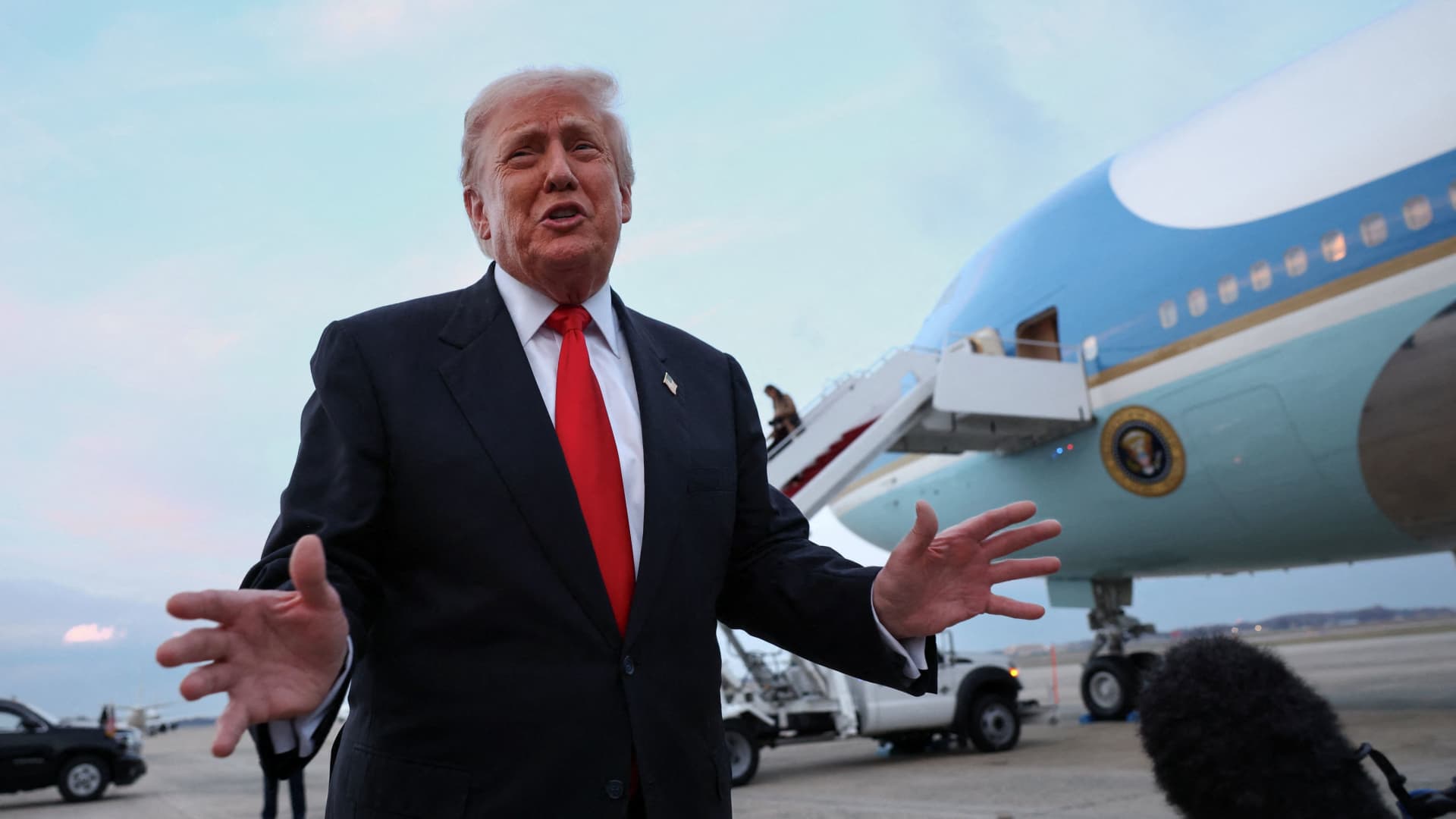
US President Donald Trump returns to Washington and speaks to reporters at Joint Base Andrews in Maryland, US, on November 9, 2025.
Kevin Lamarque | Reuters
Over the weekend, President Donald Trump proposed direct payments to Americans for health care costs and the sending of tariff refund checks to families, similar to stimulus checks issued during the coronavirus pandemic.
“Republicans should directly fund individual health savings accounts,” Trump wrote in a post on Truth Social on Saturday.
The president also floated the idea that a tariff “dividend” was possible. “Everyone (not including high-income earners!) will be paid a dividend of at least $2,000 per person,” he wrote in a separate post on Truth Social on Sunday.
Later that day, Treasury Secretary Scott Bessent said in an interview with ABC News that he had not discussed the idea of tariff rebates with the president and that no specific proposal was prepared.
That suggests it’s not a “realistic or likely policy action,” said Brett House, an economics professor at Columbia Business School. “I don’t think consumers should expect these rebate checks.”
“The administration is committed to putting this money to good use for the American people,” a White House official told CNBC.
American families are under pressure
Tariffs are taxes on foreign imports that are paid by U.S. companies that import goods or services. Companies often absorb some of the costs and pass the rest on to consumers through higher prices.
Economists say it is difficult to gauge the scale and extent of the damage from the tariffs, but some of the impact is already weighing on household budgets. An Oct. 30 analysis by Yale University’s Budget Institute found that the tariff policies currently in place are expected to cost households an average of $1,800 in 2025.
Rising medical costs are another issue that could cause a huge burden.
Millions of Americans are bracing for steep increases in health insurance premiums next year as the expiration of the premium tax credit triggers the so-called “subsidy cliff.” Tightening subsidies to lower insurance premiums is also at the center of the political fight over the federal government shutdown.
Bankrate financial analyst Stephen Cates said checks “will be a popular policy,” but “direct deposit payments are unlikely without Congressional involvement.”
“That’s the new problem here,” he said, adding that Congressional approval will be particularly difficult because of the ongoing partisan fight.
However, if the political tide changes, the story may be different.
“While we don’t see any stimulus coming in the near term, there could be increased interest from Congress as we approach the midterm elections, especially if consumer weakness appears,” Raymond James Washington policy analyst Ed Mills said in a Nov. 9 research note.
Unintended consequences of rebate checks
Economists have also warned that direct payments could cause a resurgence of inflation.
Pandemic-era fiscal stimulus increased U.S. inflation by about 2.6 percentage points, according to a 2023 study from the Federal Reserve Bank of St. Louis.
“Money is money, and when more money flows into the economy to demand the same amount of goods and services, there will be inflation,” Cates said.
Inflation has remained above the Federal Reserve’s 2% target since the president first introduced broad tariffs in April, but has remained relatively stable largely because businesses have been able to build up inventories and absorb some of the impact.
Looking ahead, economists say the Trump administration’s tariff policies could cause consumer prices to rise further in the coming months.
“Based on previous readings, inflation remains above 3%,” Cates said. Direct payments “would make the situation even worse.”
“The numbers that make this weird.”
The idea of sending customs rebate checks is not new. In late July, President Trump said his administration was “considering some rebates” to Americans from tariff revenues.
Sen. Josh Hawley (R-Missouri) then introduced the American Worker Rebate Act of 2025, proposing rebate checks to be funded with tariff revenue as early as this year. The Senate referred the bill to the Finance Committee, where it remains.
The United States will collect about $195 billion in tariffs by 2025, more than double last year’s total, according to a September Treasury Department report.
“If you pay Americans between $200 and $100 million, you end up with $200 billion,” said Thomas Phillipson, a professor of public policy studies at the University of Chicago and former acting chairman of the White House Council of Economic Advisers. That would represent less than a third of the population living in the United States, Phillipson said. “If (Trump) includes 200 million Americans, we’re up to $400 billion.”
A separate analysis by the Committee for a Responsible Federal Budget estimates that the payments could cost up to $600 billion, assuming the dividends were designed like coronavirus-era checks.
“We’re going to repay more than the customs revenue,” Phillipson said. “These numbers are what make this so strange.”
Meanwhile, the White House added that it was America’s trading partners, not consumers, who were bearing the brunt of President Trump’s tariff policies. “They’re kind of saying all this revenue is going to go to Americans. If foreigners are paying these duties, it’s hard to understand why,” Phillipson said.

What’s more, the fate of President Trump’s tariff policies is currently before the Supreme Court, which is likely to take months to issue a decision. Depending on the outcome, the Trump administration may have to return the tariffs already paid to companies that paid them.
In that case, no revenue would go to taxpayers, according to the Columbia House of Representatives.
“If the Supreme Court rules that the tariffs are invalid, the tariffs would have to be repaid. So all that money could go back to the companies that import the goods, and there would be no money to fund this widespread rebate,” House said.
Subscribe to CNBC on YouTube.
