

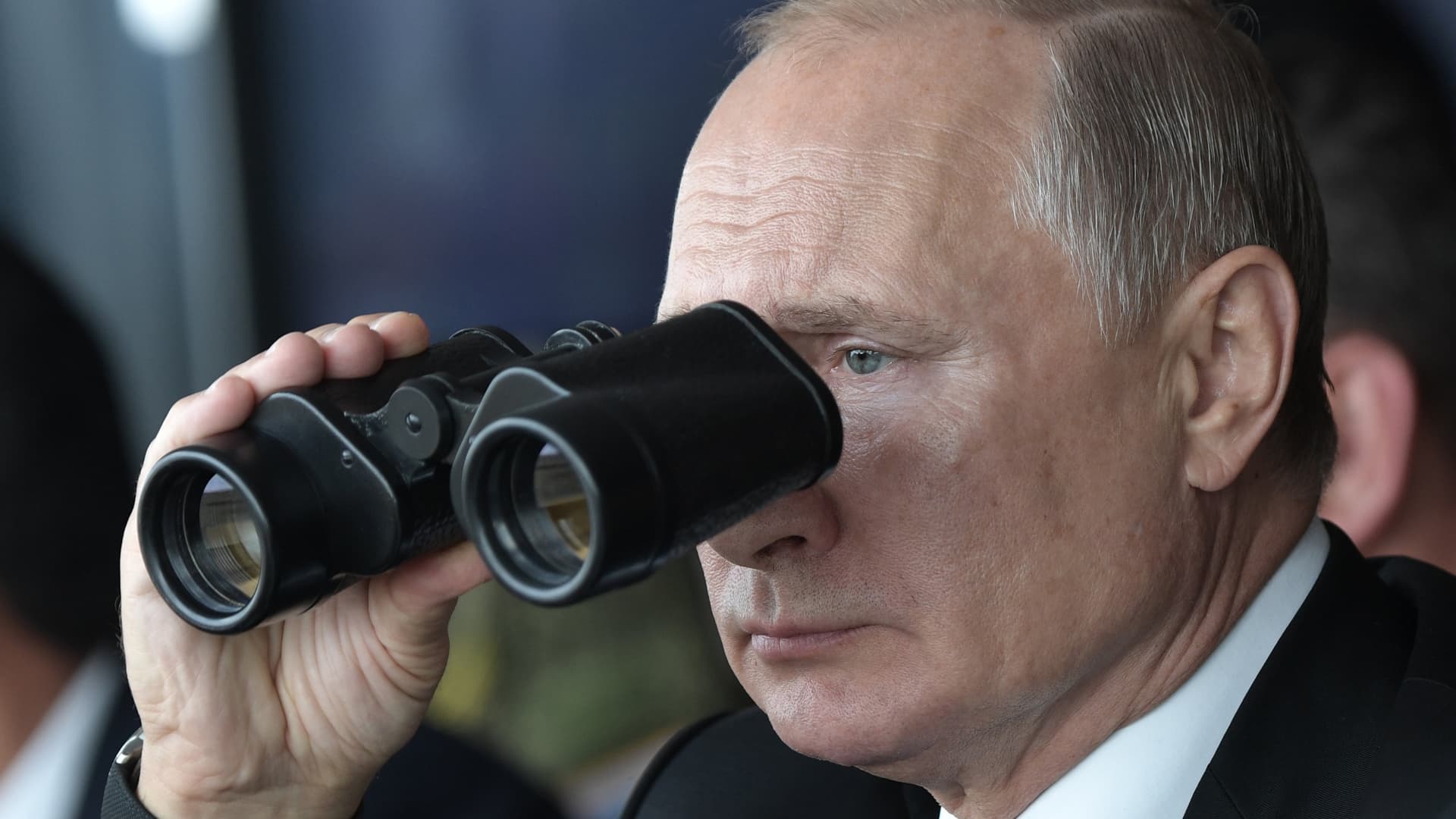
Russian President Vladimir Putin watches through binoculars during the Tsentor 2019 military exercise in the Donguz Mountains near the city of Orenburg on September 20, 2019.
Alexei Nikolsky | AFP | Getty Images
Russia was an indirect beneficiary of the Gaza war in that it diverted the attention of the United States and other Western countries from the ongoing war in Ukraine.
But with a ceasefire between Israel and Hamas and a peace process just beginning, US President Donald Trump has his sights set on ending the war in Ukraine.
The president announced Thursday that he and other “high-level advisers” will meet with Russian President Vladimir Putin in Budapest, Hungary, to discuss ways to end the war. This comes after President Trump said during a telephone conversation with the two leaders that President Putin congratulated him on the “great achievement of peace in the Middle East.”
“President Putin and I will then meet at an agreed upon location in Budapest, Hungary, to see if we can end this ‘disgraceful’ war between Russia and Ukraine. … I believe we made significant progress during today’s call,” Trump said in a post on Truth Social.
The meeting, the second time the two leaders have met in President Trump’s second term, could take place within the next two weeks, the US leader said.
tomahawk missile
One way the White House is exerting negative influence on Moscow is by discussing the possibility of supplying Ukraine with long-range Tomahawk missiles. President Trump is scheduled to meet with Ukrainian President Volodymyr Zelenskiy at the White House on Friday, where the leaders are expected to discuss the issue.
Earlier this week, Trump told reporters he could use Tomahawk missiles as leverage with Russia, saying he could say to Putin, “Look, if this war doesn’t get resolved, I’m going to send them a Tomahawk.”
In another sign that the administration is ready to ramp up military support to Kiev, U.S. Defense Secretary Pete Hegseth promised on Wednesday that “firepower” would be coming to Ukraine, although he did not mention the Tomahawks by name.
A new approach to peace
President Trump went public this week with the fact that he and his special envoys plan to restart efforts to immediately end the war in Ukraine, which marks its fourth anniversary.
“We have to end Russia,” President Trump told Israeli lawmakers in the Knesset on Monday as they celebrated the ceasefire agreement between Hamas and Israel.
President Trump told U.S. Special Envoy Steve Witkoff: “Steve, let’s focus on Russia first. OK? We’ll get it done.”

Ahead of his second term in office, he boasted that he could end the war in Ukraine in “one day,” but admitted it was more difficult than he expected. “I thought it would be easy. I thought it would be much easier than doing what we did (in Gaza).”
Victoria Coates, deputy director of the Davis Institute at the Heritage Foundation, told CNBC this week that a ceasefire agreement between Israel and Hamas is likely to have an impact on the Russia-Ukraine war.
Coats, who served as vice presidential national security adviser in Trump’s first administration, told CNBC’s “Squawk Box” on Tuesday that “the momentum to resolve the Gaza conflict could lead to a resolution to the war in Ukraine.”
“With the president meeting with other countries (this week) and pushing for a resolution to the conflict, it could lead to some pressure on President Putin to come to the table. So this could have a positive impact on Ukraine,” she said.

Of course, the big question now is whether Russia is willing to work with President Trump and his team.
Will Moscow play ball?
While the Kremlin appears keen to demonstrate its willingness to work towards ending the conflict, critics, particularly in Ukraine, say Russia is skillfully using delaying tactics to prolong the war in order to gain territory.
On Tuesday, the Kremlin reiterated Russia’s position, fiercely contested by Kiev and its Western allies, that it is Ukraine’s intransigence that is preventing Russia from ending the war it started in February 2022.
“Certainly we welcome such intentions and confirmation of the political will to support the search for a peaceful solution in all possible ways,” Russian Presidential Spokesman Dmitry Peskov said in comments reported by the Interfax news agency on Tuesday.
Russian President Vladimir Putin speaks with Kremlin Spokesperson Dmitry Peskov during the summit of the Commonwealth of Independent States (CIS) member states in Moscow, Russia, October 8, 2024.
Sergei Ilnitsky | via Reuters
Peskov said Russia “remains open and ready for peace talks,” adding: “We hope that the influence of the United States and the diplomatic skills of President Trump’s special envoy will certainly help to encourage the Ukrainian side to become more prepared for the peace process.”
CNBC has reached out to the Kremlin for further comment on expectations for renegotiation with the United States and is awaiting a response.
criticize Putin’s bluff
U.S. President Donald Trump shakes hands with Russian President Vladimir Putin before a joint press conference after their meeting at Joint Base Elmendorf-Richardson in Anchorage, Alaska, U.S., August 15, 2025.
Gabriel Grigorov | via Reuters
In addition to touting the possibility of sending Tomahawks to Ukraine (which the Kremlin acknowledged last Sunday was of “extreme concern”), Trump has also put pressure on Russia’s allies, including imposing tariffs on India on purchases of Russian oil.
President Trump has recently denigrated Russia as a “paper tiger” and repeatedly threatened to impose additional sanctions on Russia itself, but he has so far held back, disappointing Kiev and other Western partners.
The Tomahawk talks could be a turning point for Russia, said Peter Dickinson, editor of Ukraine Alert, a publication of the Atlantic Council think tank. Dickinson said Tuesday that if President Trump intends to call Putin’s bluff by promising supplies of Tomahawks, that’s what will happen, whether he ultimately does or not.
“President Trump has to decide whether to take advantage of President Putin’s bluff and launch Tomahawk missiles into Ukraine. There are increasing signs that President Trump may be inclined to do so,” Dickinson said.
“President Trump has an opportunity to convince his Russian counterpart that he is not as easily intimidated as other Western leaders and is prepared to increase pressure on Russia until President Putin agrees to pursue peace,” he said in an online analysis.
“Many of President Trump’s critics will no doubt scoff at the idea that the U.S. president would take such an uncompromising stance toward President Putin, but few objective observers would doubt that this approach is the only way to end the war,” he said.
